


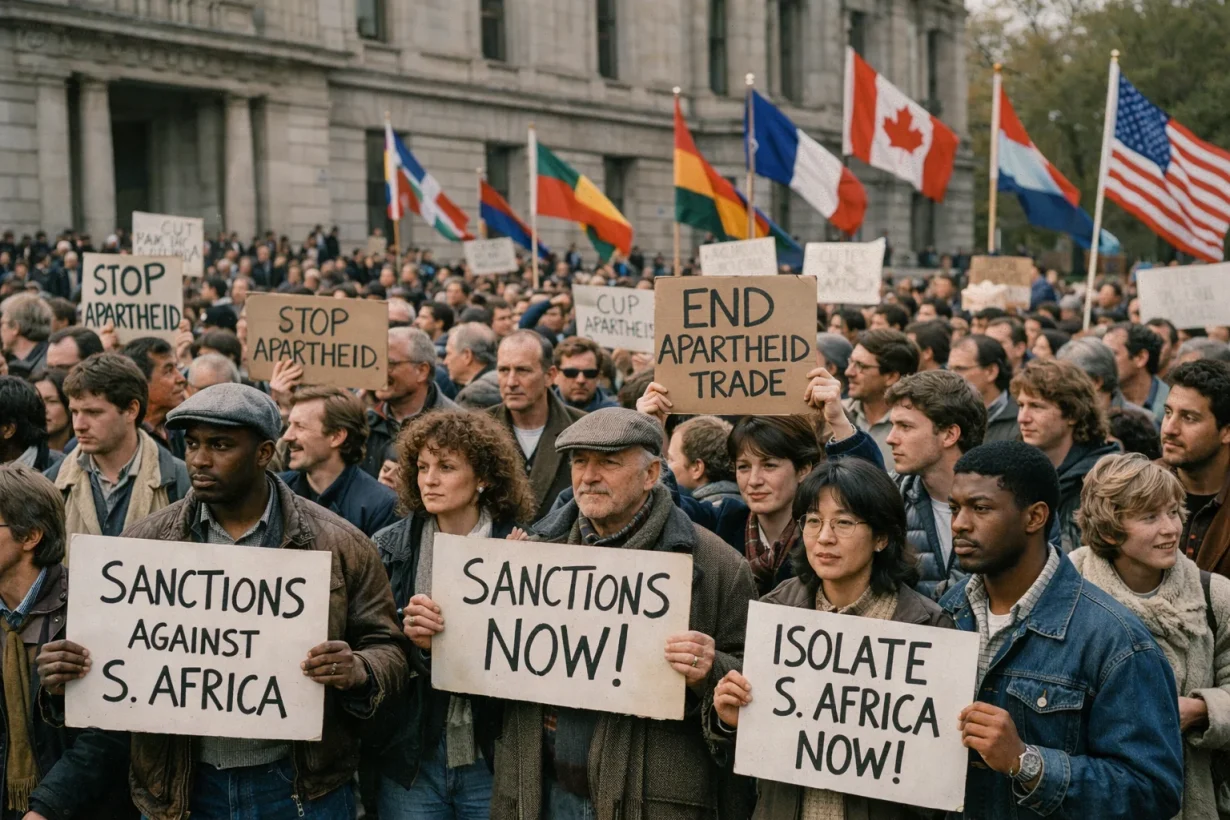

The international community responded to South Africa’s apartheid policies in the 1980s with widespread condemnation and multifaceted pressure, playing a crucial role in the regime’s eventual collapse.
Through a combination of economic sanctions, global divestment, diplomatic isolation, and cultural boycotts, countries and citizens alike targeted the apartheid system’s legitimacy and sustainability.
Key points covered in this blog:
- Economic sanctions from the US, UK, and EU weakened South Africa’s financial structure
- Divestment campaigns led by universities and activists forced corporate withdrawals
- Cultural and sporting boycotts isolated South Africa internationally
- Grassroots movements mobilized global civil resistance
- The UN and Commonwealth imposed diplomatic and arms sanctions
- International and domestic pressure forced political reforms by the decade’s end
Why Did the World React So Strongly to South Africa’s Apartheid Policies?
The reaction from the international community during the 1980s was neither sudden nor superficial.
It was the culmination of decades of growing outrage and activism surrounding apartheid, a policy of institutionalised racial segregation and discrimination implemented by the South African government starting in 1948.
By the 1980s, the global community of governments, citizens, organizations had reached a breaking point.
Apartheid had transformed South Africa into a state where racial classification determined every facet of one’s life. Laws restricted where Black South Africans could live, work, and study.
Interracial marriage was banned, political rights for the non-white population were nonexistent, and forced removals displaced millions.
Television, print journalism, and photographic evidence played a major role in galvanizing support abroad.
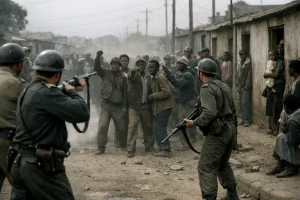
Reports of the brutal suppression of uprisings, such as the Soweto Uprising of 1976 where hundreds of schoolchildren were gunned down, shocked viewers worldwide.
In the early 1980s, further footage of political repression, detentions without trial, and censorship highlighted the extent of state control.
Governments that had remained ambivalent began reassessing their diplomatic relationships.
The Cold War had made some Western nations hesitant to support the African National Congress (ANC) due to its associations with communist countries, but by the mid-1980s, the moral imperative to oppose apartheid overtook geopolitical caution.
The sheer scale and visibility of the human rights abuses could no longer be ignored.
How Did Economic Sanctions and Divestment Shape South Africa’s Economy?
Economic sanctions were perhaps the most measurable tool employed to isolate and punish the apartheid regime.
Unlike diplomatic condemnations or cultural snubs, sanctions and divestment hit the South African government where it hurt most its financial infrastructure.
What Were the Key Economic Sanctions?
Several major economies implemented sanctions during the 1980s. The shift began slowly, with partial bans and symbolic gestures, but escalated rapidly due to public and political pressure.
The most impactful came from the United States. In 1986, despite President Ronald Reagan’s initial resistance and use of “constructive engagement” with South Africa, Congress passed the Comprehensive Anti-Apartheid Act by overriding his veto. This act included:
- Bans on new investments by American companies in South Africa
- Sanctions on imports such as coal, iron, steel, and uranium
- Prohibitions on landing rights for South African Airways in the U.S.
- A ban on nuclear technology transfers
European nations followed suit. The European Economic Community (EEC) agreed to ban oil exports, military technology, and cultural exchanges.
Scandinavian countries imposed additional financial restrictions and were often the first to support more aggressive economic distancing.
Japan, South Korea, and Canada imposed partial restrictions mostly targeting financial sectors and defense-related industries.
Key Countries and Their Economic Sanctions
| Country | Sanctions Imposed | Year Introduced |
| United States | Investment ban, import/export restrictions, airline ban | 1986 |
| United Kingdom | Arms embargo, voluntary business code of conduct | 1986 |
| European Community | Oil embargo, cultural boycott, trade limitations | 1985–1986 |
| Japan | Reduced investment and military ties | 1986 |
| Canada | Bans on bank loans and government contracts | 1985–1987 |
While some countries were slower to act (the UK, under Margaret Thatcher, resisted full-scale sanctions), financial pressure became increasingly unavoidable. South Africa’s access to capital markets began to erode.
How Did Divestment Campaigns Influence Global Finance?
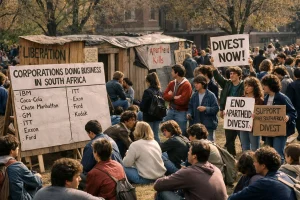
Alongside state-led sanctions were thousands of divestment campaigns, primarily driven by students, churches, trade unions, and municipal governments.
These campaigns pressured large institutional investors to pull funding from companies operating in South Africa.
I recall attending a university teach-in where students presented a list of campus investments connected to South African subsidiaries. The tone in the room was intense.
“If you invest in apartheid, you support apartheid,” one speaker said. That sentiment drove an entire wave of change across American universities, many of which later passed resolutions to divest.
Divestment forced major multinational corporations—including IBM, Coca-Cola, and General Motors to withdraw or reduce operations in South Africa.
Banks like Barclays and Citibank also faced public scrutiny and saw reduced business in regions where anti-apartheid activism was strong.
Major Companies that Withdrew from South Africa
| Company Name | Type of Business | Year of Withdrawal |
| IBM | Technology | 1986 |
| Coca-Cola | Beverage Manufacturing | 1986 |
| General Motors | Automotive | 1986 |
| Barclays Bank | Financial Services | 1987 |
| Mobil Oil | Energy | 1988 |
These actions had both symbolic and real economic consequences. Over time, South Africa’s ability to attract foreign investment shrank, and its international credit rating fell sharply.
Dr. Anthony Dlamini, who advised UN missions on Southern Africa in the late 1980s, once remarked in a lecture I attended,
“The power of these sanctions wasn’t immediate bankruptcy it was reputational. No bank wants to be the last one lending to a government everyone else is isolating.” His words clarified how financial tools served not only as economic weapons but also as a global signal of illegitimacy.
How Did Cultural and Sporting Boycotts Isolate South Africa?
If sanctions starved the regime financially, cultural and sporting boycotts isolated it emotionally and symbolically.
South Africa’s exclusion from international events served as a stark reminder that it was an outcast on the world stage.
South Africa was banned from the Olympics as early as 1964, but by the 1980s, these boycotts extended beyond the Olympic Games to all major sports. FIFA expelled South Africa, and international rugby tours were canceled after protests.
In 1981, the South African rugby team toured New Zealand, igniting massive protests thousands took to the streets, and games were disrupted.
The incident underscored how passionate the global community had become in fighting apartheid, even in arenas traditionally seen as apolitical.
Musicians and artists joined the boycott, too. The “Sun City” project, spearheaded by Little Steven Van Zandt in 1985, brought together 50 musicians including Bruce Springsteen, Miles Davis, and Run DMC.
The message was clear: “I ain’t gonna play Sun City” a resort known for attracting international performers despite its connection to the apartheid elite.
Key Cultural and Sporting Boycotts
| Event/Initiative | Description | Outcome |
| Olympic Ban | South Africa banned from Olympic Games | Lasted from 1964 to 1992 |
| Rugby Tour Protests | Mass protests during Springboks’ international tours | Cancellations and global outrage |
| FIFA Expulsion | South Africa removed from FIFA | Barred from World Cup and qualifiers |
| Sun City Boycott | Music protest against entertainers visiting South Africa | Global music collaboration for awareness |
The boycotts deeply affected white South Africans, many of whom viewed sports and culture as vital to national identity. For a rugby-loving nation, exclusion was both painful and humiliating.
What Role Did Grassroots Movements and “People’s Sanctions” Play?
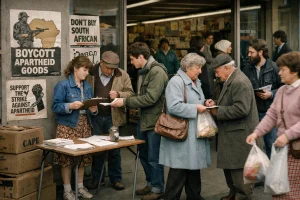
Governments and institutions weren’t the only forces behind apartheid’s collapse. Across the United States, United Kingdom, Canada, Australia, and beyond, regular citizens played a massive role.
“People’s sanctions,” as they were often called, took the form of consumer boycotts, campus protests, labor union actions, and religious pressure campaigns. While they may not have involved large sums of money, their visibility and political impact were immense.
In the UK, for example, there was a well-organized boycott of Outspan oranges and Cape apples, both of which were grown on segregated farms under apartheid labor laws. Supermarkets faced increasing pressure to stop stocking South African produce.
In the U.S., universities were often the epicenters of divestment activism. Shantytowns were built on campuses to mimic the living conditions of Black South Africans.
These dramatic visual statements received media attention and influenced public opinion.
Some notable grassroots actions included:
- Church denominations are refusing to invest in South African companies
- Labour unions are refusing to handle South African goods at ports
- Mass petition drives urging governments to adopt stronger sanctions
As someone involved in solidarity campaigns during graduate school, I witnessed firsthand how seemingly small actions petitions, sit-ins, student votes gathered momentum. One divestment vote at our university senate created a chain reaction, leading to full disinvestment within two years.
How Did Global Diplomacy and Institutions Respond to Apartheid?
While public movements were stirring globally, official diplomatic bodies also took a stand.
What Was the UN’s Role?
The United Nations had long condemned apartheid, but in the 1980s, it intensified its approach. The UN General Assembly passed multiple resolutions urging sanctions and labeling apartheid a crime against humanity.
In 1984, the International Convention Against Apartheid in Sports came into effect, encouraging governments to prevent sports exchanges with South Africa.
The UN Security Council Resolution 418 (though passed earlier in 1977) was continually referenced and strengthened during this time it imposed a mandatory arms embargo.
Although enforcement varied, the symbolic weight of a unified UN stance against apartheid carried tremendous legitimacy and gave national governments political cover to act more decisively.
What Actions Did the Commonwealth Nations Take?
The Commonwealth played a vital role, especially with member nations in Africa and the Caribbean pressing for stronger action. The pivotal Nassau Accord of 1985 marked a clear shift.
Despite resistance from the UK under Prime Minister Margaret Thatcher, who believed in “constructive engagement,” other leaders forced through sanctions. These included:
- Bans on bank loans
- Trade restrictions on agricultural imports
- Prohibition of nuclear and military cooperation
The Commonwealth also established a Group of Eminent Persons, which traveled to South Africa to assess the situation firsthand. Their report, condemning the government’s actions, added further fuel to the global push for reform.
Did International Pressure Actually Lead to Change in South Africa?
By the late 1980s, South Africa was under immense strain. The apartheid regime faced pressure from every direction—internationally through sanctions, diplomatically through isolation, financially through divestment, and internally through mass resistance.
The country’s creditworthiness collapsed. Major financial institutions refused to roll over South African debt. Inflation rose, the economy stagnated, and unemployment soared.
Inside the country, civil unrest grew. The ANC intensified its underground campaigns, and the United Democratic Front organized massive nonviolent resistance. Townships erupted in protest, and the apartheid regime responded with increasing brutality—which in turn provoked more global outrage.
In 1989, F.W. de Klerk replaced P.W. Botha as president and began tentative reforms. By 1990, Nelson Mandela was released, and the unbanning of political parties followed. These events signaled the beginning of the end.
“None of these changes happened in isolation,” I wrote in my journal at the time. “It was a massive, messy, global effort but it worked. And everyone activists, artists, politicians, students played a role.”
Conclusion
The global response to apartheid in the 1980s offers a blueprint for international solidarity. Governments, civil society, businesses, artists, and ordinary people joined forces to confront a systemic injustice, applying pressure from every possible direction.
While it took years for these efforts to bear fruit, they demonstrated the value of coordinated, persistent activism. Economic sanctions cut off the regime’s financial lifeline, while cultural boycotts and grassroots actions denied it legitimacy.
For those of us who study or participate in global justice movements today, the anti-apartheid response reminds us that international action when rooted in principle and backed by people power can truly help bring about transformative change.
Frequently Asked Questions
What were the main economic sanctions imposed on South Africa in the 1980s?
The main sanctions included bans on new investments, oil and arms embargoes, air travel restrictions, and financial loan cutoffs by countries like the US, UK, and the European Community.
How did divestment campaigns impact South Africa’s apartheid government?
Divestment campaigns led to billions in withdrawn investments from universities, pension funds, and corporations, significantly weakening the apartheid economy and increasing political pressure.
Why were cultural and sporting boycotts effective?
They deprived South Africa of international visibility and participation, damaging morale and sending a strong message of global disapproval, especially among the white minority.
What role did the United Nations play in ending apartheid?
The UN passed numerous resolutions, coordinated sanctions, and declared apartheid a crime against humanity. Its influence helped legitimize and amplify anti-apartheid efforts.
How did public activism contribute to the anti-apartheid movement?
Public activism through boycotts, protests, and campus movements pressured governments and institutions to act, shaping national policy and creating momentum for international solidarity.
Was the international pressure alone responsible for ending apartheid?
No, it was a combination of internal resistance (ANC, UDF, and mass protests) and external pressure that forced the apartheid regime to begin negotiations.
Are there lessons from the apartheid struggle that apply to modern conflicts?
Yes, the movement shows how persistent international pressure, aligned with local resistance, can challenge oppressive systems. It’s a model for addressing issues like climate justice and authoritarianism today.