






Long-term career success doesn’t come from wishful thinking, it comes from consistent, strategic effort. Yet when your career vision stretches five or ten years into the future, it can feel daunting to even begin.
That’s where short-term goals come in.
By setting focused, achievable targets for the next few days, weeks, or months, you create a clear path toward your long-term ambitions.
These small steps build momentum, help develop key skills, and provide regular feedback to ensure you’re on track.
In this blog, you’ll learn:
- The difference between short-term and long-term goals
- How short-term goals accelerate your career development
- Practical examples, goal-setting frameworks, and future-proofing strategies
- Actionable steps you can take today to move forward
Let’s dive into how you can transform your long-term vision into reality, one short-term goal at a time.
What Are Short-Term and Long-Term Career Goals, and How Do They Differ?
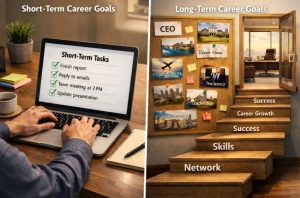
Career planning usually involves two types of goals: short-term and long-term. Short-term goals are immediate and practical, helping you build skills, gain experience, or make quick improvements.
Long-term goals are broader and define where you ultimately want your career to go. Understanding the difference helps you plan with clarity and purpose.
Short-term goals are typically achieved within weeks or months, such as completing a certification, attending an industry event, or updating your CV and LinkedIn profile. They are flexible and easy to adjust as circumstances change.
Long-term goals, on the other hand, may take several years. These include reaching senior leadership, changing industries, or launching a business. They require sustained effort and commitment.
Short-term vs Long-term Career Goals
| Feature | Short-Term Goals | Long-Term Goals |
| Timeframe | Weeks to 1 year | 3–10+ years |
| Focus | Tactical, skill-based | Strategic, vision-driven |
| Examples | Online courses, networking | Executive roles, entrepreneurship |
| Flexibility | High | Moderate |
| Tracking | Immediate results | Milestones over time |
Together, short-term goals create momentum, while long-term goals provide direction.
Why Are Short-Term Goals Essential for Achieving Career Success?
Without short-term goals, your long-term aspirations may remain abstract or feel too far away to be actionable. Short-term goals function as concrete, manageable steps that keep you moving forward.
They help you:
- Clarify next steps toward your larger vision
- Build consistency through repeated effort and habit formation
- Avoid overwhelm by simplifying complex career objectives
- Gain valuable feedback that guides your decisions
“You don’t climb a mountain by jumping to the top. You get there one step at a time. Each short-term goal is a foothold on the way up.” – Anonymous career coach
For example, setting a short-term goal to lead one cross-functional team project can showcase your leadership ability and pave the way for a future promotion.
These small wins accumulate, preparing you for more complex challenges as your career evolves.
How Do Short-Term Goals Build the Skills Needed for Long-Term Growth?

Career advancement is not just about having big goals, it’s about acquiring the right skills and experiences over time. Short-term goals give you the structure and opportunity to build these competencies in a focused and consistent way.
Targeted Learning
Skill-building starts with clarity. Vague goals like “improve leadership” lack direction and are hard to measure. Short-term goals turn intentions into action.
For example, replacing “learn marketing” with “complete a Google Analytics certification in 30 days” creates a clear, measurable, and time-bound path for faster professional growth.
Certifications and Experience
Many long-term roles require formal certifications, demonstrable experience, or niche knowledge.
Setting short-term goals around these requirements allows you to build credentials without becoming overwhelmed by the big picture.
The key is to prioritize the certifications or experiences that align directly with your intended career trajectory.
Some impactful short-term goals might include:
- Enroll in a PMP course to build project management credentials
- Contribute to an open-source software project to gain practical experience in development
- Take on a leadership role in a volunteer organization to build management and collaboration skills
- Complete a Salesforce Trailhead module to develop CRM system proficiency
These goals not only build your expertise but also strengthen your resume with tangible achievements that hiring managers and internal stakeholders can recognize and value.
Real-Time Application
Learning is most effective when paired with real-world application. Short-term goals often involve direct implementation of newly acquired skills, which reinforces learning and improves retention.
For instance, presenting a marketing report to senior leaders helps you practice data storytelling while simultaneously gaining visibility.
Below is a table that highlights how specific short-term actions lead to long-term growth through active application:
| Short-Term Goal | Skill Applied | Long-Term Career Impact |
| Lead a small internal project | Project coordination, leadership | Builds credibility for future managerial roles |
| Conduct user interviews for a case study | UX research, communication | Strengthens portfolio for product or UX design roles |
| Present findings at a team meeting | Public speaking, data interpretation | Enhances leadership and influence within the team |
| Redesign a slide deck for your department | Visual communication, storytelling | Improves branding and internal presentation skills |
Through repeated practice and feedback, these applied experiences solidify your competencies, enhance your professional presence, and prepare you for higher levels of responsibility in the long term.
How Can You Align Your Short-Term Actions with Your Career Vision?

A common mistake is setting goals that feel productive but don’t align with your long-term career direction. You might stay “busy,” but not actually move closer to your aspirations.
Start with reflection:
- Where do I want to be in 5 years?
- What skills, knowledge, or network do I need to get there?
- What actions can I take this month to build toward that vision?
Avoiding Goal Drift:
It’s easy to fall into the trap of reacting to opportunities without checking if they’re aligned with your desired outcomes.
By reviewing your short-term goals monthly or quarterly, you can ensure you’re staying on the right path.
“Don’t confuse being busy with being strategic. Short-term goals should be the compass, not just the calendar.” — Erin Mitchell, career strategist
Aligning your short-term efforts with your long-term goals keeps your energy focused and intentional.
What Is the SMARTER Framework, and How Does It Improve Goal-Setting?
Setting goals isn’t just about deciding what you want. It’s about structuring those desires into clear, achievable objectives.
The SMARTER framework expands the classic SMART model by emphasizing evaluation and revision, two vital steps for sustainable success.
SMARTER Breakdown:
| Letter | Meaning | Example |
| S | Specific: Clear and defined | “Complete Excel course on Coursera” |
| M | Measurable: Trackable outcome | “Score 90%+ on the final test” |
| A | Achievable: Realistic and doable | Based on time and available resources |
| R | Relevant: Tied to long-term goals | Helps build data skills for analyst role |
| T | Time-bound: Deadline set | Finish within 30 days |
| E | Evaluated: Regular review checkpoints | Weekly progress check-ins |
| R | Revised: Adjusted if needed | Extend timeline during busy periods |
Using SMARTER goals ensures that you’re not just planning well, you’re also reviewing and adapting in real-time.
How Can You Break Down a Long-Term Career Goal into Actionable Milestones?
Big goals can feel impossible, until you break them into smaller, achievable steps. This technique, known as goal decomposition, makes even the most ambitious career dreams manageable.
Backward Planning
Backward planning is a strategic technique that starts at the finish line. Begin by clearly defining your long-term career goal, something 3, 5, or even 10 years down the road.
Then, work backward to establish what must happen in 12 months, 6 months, and so on, all the way to what you can do this week. This approach gives you clarity and prevents you from drifting off course.
For example, if your long-term goal is to become a Senior UX Designer, your backward plan may include:
- Completing advanced UX training
- Gaining team leadership experience
- Developing a standout portfolio
- Building a visible personal brand in the UX space
Each of these larger steps can be broken down even further, creating a chain of realistic short-term goals that lead you forward.
The “Micro-Milestone” Model
Instead of vague tasks like “update resume,” micro-milestones make your efforts intentional. You might break this into:
- Revise bullet points under “Current Role” to reflect recent skills
- Add measurable outcomes from key projects
- Seek feedback on your resume from a mentor or recruiter
These micro-goals are easier to complete, track, and celebrate—fueling ongoing momentum.
Example Breakdown
| Long-Term Goal | Mid-Term Milestone | Short-Term Action |
| Become a Senior UX Designer | Complete portfolio redesign | Research UX trends, audit current design projects |
| Gain user testing experience | Volunteer to test internal features or user flows | |
| Build personal brand | Share weekly UX insights or case studies on LinkedIn |
By mapping out your plan this way, you convert a vague aspiration into a step-by-step roadmap, making your long-term goal both practical and achievable.
In What Ways Do Short-Term Goals Provide Motivation and Momentum?

Staying motivated can be challenging, especially when your end goal feels years away. Short-term goals act as emotional and motivational fuel, giving you quick wins and a sense of achievement.
Here are a few examples of motivating short-term wins:
- Completing a course
- Finishing a portfolio project
- Receiving praise from a manager
- Gaining a new connection on LinkedIn
Each win builds your confidence and generates forward momentum.
“I tell my clients, ‘Progress is the best form of motivation.’ It’s hard to feel stuck when you’re checking off weekly wins.” — Jada Perez, career coach
More importantly, these wins create a habit loop that reinforces action. That loop looks like this:
Goal → Action → Result → Confidence → Next Goal
Once you start experiencing success from short-term goals, it becomes easier to stay consistent and reach for the next milestone.
How Should You Monitor Progress and Adjust Short-Term Goals Over Time?
No plan survives without adjustment. That’s why it’s crucial to monitor progress and stay flexible. Life happens, deadlines shift, priorities change, and new opportunities arise.
Monitoring Tactics:
- Weekly reflections: Ask yourself what worked and what didn’t
- Goal tracking tools: Use Trello, Notion, or monday.com
- Mentor feedback: Gain outside perspective regularly
- Journaling: Note successes, obstacles, and learnings
When to Pivot?
There will be times when your short-term goals no longer serve your career vision, or when unexpected opportunities require a shift in focus. That’s not failure; it’s adaptability.
Ask yourself:
- Is this goal still relevant to my long-term vision?
- Am I learning and growing, or simply going through the motions?
- Would revising or replacing this goal serve me better in this season?
The ability to pivot isn’t a setback, it’s a sign of a responsive, resilient professional mindset.
What Are Real-World Examples of Short-Term Goals Leading to Career Milestones?
Thousands of professionals advance their careers by strategically setting and completing short-term goals.
These aren’t abstract concepts, they’re tried and tested paths to growth. Let’s explore a few tangible examples across different career areas:
Real-World Goal Transformation Table:
| Short-Term Goal | Skill/Experience Gained | Long-Term Outcome |
| Complete a project management course | Planning, task coordination, leadership | Transition into a full-time Project Manager role |
| Speak at a company town hall | Public speaking, communication | Greater visibility and consideration for promotion |
| Write monthly blog posts on LinkedIn | Personal branding, industry credibility | Position yourself as a thought leader |
| Network with 2 professionals per month | Expand industry knowledge, mentorship | New job opportunities or career pivot |
| Build and update a personal website | Web design, content strategy | Launch a freelance or consulting career |
Each of these examples illustrates how short-term actions contribute directly to career-defining moments. When planned thoughtfully, even simple goals can lead to extraordinary outcomes.
How Can You Future-Proof Your Career Using Short-Term Goal Planning?

In today’s dynamic work environment, your ability to adapt and grow is more valuable than any single job title. Setting ongoing short-term goals is a proactive way to future-proof your career.
Focus on:
- Upskilling: Regularly learn about emerging tools (e.g., AI, automation, data)
- Networking: Maintain connections that can open new doors
- Personal Branding: Make your expertise visible online
- Cross-training: Explore adjacent skills within or beyond your role
“A future-proof career isn’t about one big leap—it’s about constantly tuning your skill set through short-term sprints.” — Dev Sinha, digital strategist
By consistently engaging in goal-driven learning and reflection, you’re building a career that’s not only successful, but sustainable and resilient.
What’s the First Step You Should Take Today Toward Your Career Goals?
Big change doesn’t start with a massive overhaul. It starts with one small, intentional step, a commitment to act now rather than waiting for the “right time.”
Here’s how you can take your first step today:
- Reflect: Where do you want to be in the next 3–5 years? What excites or motivates you professionally?
- Identify a Skill Gap: Choose one key area where you feel underprepared for the role you aspire to.
- Set a SMARTER Goal: Make it specific, measurable, and time-bound. For instance: “Complete a negotiation workshop by the end of the month.”
- Take Immediate Action: Register for a course, book time on your calendar to work on a goal, or reach out to a mentor for guidance.
Remember: progress begins with movement. Whether it’s a small email or a major decision, every action you take today sets the stage for future success.
Even tiny wins create momentum, and momentum leads to transformation.
Conclusion
Short-term goals are the key to unlocking long-term career success. By breaking down big ambitions into focused, manageable actions, you gain clarity, build skills, and maintain momentum.
Whether you’re aiming for a promotion, a career change, or future-proofing your role, consistent short-term planning keeps you on track. With each completed goal, you grow more confident and capable, step by step.
Use frameworks like SMARTER, stay adaptable, and start today. Because the journey to any long-term dream begins with one small, intentional action taken right now.
FAQs About Short-Term and Long-Term Career Goals
What is a short-term goal in career planning?
A short-term goal is a clear, actionable objective you aim to achieve within a short timeframe to support your career growth.
Why are short-term goals important for long-term career success?
They create momentum, build relevant skills, and provide measurable progress toward long-term career ambitions.
How do short-term goals support career transitions?
They help you acquire new skills, gain experience, and prepare gradually for a shift into a new role or industry.
How often should short-term career goals be reviewed?
Short-term goals should be reviewed weekly or monthly to ensure they remain aligned with evolving priorities.
What framework is best for setting effective short-term goals?
The SMARTER framework is ideal because it ensures goals are structured, measurable, flexible, and aligned with long-term plans.
Can short-term goals improve motivation at work?
Yes, achieving small, consistent wins boosts confidence and keeps motivation high over time.
What tools can help track short-term career goals effectively?
Digital tools like Trello, Notion, and monday.com make it easier to track progress and stay accountable.