
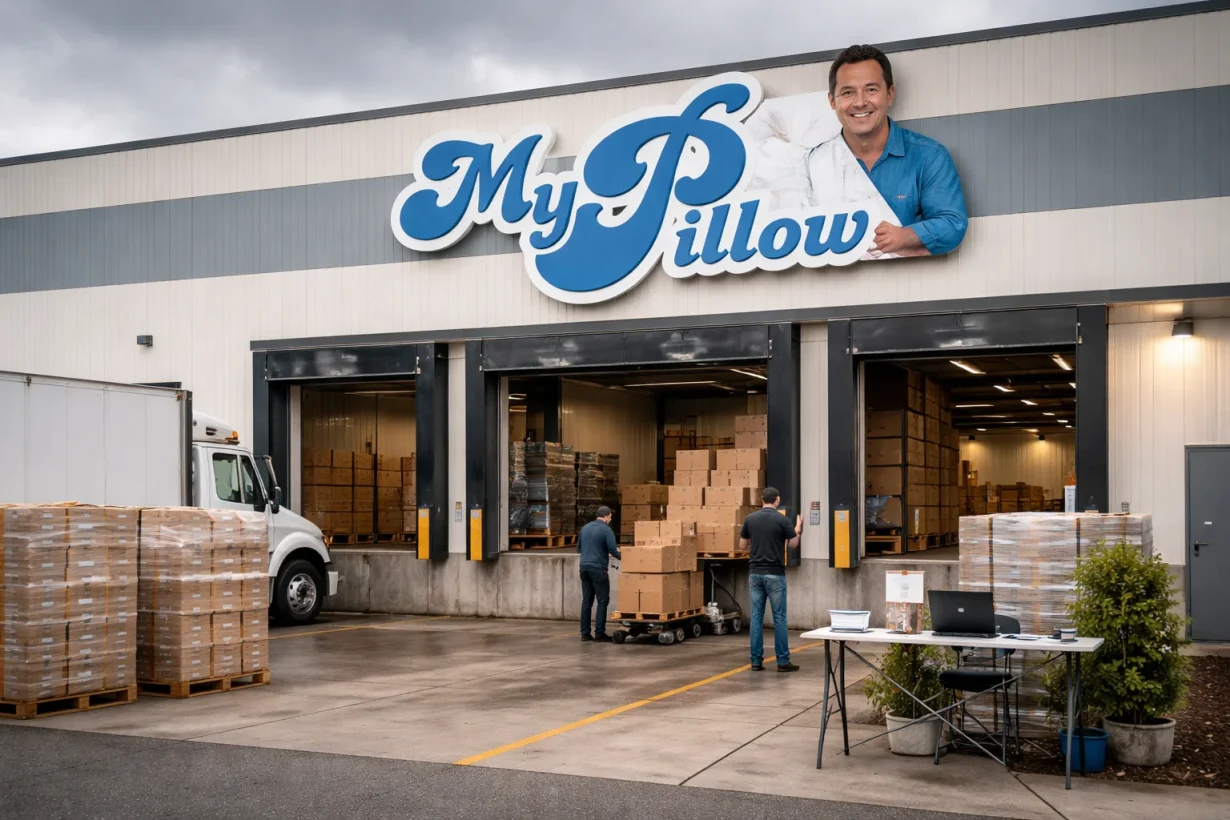

🛏️ MYPILLOW BUSINESS UPDATE – 2026
Quick Summary: MyPillow continues operating in 2026 but is under heavy pressure from legal troubles, financial debt, and loss of retail partnerships.
- CEO Status: Mike Lindell claims personal financial ruin
- Evictions: Lost multiple facilities since 2024
- Court Judgments: Owes $2.7M to FedEx, $56K to Smartmatic
- Amazon Dispute: $15M debt led to vendor fallout
- Political Impact: Federal investigation still ongoing
Check official MyPillow sources or reliable media for the most recent updates on business operations.
What Is the Current Status of MyPillow in 2026?
As of 2026, MyPillow remains operational but is struggling under overwhelming financial pressure and a cascade of legal challenges.
Court filings have revealed that the company is at risk of defaulting on contracts, failing to meet basic financial obligations, and losing its capacity to function. Yet, no official announcement of bankruptcy or closure has been made.
CEO Mike Lindell continues to present a defiant front. In court and media appearances, he maintains that “the company is still standing” despite mounting obstacles.
These include evictions, staff layoffs, massive legal fees, and frozen business accounts. While MyPillow’s sales and exposure have drastically fallen from their early 2020s peak, some operations continue especially direct sales and online marketing.
The biggest uncertainty now surrounds whether these limited operations can be sustained. Legal experts suggest the business is “at the brink,” especially as court records describe MyPillow as being “irreparably injured” by frozen assets and withheld funds.
The company’s legal team is even arguing that current financial restrictions could “force MyPillow out of business.” Yet, technically, MyPillow is still active, still selling, and still fighting.
Why Is MyPillow Facing Financial Trouble?
MyPillow’s financial troubles stem from a combination of massive debt, court rulings, frozen funds, and disrupted partnerships. These issues started compounding around 2022 and have intensified into 2026.
Major contributing factors include legal sanctions, defaulted payments, severed business relationships, and poor cash flow.
Key causes:
- Sanctions from lawsuits: Over $50,000 owed to Smartmatic and more expected from related cases.
- Court-ordered payments: $2.7 million judgment in favor of FedEx.
- IRS liabilities: Millions owed from unpaid employee retention credits.
- Evictions: Lost major warehouse facilities due to unpaid rent (over $200,000).
- Supplier disputes: ACI International lawsuit over $15 million debt tied to Amazon revenues.
- Retailer losses: Major stores like Bed Bath & Beyond dropped MyPillow due to controversy, drastically reducing sales.
These compounding financial strains have created a liquidity crisis. Lindell himself stated
, “I borrowed everything I can. Nobody will lend me any money anymore.”
MyPillow’s decline seems to be not from one major event, but from multiple unresolved liabilities strangling the business over time.
How Has Mike Lindell’s Legal Troubles Affected MyPillow?
Mike Lindell’s personal legal entanglements have directly impacted MyPillow’s financial condition, operations, and reputation. From massive sanctions to federal investigations, Lindell’s political and legal challenges have bled into the company he founded and still leads.
Smartmatic Case Summary
The legal saga between Lindell and Smartmatic has been a key blow to his finances. Smartmatic sued Lindell for spreading false claims about the 2020 U.S. election.
Lindell lost a key motion and was ordered to pay over $50,000 in sanctions for what the judge called “frivolous” arguments. Smartmatic later filed a motion to hold him in contempt for failing to make those payments.
During a 2025 hearing, Lindell emotionally pleaded with the court. “I’m in ruins,” he said. He claimed he could not afford the sanctions, saying, “I don’t have any money.”
Lindell asked the judge to delay payment until final judgments were made, claiming his financial state was devastated. The judge ordered him to submit sealed financial records for review, questioning the validity of Lindell’s claims.
Contempt Charges and Court Hearings
When Lindell didn’t comply with the sanction payments, Smartmatic requested that he be held in contempt. The company accused him of dodging financial responsibilities, stating he had avoided making a payment of $56,369 for months.
Lindell responded,
“I borrowed everything I can… Nobody will lend me any money anymore.”
He explained that he was unable to continue making monthly installments, which had previously been proposed at $5,000. He added, “I have nothing to hide,” and agreed to provide his financial documents.
This lack of cash flow directly affected MyPillow’s ability to cover operational costs and legal defenses.
Arctic Frost Investigation and Its Impact
The federal investigation into MyPillow and Lindell, known as “Arctic Frost,” emerged after allegations of financial ties to election-related political groups.
Court filings reveal MyPillow was unknowingly a target of the FBI probe in 2022. Federal authorities seized financial records and pressured banks associated with Lindell to share wire transfers made in November 2020.
In response, MyPillow filed a lawsuit against its California-based slipper supplier, ACI International. The company argued that financial blocks related to this investigation, such as levies on their Amazon account, crippled their ability to generate revenue.
The lawsuit stated MyPillow was “irreparably injured” and could be “forced out of business” due to the frozen assets. Lindell’s legal team even hinted at filing suit against the government, stating the investigation was “improper, unwarranted, and legally actionable.”
What Role Did Political Controversies Play in the Decline?
Mike Lindell’s outspoken political positions and activism around the 2020 election have had far-reaching consequences for MyPillow.
His close alliance with former President Donald Trump, aggressive election denialism, and high-profile media appearances alienated customers and partners alike, triggering a downward spiral for the company.
Lindell’s Election Denialism and Public Activism
Lindell became one of the most prominent public voices denying the legitimacy of the 2020 election results. His claims that the election was stolen led to public backlash, corporate pushback, and legal action.
The consequences extended beyond his personal image. Court documents show that MyPillow’s vendors and partners began distancing themselves from the brand due to Lindell’s association with misinformation.
He funded campaigns, hosted controversial summits, and filed lawsuits attempting to overturn election results. These activities caught the attention of federal authorities and contributed to the Arctic Frost investigation.
Lindell’s activism directly linked MyPillow to political and legal chaos, hurting consumer trust and investor confidence.
Retailer Backlash and Severed Ties
Major retail chains, including Bed Bath & Beyond and Kohl’s, dropped MyPillow products amid growing public criticism. These decisions were publicly tied to Lindell’s political behavior.
Retailers likely feared backlash from consumers, and distancing themselves was a strategic move to avoid reputational harm.
The retail abandonment had a severe financial impact on MyPillow’s revenue. Lindell once confirmed that more than 22 retailers stopped stocking MyPillow products.
This forced the company to rely almost entirely on direct-to-consumer channels, which couldn’t match the scale of retail distribution. Lindell maintained that the drop was politically motivated, adding to his claims of persecution.
Lindell’s Gubernatorial Run and Brand Impact
In a surprising twist, Lindell announced his candidacy for Governor of Minnesota in 2026. While this move energized some of his political base, it complicated MyPillow’s standing even further.
A CEO actively campaigning on controversial positions further blurred the line between brand and politics.
MyPillow’s legal filings themselves acknowledged that Lindell’s political activity has become intertwined with the company’s hardships.
One court document noted that actions taken against MyPillow were tied to Lindell’s election advocacy, which “injured the company” in both public perception and financial operations.
What Happened with MyPillow’s Amazon Account and Supplier Dispute?
One of the most financially damaging events for MyPillow involved a fallout with California-based slippers vendor ACI International.
The company, once a partner in MyPillow’s product distribution, froze access to MyPillow’s Amazon account due to unpaid debts. An email revealed in court states the owed amount was $15 million.
MyPillow responded with a lawsuit, claiming ACI’s actions nearly shut down their operations.
Their attorney stated:
“MyPillow will be irreparably injured… and forced out of business.”
The Amazon account was a major sales platform, and its restriction drastically affected cash flow. MyPillow accused ACI of leveraging a federal investigation to justify their withdrawal and demanded the vendor lift the financial hold.
How Are Employees and Facilities Affected?
The company’s financial downfall has also taken a heavy toll on its employees and physical infrastructure. MyPillow has closed facilities, laid off workers, and lost control of key properties due to unpaid rent.
Key impacts:
- Layoffs: Lindell admitted to laying off hundreds of employees, stating,
“I borrowed everything I can… Nobody will lend me any money anymore.”
- Evictions: In 2024, MyPillow was evicted from a Minnesota manufacturing site after failing to pay $200,000 in rent.
- Ownership at risk: Employees who own shares in the company face financial losses if the company collapses.
- Loss of warehouses: Lindell shared that multiple warehouses had been lost over the past two years.
Lindell painted a bleak picture of his personal situation, too, saying he only had “two houses” and a truck left, both in the process of being sold. The internal damage to the company has been significant and ongoing.
Is There a Chance for a MyPillow Comeback?
While technically possible, a MyPillow comeback seems highly unlikely without major restructuring or financial rescue. The company’s operational challenges, legal liabilities, and CEO’s personal debts paint a grim picture.
Lindell’s continued legal disputes and lack of external financing raise concerns about how the company can stay solvent.
He has said that
“nobody will lend me any money anymore,”
indicating that traditional funding avenues are closed. The company still has some loyal consumers, but retail abandonment and cash freezes limit the ability to scale.
A potential rebound would require resolution of legal conflicts, improved vendor relationships, and a clearer separation between business and politics. For now, the situation is more about survival than recovery.
What Can US Consumers Expect from MyPillow Moving Forward?
Consumers may still see MyPillow products available online, but reliability and availability are uncertain. Operations continue, but disruptions may affect product delivery and customer service.
Consumer expectations:
- Product availability: Still selling through direct website and some online marketplaces.
- Delays possible: Legal and operational problems may affect fulfillment timelines.
- Warranties and support: May be harder to claim or process as company staff is reduced.
- Brand perception: Ongoing controversies could influence buying decisions.
- Future outlook: Dependent on legal outcomes and Lindell’s ability to stabilize the business.
While loyal supporters may continue to buy MyPillow products, broader consumer trust has likely diminished due to media coverage and political entanglements.
Conclusion: Is My Pillow Going Out of Business?
MyPillow is not officially out of business in 2026, but it is under serious threat. Financial pressure, legal battles, political controversy, and internal instability have weakened the company at every level.
CEO Mike Lindell insists the business is still standing, yet court records suggest that its future is uncertain and possibly unsustainable.
From supplier disputes to federal investigations, every aspect of MyPillow’s structure is under stress. Consumers may still find products for sale, but the long-term outlook remains clouded. Unless dramatic changes occur, MyPillow’s survival beyond 2026 is not guaranteed.
Frequently Asked Questions
Is MyPillow still operating in 2026?
Yes, MyPillow is still in business, but its operations are severely limited due to financial and legal problems.
What did Mike Lindell say about the company’s status?
Lindell stated, “The company is still standing,” even as he claimed, “I’m in ruins.”
Why was MyPillow evicted from its facility?
MyPillow was evicted in 2024 for failing to pay over $200,000 in rent on a Minnesota facility.
How much does MyPillow owe in legal judgments?
The company and Lindell owe over $2.7 million to FedEx and $56,000 to Smartmatic, among other debts.
What is the Arctic Frost investigation?
Arctic Frost is a federal probe into Lindell and MyPillow’s alleged financial transactions related to election efforts.
Did MyPillow lose its Amazon account?
Yes, a vendor froze MyPillow’s Amazon account over $15 million in unpaid debt, hurting its revenue stream.
Will MyPillow go bankrupt soon?
There is no official bankruptcy yet, but court filings suggest it is at serious risk of being forced out of business.