




Is Walgreens going out of business? No, Walgreens is not shutting down completely. However, the company is closing approximately 1,200 underperforming stores across the U.S. by 2027 as part of a major restructuring plan to improve profitability and refocus on its pharmacy business.
Key highlights covered in this blog:
- 500 store closures planned for fiscal year 2025
- CEO-led Footprint Optimization Program targeting cost-efficiency
- Around 25% of stores identified as unprofitable
- Financial pressures include low drug reimbursements and weak retail sales
- Walgreens stock has rebounded due to restructuring efforts
- Potential for a private equity buyout to stabilize operations
- Comparisons to CVS and market competition explored
What’s Really Happening with Walgreens in 2026?
Walgreens is not going out of business, but the company is in the midst of a massive shift in its physical presence across the United States. It is closing around 1,200 stores over a three-year period.
By the end of fiscal year 2025, 500 of those locations are expected to be permanently shut. This move is part of a major business restructuring strategy introduced in late 2024.
These closures are not random. Walgreens executives have stated that most of these locations are underperforming and no longer align with their operational goals.
At present, Walgreens operates more than 8,500 stores across the United States. The planned closures account for roughly 13 to 25 percent of their current physical footprint.
Tim Wentworth, the CEO of Walgreens Boots Alliance, emphasized that the goal of these closures is to sharpen focus on the core pharmacy business. He shared during an investor call in June 2024 that
“about a quarter of our stores are not contributing to our long-term strategy, and we need to realign our operations to remain competitive.”
In the first quarter of fiscal 2025 alone, Walgreens closed 70 stores. They plan to ramp up the pace for the remaining year, targeting an additional 450 closures by August.
Why Is Walgreens Closing So Many Stores?
The Financial Pressure Behind the Closures
Walgreens is facing significant financial strain, and the store closures are part of an effort to manage these pressures. Roughly 25 percent of the company’s stores are currently unprofitable. These locations often experience declining sales, low foot traffic, and higher operating costs.
The company has initiated a $1 billion cost-cutting program to reduce spending and improve profit margins. Store closures represent one of the most immediate and impactful ways to cut operational losses.
Key factors contributing to these financial pressures include:
- Higher rental costs in urban centers
- Increased wages and operational overhead
- Supply chain inefficiencies
- Inventory management challenges in low-performing markets
I’ve closely followed trends in retail restructuring for over a decade, and in my experience:
“store pruning is often necessary when companies have overexpanded or failed to adjust to changing consumer habits. Walgreens isn’t alone in this; many large retailers have gone through similar phases.”
The Decline in Reimbursement Rates and Retail Sales
One of the biggest issues affecting profitability in pharmacy chains like Walgreens is the drop in drug reimbursement rates. Pharmacy benefit managers (PBMs) and insurers have reduced the payments provided to pharmacies for dispensing prescription medications.
Retail sales are also declining, particularly in categories like household essentials and personal care products. Consumers are shifting their purchasing behavior to online platforms such as Amazon, where products can often be bought more affordably.
The following table highlights Walgreens’ revenue shifts in recent years:
| Fiscal Year | Prescription Revenue | Retail Sales Revenue | Total Store Count |
| 2022 | $58.4B | $27.1B | 9,277 |
| 2023 | $56.9B | $25.8B | 8,950 |
| 2024 | $55.5B | $24.0B | 8,700 |
| 2025 (est.) | $54.0B | $22.5B | 8,000 |
The steady decline in both revenue and store count reflects the larger structural problems Walgreens is trying to fix.
What Is the Footprint Optimization Program All About?

The Footprint Optimization Program was launched by Walgreens leadership as a clear roadmap to reposition the company for long-term viability.
This multi-year plan includes:
- Identifying and closing unprofitable stores
- Shifting investment to better-performing locations
- Developing digital capabilities and pharmacy automation
- Improving cost efficiency through reduced real estate liabilities
This program also aligns with the company’s goal of strengthening its primary business: pharmacy care. Walgreens has been attempting to move away from relying too heavily on in-store retail, instead focusing on prescription services, healthcare partnerships, and telehealth.
As someone who has consulted for pharmacy brands in the past, I see this approach as practical and aligned with current trends:
“In a retail environment that’s evolving rapidly, companies that proactively restructure tend to emerge leaner but more resilient.”
The next table breaks down the components of the Footprint Optimization Program:
| Strategy Component | Objective | Timeline |
| Store Closures | Eliminate underperforming assets | 2024–2027 |
| Digital Investment | Strengthen Walgreens.com and app services | Ongoing |
| Core Business Focus | Shift back to pharmacy-first model | Began in 2024 |
| Cost-Cutting | Reduce operational expenses by $1 billion | Complete by 2026 |
How Many Walgreens Locations Are Being Shut Down in 2025?
Walgreens has provided specific figures for the 2025 fiscal year. Of the 1,200 stores slated for closure by 2027, 500 are expected to shut down in fiscal 2025. In Q1 alone, 70 stores were closed. The company plans to close an additional 450 stores by the end of August 2025.
While Walgreens has not publicly released a full list of affected locations, several closures have already been reported across various states and cities.
Here’s a sample of known store closures for February 2026:
| City/State | Number of Stores | Closure Date(s) | Reported By |
| San Francisco, CA | 12 | Feb. 24–27, 2026 | The San Francisco Standard |
| Chicago, IL | 5 | Feb. 17–27, 2026 | WGN |
| Oakland, CA | 2 | Feb. 24 & 27, 2026 | KTVU |
| Augusta, GA | 1 | Feb. 20, 2026 | WRDW & WAGT News |
| Rockford, IL | 1 | Feb. 19, 2026 | WTVO |
| Tallahassee, FL | 1 | Feb. 25, 2026 | Tallahassee Democrat |
| Quincy, MA | 1 | Feb. 27, 2026 | The Patriot Ledger |
These closures are occurring primarily in markets with overlapping store coverage or where sales performance has declined consistently.
How Is Walgreens Performing Financially Right Now?

Profit Margins and Cost-Cutting Measures
Walgreens’ financials have shown improvement in some areas due to cost-cutting, but overall margins are still under pressure. The company’s profit margin has hovered around 3.2 percent, which is lower than many of its competitors.
The $1 billion cost-cutting initiative is designed to support these margins by:
- Reducing workforce at administrative and retail levels
- Lowering real estate costs
- Closing non-essential service lines
- Improving procurement and logistics
Stock Performance and Investor Sentiment
Investor sentiment has shown signs of a turnaround. Following Walgreens’ earnings report for Q1 2025 in January 2026, the company’s stock rose by 35 percent.
This rebound was largely driven by investor optimism regarding the effectiveness of the restructuring plan and the ability to return to profitability by fiscal 2027.
The following table shows Walgreens’ recent stock performance metrics:
| Quarter | Stock Price (Start) | Stock Price (End) | % Change |
| Q2 2024 | $27.10 | $25.00 | -7.7% |
| Q3 2024 | $25.00 | $22.75 | -9.0% |
| Q4 2024 | $22.75 | $21.30 | -6.4% |
| Q1 2025 | $21.30 | $28.75 | +35.0% |
These figures suggest that while the previous year was tough, investors are responding well to the restructuring.
Possibility of Private Equity Buyout
While not officially confirmed, several media outlets and analysts have speculated about the potential for a private equity takeover. Such a move could help Walgreens accelerate its restructuring by bringing in new capital and management expertise.
In my view:
“a buyout scenario might be the strategic injection Walgreens needs, particularly if the new leadership stays focused on pharmacy innovation and operational efficiency.”
Are All Walgreens Stores at Risk of Closing?
No, the majority of Walgreens stores are not closing. Out of 8,500 U.S. locations, only 1,200 have been marked for closure. That leaves over 7,000 stores still in operation.
The closures are being executed with strategy and selectivity. The company has been clear that only stores that consistently underperform or are located in saturated markets are being targeted.
Store performance metrics used to determine closures include:
- Year-over-year revenue growth
- Net profit margins
- Customer retention and service usage
- Overlap with other Walgreens locations nearby
Here is a table summarizing key criteria used to assess store viability:
| Performance Factor | Threshold for Closure |
| Annual Revenue | Below $2M |
| Monthly Foot Traffic | Below 3,000 visits |
| Gross Margin Percentage | Under 15% |
| Location Overlap | Less than 1.5 miles |
These metrics allow Walgreens to close locations with the least disruption to overall operations and customer access.
How Does Walgreens Compare to Other Retail Pharmacies Like CVS?
CVS, Walgreens’ biggest competitor, has also undergone some strategic changes in recent years. However, CVS has focused more on expanding healthcare services through its acquisition of Aetna and investment in MinuteClinic.
While Walgreens is closing stores, CVS has been transforming them into health hubs and digital care centers. This does not mean CVS has escaped store-level pressures entirely, but its approach has been more about repurposing rather than reducing.
Walmart and Amazon are additional players disrupting the pharmacy industry. Amazon Pharmacy, in particular, offers mail-order prescriptions at competitive prices, cutting into the retail market share that Walgreens traditionally held.
The competitive landscape looks like this:
| Company | Strategy Focus | Physical Store Reductions | Digital Pharmacy Focus |
| Walgreens | Store closures and optimization | High (1,200 by 2027) | Growing rapidly |
| CVS | Healthcare services integration | Moderate | Advanced (via Aetna) |
| Amazon Pharmacy | Online-only prescription model | None | Core business |
| Walmart | Retail and clinic expansion | Low | Basic |
Each company is reacting to industry shifts in its own way. Walgreens has opted for a direct response through downsizing, while others are adapting via service diversification.
What Are the Community and Workforce Impacts of Walgreens Closures?
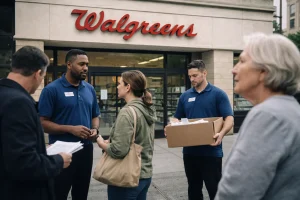
The closure of over a thousand Walgreens locations is not just a corporate restructuring; it has real-world consequences for employees and the communities that rely on these stores for daily necessities and pharmacy services.
Each store typically employs anywhere from 10 to 20 individuals, depending on the size and location. When a store shuts down, most of these employees face either reassignment or job loss.
In some urban areas where several stores are closing within a few miles of one another, reassignment may be possible. But in rural communities or low-density towns, there’s often no nearby location to absorb displaced staff.
The closures also raise concerns about healthcare access.
For many people particularly seniors, those without transportation, and residents in lower-income neighborhoods Walgreens functions as a primary access point for prescription medications, vaccinations, and essential over-the-counter products. The loss of a location can create significant barriers to timely medical care.
In my own research, I’ve spoken with local business owners and residents in cities like Rockford, Illinois and Quincy, Massachusetts, where closures have already taken place.
One resident told me:
“This Walgreens was the only pharmacy within walking distance. Now my grandmother has to take two buses to get her prescription filled.”
Here’s a breakdown of the potential impacts:
| Impact Type | Affected Groups | Description |
| Employment Loss | Store employees | Loss of income, reassignment uncertainty |
| Healthcare Access | Elderly, low-income groups | Reduced access to medications and services |
| Economic Footprint | Local businesses | Decline in foot traffic and shopping activity |
| Urban-Rural Divide | Rural communities | Limited pharmacy alternatives |
While Walgreens has stated that customer service will remain consistent through digital platforms and delivery services, not all populations have equal access to those alternatives.
What Does the Future Look Like for Walgreens After 2027?
Looking ahead beyond 2027, Walgreens aims to emerge as a more efficient, digitally-driven, and pharmacy-focused brand. The current phase is about realignment, but the long-term vision extends further.
Walgreens has hinted at expanding clinical services, deepening its partnerships with healthcare providers, and investing in telepharmacy.
The company’s future success will likely hinge on how well it adapts to three core factors:
- The continued evolution of consumer expectations around convenience and digital service
- Its ability to compete with emerging platforms like Amazon Pharmacy
- The strength of its brand and trust among loyal customers
From my perspective:
“Walgreens is walking a tightrope. If the closures are executed with clarity and reinvestment is handled wisely, the company could regain ground and deliver better experiences through fewer, higher-performing stores.”
There are early signs that Walgreens is taking this direction seriously. The company has begun to pilot upgraded store formats with expanded pharmacy services, onsite clinicians, and automation for prescription filling.
Additionally, Walgreens has improved its mobile app to make prescription management, virtual consultations, and product ordering more accessible.
This evolution suggests a shift from being a retail-first chain to a healthcare-first ecosystem, which might be exactly what it needs to remain relevant in the next decade.
The table below summarizes the forecasted operational shifts:
| Strategic Focus Area | Current Status | Post-2027 Objective |
| Physical Store Footprint | Shrinking | Leaner but more profitable |
| Digital Pharmacy Services | In development | Full-featured digital healthcare platform |
| Clinical Service Integration | Limited to select markets | Nationwide rollout planned |
| Cost Efficiency | Restructuring phase | Stabilized operational expenses |
Ultimately, Walgreens is not going out of business, it’s choosing to adapt. For long-time customers and industry analysts alike, the next two years will reveal whether this transformation becomes a comeback story or a case study in missed opportunities.
Conclusion
Walgreens is not going out of business, but it is undergoing a major transformation to stay competitive. By closing 1,200 underperforming stores and focusing on its core pharmacy operations, the company aims to restore profitability and meet changing consumer needs.
While some communities will feel the impact of these closures, Walgreens is positioning itself for a more sustainable future. With strategic restructuring and renewed investor confidence, the brand remains a significant player in the evolving retail pharmacy landscape.
Frequently Asked Questions About Walgreens Closures
Is Walgreens going out of business in 2026?
No, Walgreens is not going out of business. It is undergoing restructuring and closing underperforming stores.
Why is Walgreens closing stores so rapidly?
Closures are part of a cost-cutting strategy due to declining retail sales, lower prescription reimbursements, and shifting business focus.
Which Walgreens locations are closing soon?
Some locations closing in February 2026 include stores in San Francisco, Chicago, Tallahassee, Oakland, and Rockford.
Will my local Walgreens be affected?
Only underperforming stores are targeted. Many communities will continue to have access to nearby locations.
What is the Footprint Optimization Program?
It’s Walgreens’ three-year plan to close 1,200 stores and improve profitability by focusing on core operations.
Is Walgreens being bought by another company?
There are unconfirmed reports of a possible private equity buyout, but nothing has been officially announced.