


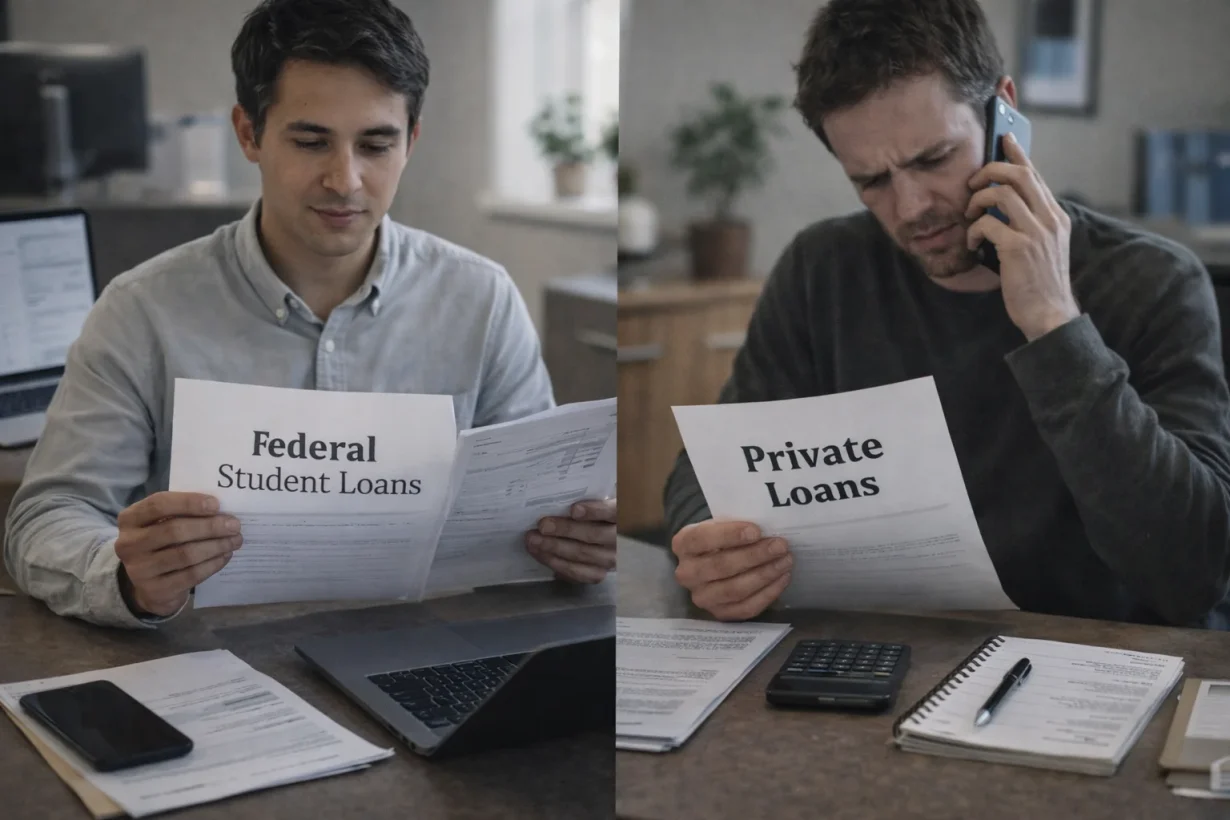

If you’ve ever missed a student loan payment, you know how stressful it can be. But the consequences vary significantly depending on whether your loan is federal or private.
Federal student loans generally offer more leniency, such as longer default timelines and no late fees, while private loans tend to penalize borrowers faster and more severely.
Understanding how these two loan types treat missed payments can help you avoid lasting damage to your credit and finances.
Key differences include:
- Federal loans default after 270 days; private loans can default after 90.
- Late fees are rare with federal loans but common with private loans.
- Federal loans offer more flexible repayment and forgiveness options.
- Private lenders may sue, require court orders for garnishment, and affect cosigners.
What Happens Immediately After a Missed Student Loan Payment?

Missing a student loan payment places your account into delinquency, usually starting the day after the due date passes without payment.
This applies to both federal and private student loans and means your account is no longer considered current. While the consequences are not severe at first, the process begins immediately.
For federal student loans, servicers typically allow a grace period before taking stronger action. During this time, borrowers are contacted and encouraged to make the missed payment.
- Delinquency begins the day after the missed due date
- Credit bureaus are usually notified after up to 90 days
- Reminder emails, letters, or calls may be sent
Private student loans follow stricter timelines and may escalate faster.
- Delinquency starts immediately
- Credit reporting can begin after 30 days
- Late fees may apply within 15–30 days
Acting quickly after a missed payment can prevent long-term damage and keep your financial options open.
When Do Federal and Private Lenders Charge Late Fees?
Late fees are one of the most frustrating consequences of missing a student loan payment, and the rules around them differ significantly between federal and private lenders.
In general, private lenders tend to be much quicker and stricter when it comes to applying late fees, while federal loans offer more borrower-friendly protections.
Federal student loans issued after 2010, particularly Direct Loans, typically do not charge late fees, even if a payment is a few days late. Some older loan types, such as FFELP loans, may still include late fee provisions, but these are now relatively uncommon.
Private lenders, on the other hand, often apply penalties soon after a short grace period ends and are less likely to waive fees without borrower outreach.
Late Fee Structures by Loan Type
| Loan Type | Grace Period | Late Fee Amount | Charged When? |
| Federal (Direct) | 15 days | None | N/A |
| Federal (FFELP) | 15 days | Up to 6% of missed payments | After the grace period |
| Private Loans | Varies | $15–$50 or 5%–6% | After 15–30 days |
Understanding these differences helps borrowers anticipate costs and take timely action to avoid unnecessary penalties.
How Quickly Do Missed Payments Affect Your Credit Score?
One of the most serious and often overlooked consequences of missing a student loan payment is the impact on your credit score. The good news is that you’re not immediately penalised by credit bureaus. The bad news? That grace period is much shorter with private loans.
Federal loans typically don’t report missed payments to the credit bureaus until you’re 90 days overdue, giving borrowers a crucial buffer period to catch up or enter a forbearance or income-driven repayment plan.
During this time, even though you’re technically delinquent, your credit score remains untouched if you act fast.
Private lenders, on the other hand, may report delinquencies as early as 30 days past due, which can result in a 50 to 100+ point drop in your credit score. This negative mark can affect your ability to rent a home, qualify for a mortgage, or even land certain jobs.
Proactively contacting your servicer or lender is the smartest move if you know you’re going to be late. It could make all the difference between a temporary setback and long-term financial consequences.
When Is a Student Loan Considered in Default?
Delinquency is the first warning sign of deeper financial trouble, but default is the point where consequences become serious and long-lasting. Understanding when a student loan officially enters default is essential for protecting your credit and keeping repayment options open.
For federal student loans, default typically occurs after 270 consecutive days (about nine months) of missed payments. This extended timeline gives borrowers time to catch up, change repayment plans, or apply for deferment or forbearance.
Private student loans, however, follow much shorter and stricter timelines, with many lenders declaring default after 90 to 120 days of non-payment.
Timeline to Default:
| Event | Federal Loans | Private Loans |
| Delinquency begins | 1 day | 1 day |
| Reported to credit bureaus | 90 days | 30 days |
| Default triggered | 270 days | 90–120 days |
Once a loan enters default, the full balance may become immediately due, collection efforts intensify, and recovery becomes significantly more difficult and costly.
What Are the Legal Consequences of Defaulting on Student Loans?
Defaulting on student loans doesn’t just affect your credit; it can lead to serious legal action, especially as the debt remains unpaid over time. The specific consequences vary depending on whether your loan is federal or private, but both carry long-term financial risks.
1. Wage Garnishment
Wage garnishment is one of the most immediate and severe actions lenders can take after default.
- For federal student loans, the government can garnish up to 15% of your disposable income without needing to take you to court. This can begin soon after the default is triggered.
- For private student loans, lenders must first file a lawsuit and win a judgment in court. If successful, they may garnish as much as 25% of your wages, depending on your state laws and financial situation.
This automatic withdrawal can strain your monthly finances and make it harder to recover.
2. Tax Refund and Benefit Seizure
With federal loans, the government can tap into other financial sources to collect the debt.
- Through the Treasury Offset Program, they may seize your federal tax refunds to cover past-due student loan payments.
- In some cases, even Social Security benefits can be withheld if the debt remains unpaid.
These aggressive collection methods are not available to private lenders, who must go through the courts to pursue repayment.
3. Loss of Borrower Protections
Defaulting means more than just legal action; it can strip you of key repayment tools and options.
- You’ll lose access to income-driven repayment plans, deferment, forbearance, and any federal loan forgiveness programs.
- You may also become ineligible for new federal student aid if you plan to return to school.
This loss of flexibility can make it significantly harder to regain control of your loan or qualify for any kind of repayment relief.
4. Lawsuits, Judgments, and Asset Seizure
Private lenders typically turn to the courts to enforce repayment once a loan defaults.
If they win a lawsuit, they can take legal action to:
-
- Garnish your wages
- Place a lien on your home or other property
- Freeze or withdraw funds from your bank account
In addition, cosigners are fully liable for the debt and may also be sued, leading to shared financial damage and strained relationships.
How Do Federal and Private Loans Handle Collections Differently?

When a borrower defaults, the loan typically moves into collections, but the methods vary sharply depending on the loan type.
Federal student loans are usually assigned to third-party collection agencies contracted by the Department of Education. These agencies can add collection costs, increasing your debt load, and may even report you to credit bureaus again, exacerbating the damage.
The federal government has unmatched collection power, they can intercept your tax refund, garnish your wages administratively, and restrict your eligibility for future federal aid.
Private loans, meanwhile, rely on traditional collection agencies or in-house legal teams. These entities often pursue aggressive phone and mail tactics, and in many cases, escalate to lawsuits if payments aren’t made.
Real-Life Example:
Sarah, a borrower with $40,000 in private student loans, lost her job and missed three payments. Her lender declared her in default after 95 days and sold her debt to a collection agency. Within two months, she received a court summons.
The court ordered a wage garnishment of 20%, and she now pays $600 monthly, more than her original agreed amount.
What Impact Does a Missed Payment Have on Cosigners of Private Loans?
When you take out a private student loan with a cosigner, often a parent, grandparent, or close family member, they become equally responsible for the debt. That means any missed or late payments don’t just affect you; they can also create serious financial consequences for your cosigner.
- Missed payments are reported on both credit reports, damaging your cosigner’s credit score just as much as your own.
- If the loan goes into default, the lender has the legal right to sue the cosigner directly for the full balance.
- If the lender wins a judgment in court, your cosigner may be subject to wage garnishment, bank levies, or property liens just like you.
- While some lenders offer a cosigner release option, this typically requires 12–36 months of consistent, on-time payments. A single delinquency or default can disqualify you from ever being eligible for release.
If your cosigner has strong credit or relies on access to financing, your missed payments could cause long-term harm to their financial profile. Maintaining open communication and taking quick action to resolve missed payments is crucial not just for your sake, but for theirs.
Are There Any Forgiveness or Relief Options If You’re Struggling to Pay?
Yes, and understanding what’s available could help you avoid the worst outcomes.
If you’re holding federal student loans, several relief options exist:
- Income-Driven Repayment (IDR): Adjusts payments to your income and family size.
- SAVE Plan: Reduces monthly payments and increases forgiveness potential.
- Deferment & Forbearance: Temporarily pauses payments without defaulting.
- Loan Rehabilitation: Offers a one-time route out of default.
For private loans, options are limited but not non-existent:
- Temporary forbearance (usually 1–3 months)
- Interest-only payment options during hardship
- One-time payment plan adjustments
- Settlement offers after default
Because private lenders are not required to offer any relief, success often depends on proactive borrower communication. If you’re struggling, don’t wait, reach out before you fall behind.
How Do Federal and Private Student Loans Compare in Terms of Flexibility?
The contrast in flexibility between federal and private loans is stark. Federal loans are regulated and designed for accessibility, offering a range of protections and adjustment mechanisms.
Private loans are contract-based, meaning your lender isn’t required to offer anything beyond what’s written in your loan terms. That includes payment plans, hardship programs, or even grace periods.
| Feature | Federal Loans | Private Loans |
| Payment Plans | Multiple income-driven options | Limited, fixed terms |
| Forgiveness Options | PSLF, SAVE, IDR forgiveness | Rarely available |
| Hardship Relief | Forbearance, deferment, rehabilitation | Temporary forbearance, if offered |
| Legal Action Timeline | Long grace periods | Faster to sue and penalize |
| Cosigner Requirement | None | Often required |
If you need predictability and options for hardship, federal loans are generally more forgiving.
What Can You Do Right Now If You’ve Missed a Payment?

If you’ve recently missed a student loan payment, don’t panic, but do act quickly. The earlier you address the situation, the more options you’ll have.
Start by contacting your loan servicer or lender. Explain your situation and ask what short-term solutions are available.
In many cases, you can request:
- A late fee waiver, especially if this is your first offense
- A temporary deferment or forbearance
- A modified payment plan that fits your current income
Also consider enrolling in autopay, which may prevent future missed payments and sometimes even qualify you for a small interest rate reduction.
Finally, monitor your credit report to ensure the late payment hasn’t been reported and if it has, begin the dispute or goodwill adjustment process right away.
Summary Table: Key Differences Between Federal and Private Student Loan Penalties
To help you clearly understand how the consequences differ, here’s a side-by-side comparison of the main penalties and features associated with late or missed payments on federal vs. private student loans:
| Feature | Federal Student Loans | Private Student Loans |
| Delinquency Begins | 1 day after the missed payment | 1 day after the missed payment |
| Late Fees | Usually none (post-2010 loans); older FFELP may charge up to 6% | Typically $15–$50 or 5%–6% after 15–30 days |
| Credit Reporting Timeline | After 90 days of non-payment | Often, after 30 days |
| Default Timeline | After 270 days of missed payments | Typically, after 90–120 days |
| Wage Garnishment | Up to 15% without a court order | Up to 25% with a court judgment |
| Tax Refund Seizure | Yes, via Treasury Offset Program | Not allowed |
| Access to Repayment Options | Extensive: IDR, SAVE, deferment, forbearance | Limited and lender-specific |
| Forgiveness Programs | Available (e.g., PSLF, SAVE, IDR forgiveness) | Rare or not offered |
| Cosigner Requirement | Not required | Often required |
| Cosigner Liability | Not applicable | Cosigner is fully liable for missed payments |
| Legal Action Process | No court is needed for garnishment or refund seizure | Must sue and win judgment to take legal enforcement steps |
| Collection Process | Government-hired agencies with administrative powers | Third-party collectors or law firms; more aggressive tactics |
Understanding these distinctions can help you make smarter financial decisions, avoid long-term damage, and choose the best strategy if you’re struggling with repayment.
Conclusion
Late payments on student loans are never ideal, but the consequences differ greatly depending on whether your loan is federal or private.
Federal loans offer grace periods, repayment flexibility, and non-judicial collection options. Private loans, on the other hand, move faster to penalize borrowers with fees, lawsuits, and aggressive collections.
By understanding these differences and acting quickly after a missed payment, you can protect your credit, reduce financial harm, and stay on track with your repayment journey.
If you’re unsure what steps to take, start by contacting your loan servicer. They’re your first line of defense in preventing delinquency from becoming default.
FAQs
Can a one-day-late student loan payment hurt my credit?
No. Credit bureaus typically aren’t notified until a payment is 30 days late for private loans and 90 days for federal loans. However, your loan servicer will still mark your account as delinquent internally.
Will a late payment affect my eligibility for loan forgiveness programs?
Yes, potentially. Programs like Public Service Loan Forgiveness (PSLF) require on-time payments. A late payment outside the 15-day window may not count as a qualifying payment.
How do I remove a late student loan payment from my credit report?
If the reporting was an error, you can dispute it with the credit bureaus. Some servicers may also grant a “goodwill adjustment” for first-time late payments.
What if I missed a payment because of a banking error?
Call your lender immediately and explain. If the error was outside your control, many servicers will waive late fees or cancel the delinquency status.
Can private lenders report late payments before 30 days?
Typically, private lenders report to credit bureaus after 30 days. However, some may start internal collections sooner, so always check your loan terms.
What repayment options are available if I lose my job?
Federal borrowers may qualify for $0 payments under IDR plans. Private borrowers should call their lender to ask about temporary hardship plans.
Does defaulting on a loan affect my ability to go back to school?
Yes. If you have federal loans in default, you cannot receive new federal financial aid until you rehabilitate or consolidate your existing loans.