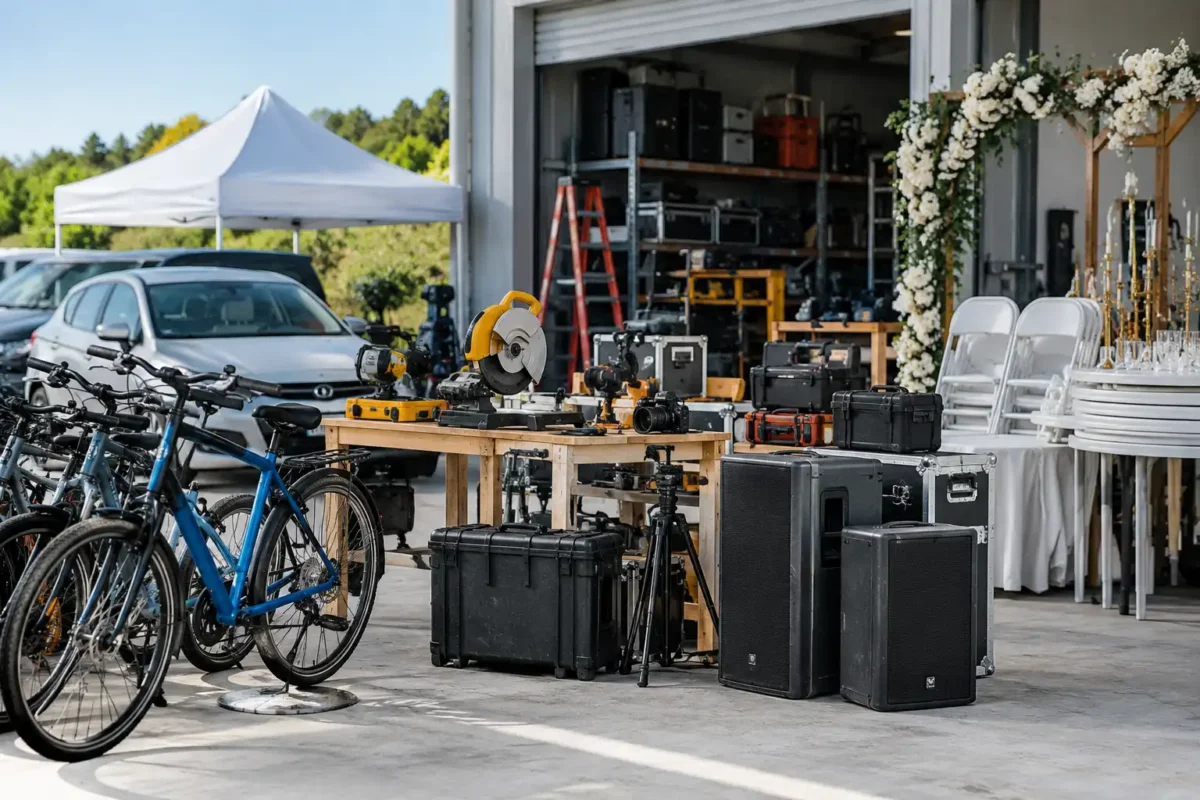
A rental business can make money from the same asset repeatedly instead of selling it once. That simple model can work with houses, cars, dumpsters, tools, cameras, bicycles, furniture, party equipment and dozens of other assets.
But choosing between rental business ideas should involve much more than asking which item commands the highest rental price.
A $2,000 piece of equipment that rents reliably, fits inside a garage and takes ten minutes to inspect may be a better business asset than a $50,000 vehicle that spends half the month unused. Storage, transportation, maintenance, insurance, customer handovers and downtime can matter just as much as the purchase price.
That is why this comparison focuses on four questions:
How much capital might the business require? What equipment or property has to be acquired? How difficult is the operation to run? What will the owner actually spend each day doing?
The distinction between rental categories is important too. The U.S. Census Bureau places tangible-goods rental and leasing activities such as vehicles, consumer goods and industrial machinery within Rental and Leasing Services, while real-estate lessors fall into a separate classification.
For an entrepreneur, that means a rental property business can look completely different from a tool, car or party equipment rental operation even though customers are paying for temporary use in each case.
Rental Business Ideas Compared at a Glance
The figures below are planning ranges rather than promises or supplier quotations. They show what a relatively lean U.S. launch might require before major premises costs, owner salary and financing charges.
Starting costs can be dramatically higher or lower depending on location, whether assets are bought new or used, and whether the entrepreneur already owns suitable property, vehicles or storage.
| Rental Business Idea | Approximate Lean Starting Budget | Main Assets Required | Storage Need | Transport Need | Daily Workload |
| Long-term rental property | $30,000–$150,000+ | Residential property | Built in | Low | Medium |
| Vacation rental | $5,000–$100,000+ | Furnished home/unit | Built in | Low | High |
| Party equipment | $3,000–$25,000 | Tables, chairs, tents, décor | Medium–High | High | High |
| Wedding décor | $3,000–$20,000 | Arches, furniture, tableware, décor | Medium–High | High | High |
| Tool rental | $5,000–$30,000 | Power tools and specialist equipment | Medium | Medium | Medium |
| Camera and AV rental | $5,000–$40,000 | Cameras, lenses, microphones, lighting | Low | Low | Medium |
| Bicycle/e-bike rental | $8,000–$35,000 | Bikes, locks, helmets, chargers | Medium | Medium | High |
| Car rental | $50,000–$250,000+ | Cars and fleet-management equipment | High | Medium | High |
| Peer-to-peer car hosting | $10,000–$60,000+ | One or several vehicles | Medium | Medium | Medium–High |
| Trailer rental | $8,000–$40,000 | Utility, cargo or dump trailers | High | Medium | Medium |
| Dumpster rental | $20,000–$100,000+ | Containers, trailers or roll-off equipment | High | Very High | High |
| Bounce house rental | $5,000–$25,000 | Inflatables, blowers and anchoring equipment | Medium | High | High |
| Baby equipment rental | $2,000–$10,000 | Cribs, strollers, high chairs and similar gear | Medium | Medium | Medium |
| Camping equipment rental | $3,000–$15,000 | Tents, sleep systems, outdoor equipment | Medium | Medium | Medium |
| Furniture rental | $10,000–$50,000+ | Furniture and staging inventory | High | Very High | High |
| Lawn and garden equipment | $5,000–$30,000 | Mowers, tillers, aerators and similar tools | Medium–High | High | Medium–High |
| Construction equipment | $75,000–$300,000+ | Compact machinery and site equipment | Very High | Very High | High |
| Moving-box rental | $3,000–$15,000 | Reusable boxes, dollies and labels | Medium | High | Medium |
| Office/technology rental | $10,000–$50,000 | Laptops, displays, projectors and networking gear | Medium | Medium | Medium |
| Sports equipment rental | $5,000–$30,000 | Ski, surf, golf, paddle or specialist sports equipment | Medium | Medium | Medium–High |
The table exposes one of the most important truths about rental businesses: startup cost and workload do not necessarily move together.
A low-cost party rental company can involve constant loading, delivery, setup and collection. A more expensive long-term rental property may involve fewer customer interactions but greater financing, property and regulatory exposure.
What Makes a Rental Business Attractive?
The economics of renting are based on asset reuse.
Instead of earning once when an item is sold, the operator attempts to earn repeatedly before that asset becomes obsolete, damaged or uneconomic to maintain.
That creates an important equation:
Asset return = rental revenue generated over the useful rental life − acquisition cost − operating costs − maintenance − losses − financing − disposal costs
The attraction is obvious. If a piece of equipment can complete enough profitable rental cycles, its acquisition cost may eventually be recovered while the asset remains capable of generating further revenue.
But rental businesses also inherit costs normal retailers do not face.
An operator must normally retrieve the asset, inspect it, clean it, repair it, store it and make it available for the next customer. Lost accessories, late returns, theft and accidental damage can turn what appears to be a high-margin transaction into an expensive one.
That is why utilization is usually more informative than the headline rental rate.
An asset renting for $300 per day but booked twice a month produces $600 of gross monthly rental revenue. An asset earning $100 per day but rented 15 days produces $1,500.
The second asset may therefore be far more useful to the business even though its advertised price is lower.
How Should Startup Costs Be Calculated?
Buying the rental asset is only one part of startup expenditure.
The U.S. Small Business Administration recommends identifying startup expenses before launch so entrepreneurs can estimate profitability, conduct break-even analysis and work out how much funding they require. Its startup-cost planning resources are useful when building the first financial model.
A realistic rental startup budget should consider inventory or property, vehicle costs, storage, insurance, licenses, booking software, payment processing, repairs, cleaning equipment, security systems, deposits with suppliers, branding, advertising and enough working capital to operate while bookings are still irregular.
There should also be an emergency reserve.
A rental company whose only high-value asset fails may temporarily have no product to sell. That is fundamentally different from many service businesses where the founder’s knowledge remains available regardless of equipment failure.
How Can Asset Payback Be Estimated?
One simple measure is the rental-turn payback calculation:
Asset purchase price ÷ contribution from each rental = approximate rental turns required to recover the purchase price
Suppose a commercial pressure washer costs $1,200.
If the achievable one-day rental price is $80 and cleaning, payment fees and routine wear average $20 per rental, the contribution before fixed overhead is approximately $60.
$1,200 ÷ $60 = 20 paid rental days
That does not mean the business becomes profitable after 20 rentals. Insurance, advertising, storage, labor, taxes and other overhead still exist.
It does, however, provide a useful comparison between potential inventory items.
The SBA also provides a break-even calculation methodology based on fixed costs, selling price and variable costs.
1. Long-Term Rental Property Business
Residential property is one of the largest rental-business categories, but it should not be treated like equipment rental.
The operator acquires or already owns a house, condo, duplex or multifamily property and receives rent in exchange for occupancy.
Capital requirements are usually substantially higher than for a garage-based equipment operation because the owner may need a down payment, closing costs, initial repairs and cash reserves.
Daily work can include answering tenants, coordinating repairs, managing contractors, checking payments, bookkeeping and handling lease administration. Owners who employ a property manager can reduce their direct workload, but management fees become another operating cost.
Property investors also need to distinguish gross rent from cash flow. Mortgage payments, property taxes, insurance, repairs, vacancies, management expenses and capital expenditure can consume a substantial proportion of the rent collected.
Federal tax treatment also differs from many operating rental businesses. The IRS explains that rental real-estate income generally has to be reported and discusses deductible expenses including certain operating costs, insurance, maintenance, taxes and depreciation. Its rental real-estate tax guidance is a useful starting point before obtaining personalized tax advice.
Typical daily work: tenant communication, rent administration, maintenance scheduling and records.
Main challenge: substantial capital exposure combined with property-specific legal and maintenance obligations.
2. Vacation Rental Business
A vacation rental turns residential accommodation into a short-stay hospitality operation.
That distinction changes the daily workload significantly.
Instead of one tenant occupying a property for months or years, a short-term rental may have multiple guest turnovers every week. Each turnover creates cleaning, linen, inspection and communication tasks.
A typical working day can involve answering booking questions, changing rates, sending check-in information, coordinating cleaners, checking supplies and dealing with maintenance between guests.
Location is fundamental. A beautifully furnished property cannot compensate for weak local visitor demand.
Local short-term rental regulations also require careful research before money is committed because rules can vary by city, county, building and homeowners association.
This type of rental business suits operators who understand that they are effectively combining property ownership or management with hospitality.
3. Party Equipment Rental
Party rental remains attractive because customers frequently need bulky products for only a few hours.
Tables, folding chairs, linens, tents, lighting and serving equipment can potentially serve many separate events before replacement.
A small operator can begin with a narrow inventory rather than trying to supply an entire wedding.
The difficult part is logistics.
Saturday may require several morning deliveries, afternoon emergency calls and late-evening collections. Every returned chair must be counted and inspected before the next booking.
Storage can also become a bottleneck quickly.
A business with 200 chairs does not just need floor space for 200 chairs; it needs loading aisles, cleaning space, damaged-stock separation and enough access to assemble orders without unloading the entire warehouse.
Typical daily work: picking orders, loading vans, deliveries, setup, collection, cleaning and inventory checks.
Main challenge: labor and transport can grow faster than inventory.
4. Wedding Décor Rental
Wedding rental overlaps with party rental but often competes through appearance rather than simple utility.
Inventory might include ceremony arches, table decorations, premium seating, backdrop structures, candle holders, signs, tableware and lounge furniture.
A focused design style can be easier to manage than trying to carry inventory for every possible wedding theme.
The important operational issue is set integrity.
If a couple books 100 matching pieces and five return damaged from the previous event, the business has a customer-service problem even though 95% of its inventory is technically available.
Operators therefore need spare stock, careful packing systems and clear condition records.
Typical daily work: preparing coordinated orders, communicating with planners, transporting décor, setup and post-event inspection.
Main challenge: maintaining matching inventory in presentation-ready condition.
5. Tool Rental Business
Tools have several characteristics that make them suitable for renting: many are expensive relative to how infrequently a homeowner needs them, durable equipment can complete numerous jobs, and local customers often need products at short notice.
Potential inventory includes pressure washers, floor sanders, tile saws, demolition tools, concrete mixers, drain-cleaning equipment, generators and landscaping machines.
The stronger model is usually not “own every tool.”
It is identifying the equipment local customers regularly need but dislike purchasing.
Daily operations revolve around safety and condition.
A tool returned on Friday evening may be booked again Saturday morning. It has to be checked, cleaned and made ready before that next customer arrives.
Typical daily work: reservations, demonstrations, condition inspections, battery charging, cleaning and basic maintenance.
Main challenge: preventing heavily used inventory from becoming unreliable.
6. Camera and AV Equipment Rental
Professional cameras, lenses, microphones, lighting and audio equipment can carry high purchase prices despite being physically compact.
That makes the category attractive to photographers, production crews, students, agencies and creators who need specialist equipment for individual projects.
Unlike chairs or dumpsters, however, electronic inventory can become technologically obsolete.
The operator therefore has two risks: physical damage and declining market value.
Detailed check-in and check-out procedures are important. A camera kit containing a body, three batteries, charger, memory cards, cables and adapter should return with every component accounted for.
Serial-number tracking can also become essential as inventory grows.
Typical daily work: equipment testing, charging, cleaning lenses, assembling kits, customer handovers and return inspections.
Main challenge: balancing strong rental value against theft, damage and technological depreciation.
7. Bicycle and E-Bike Rental
Bike rental can work particularly well around tourist areas, trails, resorts, parks and locations where visitors need temporary transportation.
Electric bikes increase the potential customer base but add battery management, charging and electrical maintenance.
The business must think in fleets rather than individual products.
A customer often wants several compatible bikes simultaneously, meaning availability by size and type becomes important.
The day can begin with tire-pressure checks and battery charging before moving into customer fittings, route advice, repairs and returns.
Weather also matters considerably. A rainy weekend can reduce demand while fixed costs continue.
Typical daily work: safety checks, tire and brake maintenance, battery charging, customer fitting and route support.
Main challenge: seasonality and intensive fleet maintenance.
8. Car Rental Business
Starting a conventional car rental company requires considerably more capital and operating infrastructure than many equipment businesses.
Vehicles need to be acquired, registered, insured, cleaned, maintained and tracked.
There is also an expensive distinction between fleet size and useful fleet size.
Owning five vehicles does not mean five vehicles are available. One may be in a body shop, another may require scheduled servicing and another may be awaiting a customer return.
That makes fleet utilization and downtime central financial metrics.
The Census Bureau specifically classifies passenger car rental separately within the wider Rental and Leasing Services sector.
Typical daily work: bookings, identity/document checks, vehicle inspections, cleaning, customer handovers, maintenance coordination and claims administration.
Main challenge: high capital requirements combined with depreciation, insurance and downtime.
9. Peer-to-Peer Car Rental Hosting
A smaller entrepreneur may consider listing one or several vehicles through a peer-to-peer car-sharing marketplace rather than building an independent reservation platform immediately.
This can lower certain customer-acquisition and technology barriers, but it creates platform dependency.
Hosts need to understand current platform eligibility, fee, protection and vehicle rules directly from the service being used before buying a car specifically for hosting.
The daily work remains physical: vehicles need cleaning, photographs, inspections, fuel or charge management, maintenance and timely handovers.
Operators should model the business using net payout after platform costs, not the customer-facing daily rental price.
10. Trailer Rental
Utility trailers, enclosed cargo trailers, vehicle haulers and dump trailers can serve homeowners, landscapers, contractors and people moving bulky items.
Compared with cars, trailers contain fewer complex mechanical systems, but they are far from maintenance-free.
Tires, wheel bearings, brakes, lights, couplers and safety chains all require attention.
The customer also needs a compatible tow vehicle and appropriate connection equipment.
A trailer business therefore benefits from a precise handover procedure rather than simply passing over the keys.
Typical daily work: connection checks, light testing, cleaning, inspection, bookings and maintenance.
Main challenge: towing safety, storage and damage caused by inexperienced users.
11. Dumpster Rental
Dumpster rental has a straightforward customer proposition: provide a container, leave it for an agreed period and collect it when the project is finished.
Behind that simple transaction is a logistics business.
The operator must coordinate container availability, delivery routes, pickups, disposal facilities, weight limits and prohibited materials.
Customers may keep containers longer than expected, creating scheduling problems for the next booking.
A lean entry model might use smaller dump trailers or containers, while a larger roll-off operation can require substantial truck and container investment.
This is also one rental category where local disposal rules, commercial vehicle requirements and operating permits need to be investigated carefully before launch.
Typical daily work: dispatching, deliveries, pickups, disposal runs, customer calls and container inspection.
Main challenge: transport, disposal costs and scheduling.
12. Bounce House and Inflatable Rental
Inflatables are often presented as simple weekend businesses, but operations are highly hands-on.
The inflatable has to arrive clean, dry and undamaged. It must be placed appropriately, anchored correctly and collected after use.
Weather can also affect bookings and safe operation.
The major advantage is that a small number of products can create a marketable initial inventory. Different themes and sizes can be added as actual booking patterns become visible.
Typical daily work: loading, delivery, setup, inspection, collection, drying and cleaning.
Main challenge: weather dependency and labor-intensive event days.
13. Baby Equipment Rental
Families traveling with young children may prefer to rent bulky equipment at their destination rather than transport everything through airports.
Possible inventory includes portable cribs, strollers, high chairs and other travel equipment.
This category requires unusually careful product management.
Cleaning standards, manufacturer instructions, product condition and safety recalls all deserve systematic attention. Certain products may carry greater liability exposure and should not simply be added because they appear popular.
The operational advantage is that inventory can often be stored more efficiently than party furniture or vehicles.
Typical daily work: sanitizing, inspecting equipment, preparing family orders and coordinating hotel or accommodation deliveries.
Main challenge: maintaining exceptionally high standards of condition and safety.
14. Camping and Outdoor Equipment Rental
Tents, sleeping systems, camp furniture, coolers and outdoor cooking equipment can be packaged together for customers who do not camp often enough to justify owning everything.
Bundles can simplify both pricing and customer decisions.
A two-person camping kit, family camping kit and premium weekend kit may be easier to market than 75 individually priced components.
However, returned outdoor gear cannot always go straight back onto the shelf.
Wet tents need drying. Cooking equipment needs cleaning. Missing stakes and poles can make an otherwise complete tent unusable.
Typical daily work: packing kits, checking accessories, cleaning, drying and customer handovers.
Main challenge: maintaining complete, ready-to-rent kits during peak periods.
15. Furniture and Home-Staging Rental
Furniture rental can serve corporate relocations, temporary accommodation, events, offices and real-estate staging.
Individual rental values can be attractive, but furniture consumes enormous amounts of storage and vehicle capacity relative to smaller equipment.
Every movement also creates potential cosmetic damage.
Warehouse design therefore becomes part of the business model.
Poor stacking or inefficient loading can increase labor costs and shorten furniture life.
Typical daily work: warehouse picking, loading, delivery, installation, collection, cleaning and repair.
Main challenge: storage, delivery labor and repeated handling damage.
16. Lawn and Garden Equipment Rental
Many homeowners need equipment such as aerators, tillers, log splitters, pressure washers or specialist landscaping machinery for a single project.
That produces a similar economic case to tool rental.
Demand, however, can be more seasonal.
Spring lawn work, autumn cleanup and weather conditions may create concentrated peaks that require additional inventory for only part of the year.
Maintenance capability is a genuine competitive advantage because customers expect machinery to work immediately after pickup.
Typical daily work: mechanical checks, fueling or charging, cleaning, demonstrations and repairs.
Main challenge: seasonal demand combined with mechanical wear.
17. Construction Equipment Rental
Compact excavators, skid steers, trenchers, generators, compressors and other job-site equipment can produce substantial rental invoices, but they also require substantial investment.
Transport is one of the biggest differences from small tool rental.
A mini excavator cannot simply be placed in the back of a normal passenger vehicle. Suitable trailers, trucks and loading procedures may be required.
Downtime is expensive too.
A $50 hand drill being repaired is inconvenient. A high-value machine sitting unused while financing and insurance costs continue can materially affect cash flow.
Typical daily work: dispatching machines, inspections, servicing, transport coordination and contractor communication.
Main challenge: capital intensity and expensive equipment downtime.
18. Moving-Box Rental
Reusable plastic moving boxes offer a different rental model.
Rather than asking customers to buy cardboard boxes, the business delivers stackable containers before the move and collects them afterward.
The inventory is relatively simple, but route efficiency determines whether the economics work.
A $100 booking that requires long-distance delivery and collection twice may be less attractive than several geographically concentrated orders.
The operator therefore has to think like a delivery company as much as a rental company.
Typical daily work: route planning, delivering containers, collecting returns, cleaning and counting boxes.
Main challenge: controlling delivery cost per order.
Which Rental Businesses Can Be Started From Home?
Home-based operations are most practical when inventory is compact, clean, secure and unlikely to cause zoning or neighborhood issues.
Camera equipment, small tools, camping kits, baby equipment and limited event décor are examples worth investigating when suitable storage is available.
Dumpsters, construction equipment, large trailers and extensive party inventory normally create greater storage and vehicle requirements.
The mistake is assuming a garage automatically represents free storage.
If rental stock makes the garage unusable for household purposes, requires new shelving, creates security risks or forces a vehicle onto paid parking elsewhere, the storage still has an economic cost.
Which Rental Businesses Require the Most Physical Work?
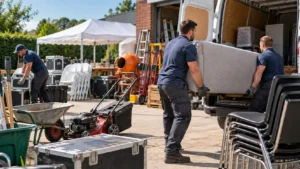
Party equipment, furniture, inflatables, dumpsters and heavy-equipment operations can become labor businesses disguised as asset businesses.
The product earns the revenue, but people still have to move it.
Founders should therefore calculate labor minutes per rental, not merely revenue per rental.
Consider two $300 orders.
One camera package might require 20 minutes to prepare and inspect. A $300 party order could require two people to load, drive, unload, set up, return later, dismantle and reload everything.
The revenue is identical. The operational economics are not.
That is why the “daily work” column should influence the business decision just as much as startup cost.
B2B or B2C: Which Rental Model Fits Better?
Consumer rental businesses usually generate a larger number of relatively small transactions.
Business-to-business rentals may generate fewer but larger or longer bookings.
A homeowner might rent a tool for one Saturday. A contractor may rent several items for two weeks.
A family might need chairs once for a graduation. An event planner may book equipment repeatedly throughout the year.
Repeat commercial accounts can reduce customer-acquisition pressure, but businesses may expect account terms, guaranteed availability, delivery windows and detailed invoices.
The better model therefore depends on the inventory and operational capability rather than on one market universally producing better returns.
How Should Local Demand Be Tested Before Buying Equipment?
This is where many rental-business plans fail.
The entrepreneur discovers an interesting product and immediately purchases a fleet.
A better sequence is to validate the problem first.
The SBA’s market research and competitive analysis guidance recommends researching demand, market size, location, saturation and competitor pricing when testing a business opportunity.
For a rental operator, that research can be made particularly practical.
Search the local market for the exact item. Record competing inventory, advertised rates, minimum hire periods, deposits, delivery fees and weekend availability.
Then speak with potential customers.
A contractor may reveal that plenty of excavators are available but small dump trailers are constantly difficult to source. An event planner might say another chair company is unnecessary while premium ceremony furniture is routinely unavailable.
That information is more valuable than choosing an idea purely because a national article describes it as profitable.
Why Does Utilization Matter More Than Inventory Size?
A rental business makes money when assets are out on paid rental, not when they are sitting neatly in a warehouse.
Consider two companies.
Company A owns $100,000 of equipment and produces $8,000 in monthly rentals.
Company B owns $40,000 and produces $7,000.
Company A has more inventory and more revenue, but Company B may be generating substantially more revenue relative to the capital tied up in assets.
That is why founders should monitor revenue per asset, paid rental days, idle days, maintenance downtime and customer turnaways caused by unavailable stock.
Expansion should generally be driven by evidence.
If one model of machine is repeatedly unavailable while another sits unused, the booking history has effectively told the owner what to buy next.
How Should Rental Prices Be Set?
Competitor prices are useful, but copying them is not a pricing strategy.
A rental price needs to support the complete operating model.
The calculation should consider acquisition cost, expected useful rental life, maintenance, cleaning, payment costs, storage, delivery, labor, insurance, expected damage, seasonality and target return.
Delivery should receive particular attention.
“Free delivery” is not actually free when an employee spends 90 minutes driving a truck.
That cost has simply been hidden inside the rental price.
A strong pricing model can therefore separate base rental, delivery, setup, consumables, damage protection and late-return charges when appropriate.
The objective is not to create as many fees as possible. It is to understand exactly which activity is consuming money.
What Should Happen When Equipment Comes Back?
Returns are where rental operations either become efficient or chaotic.
Every asset should have a consistent return workflow.
Its identity needs confirming. Accessories should be counted. Condition should be recorded. Cleaning should happen before the item is marked ready. Maintenance faults should move the equipment into an unavailable status rather than leaving it bookable.
The same principle applies to rental property on a longer time scale.
A move-out or guest turnover requires inspection, cleaning, repairs and confirmation that the asset is genuinely ready for another customer.
The rental business is therefore a circular inventory operation:
Ready → Reserved → Rented → Returned → Inspected → Cleaned/Repaired → Ready again
Reducing the time between “returned” and “ready again” can increase effective capacity without buying another asset.
What Insurance Does a Rental Business Need?
There is no single policy that covers every rental model.
A camera company, landlord, car fleet and heavy-equipment operator face very different exposures.
The correct coverage can also depend on ownership, location, employees, delivery vehicles and exactly what the customer is allowed to do with the asset.
Insurance should therefore be researched before purchasing inventory, not after the first booking.
Business structure does not replace insurance either.
The SBA explains that legal structure affects issues including taxation, paperwork and personal liability. Entrepreneurs comparing structures can use its business-structure guidance as an introduction before taking professional advice.
What Licenses and Permits Might Be Required?
Requirements depend heavily on activity and location.
A home-based camera rental operation will not necessarily face the same requirements as a dumpster company operating commercial trucks or a short-term rental in a regulated tourist city.
Zoning can matter. Commercial vehicles can matter. Waste handling can matter. Building rules can matter. Certain equipment categories can bring additional safety requirements.
The SBA’s business launch guidance specifically directs business owners to investigate state and local registration, licenses, permits, taxes and insurance.
For that reason, a national rental-business article can explain the issues to investigate but cannot determine the permits required for every city or county.
How Is Rental Business Income Taxed?
Tax treatment depends on what is being rented and how the activity is operated.
The IRS states that when someone rents personal property such as equipment or vehicles, how income and expenses are reported depends partly on whether the activity constitutes a business and whether it is conducted for profit.
It notes that an activity conducted with continuity and regularity primarily for income or profit is generally treated as a business.
Rental real estate has separate guidance and commonly involves different reporting considerations.
Business entity selection can create additional tax consequences. The IRS recognizes common structures including sole proprietorships, partnerships, corporations, S corporations and LLCs, with federal tax treatment depending on the entity and elections made.
A new operator should therefore avoid assuming that income from renting a house, a camera and a fleet of equipment will automatically be reported in exactly the same way.
What Metrics Should a Rental Business Track?
A rental company can generate increasing revenue while becoming less efficient, so revenue alone is not enough.
The strongest operating dashboard should monitor:
| Metric | What It Shows |
| Utilization rate | How frequently available inventory earns money |
| Revenue per asset | Which assets produce the most sales |
| Contribution per rental | What remains after rental-specific costs |
| Turnaround time | How quickly returned items become rentable again |
| Maintenance downtime | How much earning capacity is being lost |
| Damage rate | How frequently rentals create repair costs |
| Loss rate | How frequently items or components disappear |
| Average order value | Typical revenue per booking |
| Delivery cost per order | Whether logistics are consuming margin |
| Repeat customer rate | Whether customers are returning |
| Cancellation rate | How much booked capacity fails to convert |
| Payback progress | How close each asset is to recovering acquisition cost |
This level of measurement is one of the biggest opportunities for a new operator.
Instead of saying, “Party rentals seem busy,” the owner can say, “Our 6-foot tables were rented for 17 days last month while our premium chairs were rented for six.”
That leads to much better purchasing decisions.
How Can Someone Choose Between These Rental Business Ideas?
Start with constraints rather than excitement.
| If This Describes You | Rental Ideas Worth Investigating |
| Under $10,000 available | Baby equipment, camping gear, small tools, wedding décor, moving boxes |
| Garage or small secure storage | Cameras, tools, camping gear, baby equipment |
| Truck or delivery van already available | Party equipment, furniture, moving boxes, inflatables |
| Mechanical skills | Tools, lawn equipment, trailers, bikes, construction equipment |
| Strong hospitality experience | Vacation rentals |
| Existing real-estate capital | Long-term residential rentals |
| Strong logistics capability | Dumpster, furniture, party and equipment rentals |
| Tourism-heavy local market | Bikes, outdoor equipment, vacation rentals |
| Contractor relationships | Tools, trailers and construction equipment |
| Event-industry contacts | Weddings, party equipment, AV and furniture |
| Limited desire for customer interaction | Long-term property may fit better than event rental |
| Comfortable with frequent customer handovers | Tools, bikes, cameras and vehicles |
The aim is not to find a universally “best” rental business.
It is to find an asset that matches local demand, available capital and the type of work the owner is prepared to perform every day.
A Practical Rental Business Launch Framework
| Stage | What to Establish Before Moving On |
| Demand | Evidence that customers are actively looking for the asset |
| Competition | Existing suppliers, rates, availability and service gaps |
| Unit economics | Purchase cost, rental rate, variable cost and expected utilization |
| Operations | Storage, cleaning, maintenance, handover and return process |
| Logistics | Pickup, delivery, route distance and loading requirements |
| Risk | Insurance, theft, damage, deposits and customer verification |
| Compliance | Entity structure, registrations, permits, zoning and taxes |
| Technology | Website, availability calendar, payments and inventory tracking |
| Pilot | Small initial inventory tested against real bookings |
| Expansion | Additional inventory purchased from actual demand data |
This approach protects the founder from one of the most expensive mistakes in the industry: buying an impressive fleet before proving that local customers will rent it often enough.
How Does a Rental Business Become More Profitable?
Profitability generally improves when the business makes existing assets work harder before buying more.
That can mean reducing turnaround time, increasing utilization, charging appropriately for delivery, selling related services, minimizing maintenance downtime and encouraging repeat bookings.
Bundling can also help.
A camera customer may need lenses, batteries and lighting. A party customer may need tables, chairs and linens. A camping customer may need a tent, sleeping equipment and cooking gear.
The important distinction is that additional products should solve the same customer’s problem rather than simply make the inventory catalog larger.
A narrow, heavily used fleet can be healthier than a warehouse filled with products that rarely leave the building.
Is a Rental Business Passive Income?
Usually not.
Some rental models can become less hands-on after systems, employees or professional managers are introduced, but most require ongoing operational work.
Assets have to remain available and usable.
A landlord deals with maintenance and tenants. A vacation rental requires turnovers. Cars need cleaning. Tools need inspection. Party equipment needs moving. Dumpsters need collecting.
“Passive” often means the owner has paid someone else to perform that work, not that the work disappeared.
That distinction should be part of the financial model from the beginning.
Conclusion
The strongest rental business idea is not necessarily the product with the highest daily rental price or the business that appears most frequently on lists of “profitable rental ideas.”
A viable rental business needs an asset that customers repeatedly need, an acquisition price the operator can support, enough utilization to recover the investment and an operating system capable of getting that asset from one customer to the next efficiently.
For some entrepreneurs, that could mean a residential rental property producing monthly rent.
For another, it may be ten power tools stored in a garage.
Someone with event-industry relationships may be better positioned to build a party or wedding rental company, while an operator with trucks, yard space and logistics experience may find trailers, dumpsters or construction equipment more compatible with existing resources.
Before choosing, compare startup capital, local demand, storage, transportation, maintenance, insurance, seasonality and the daily work required.
Then test the smallest commercially useful version of the idea.
Rental companies ultimately win by doing something deceptively simple well: keeping the right assets available, in good condition, for customers who are willing to pay to use them again and again.
FAQs About Rental Business Ideas
What Is the Easiest Rental Business to Start?
Smaller products with manageable storage and maintenance, such as camping equipment, event décor, baby gear or selected tools, generally have fewer infrastructure requirements than vehicle or heavy-equipment fleets. Local demand still needs to be validated first.
Can a Rental Business Be Started With $5,000?
Yes, some small inventory models can potentially be piloted within that budget, particularly décor, yard games, camping gear, baby equipment, moving boxes or carefully selected tools. The amount must also cover insurance, marketing and working capital rather than inventory alone.
What Is the Most Important Number in a Rental Business?
Utilization is one of the most useful metrics because an asset only generates rental revenue when a customer is paying to use it. Rental rate, contribution per booking and downtime should be reviewed alongside it.
Are Rental Businesses Profitable?
They can be, but there is no universal rental-business margin. Profitability depends on asset cost, achievable rental rates, utilization, maintenance, labor, storage, transportation, insurance, financing and losses.
Should Rental Equipment Be Bought New or Used?
Both can work. Used equipment may lower initial capital requirements, while new equipment may provide greater remaining life or warranty protection. Condition, maintenance history and total expected lifetime cost matter more than purchase price alone.
Do Rental Businesses Need an LLC?
Not automatically. Entity requirements and the appropriate structure depend on the owners, location, taxation and liability considerations. The IRS and SBA both recommend evaluating available business structures rather than assuming one form suits every company.
How Much Inventory Should a Rental Business Buy Initially?
Enough to test genuine demand without tying excessive cash up in idle assets. Starting narrow makes it easier to identify what customers actually request before expanding the fleet.
Is Property Rental the Same as an Equipment Rental Business?
No. Both generate revenue from temporary use of an asset, but real-estate rental and tangible-goods rental have different operating models, industry classifications, regulations and tax considerations.