



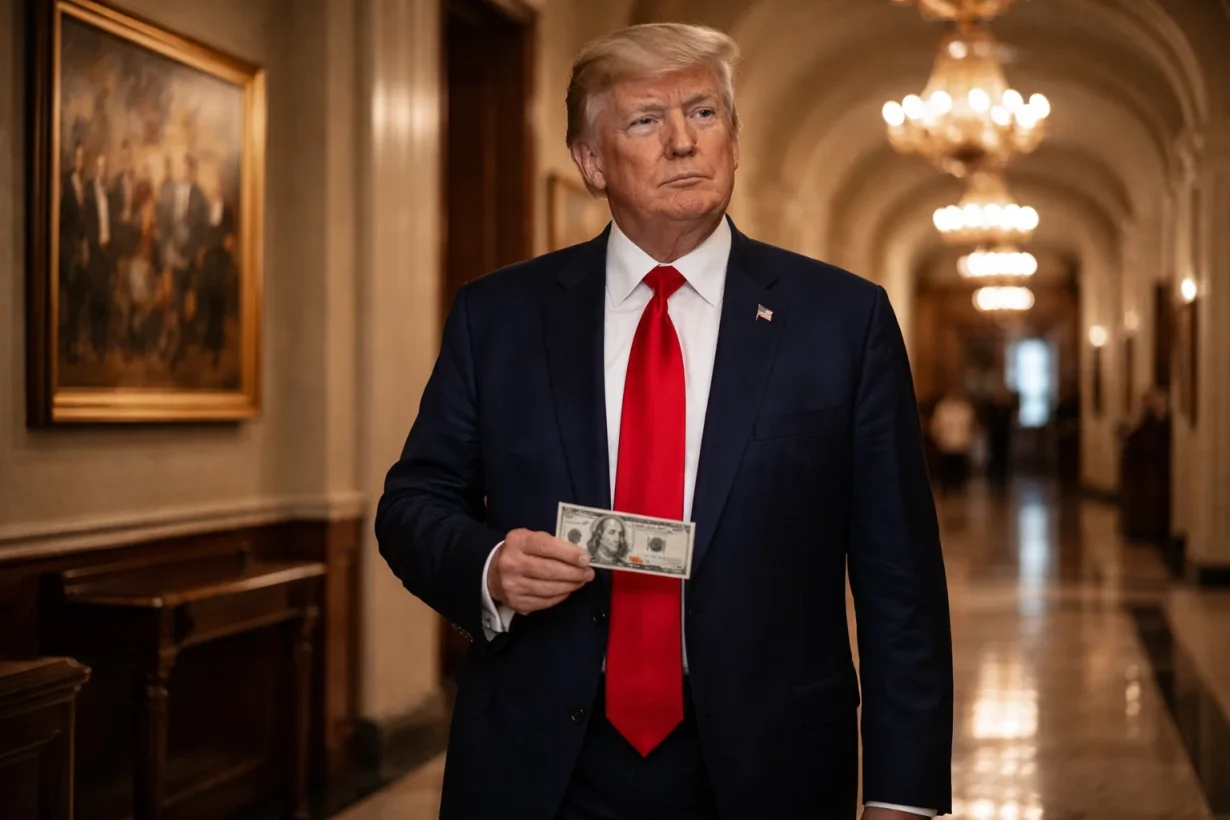

The Trump signature on money refers to a major change in U.S. currency design where President Donald Trump’s signature will appear on paper dollar bills for the first time in history.
Traditionally, U.S. currency features the signatures of the Treasury Secretary and Treasurer, making this shift particularly notable from both a legal and historical perspective.
This update is tied to the 250th anniversary of American independence and marks a symbolic shift in how U.S. currency is presented.
It reflects a broader effort to commemorate a major national milestone while introducing a modern change to a long-standing system.
Key highlights of this change include:
- Trump will be the first sitting president to have his signature on U.S. paper currency
- The Treasurer’s signature will be removed, ending a 165-year tradition
- The $100 bill will be the first denomination to feature the new signature
- The update is largely symbolic and does not affect the value of money
This move has sparked widespread interest, raising questions about legality, tradition, and the future of American currency.
What Does “Trump Signature on Money” Actually Mean?
The phrase “Trump signature on money” refers to the inclusion of President Donald Trump’s official signature on U.S. paper currency.
Traditionally, U.S. dollar bills include the signatures of the Treasury Secretary and the Treasurer of the United States. However, this long-standing format is now being changed.
Under the new policy, Trump’s signature will replace that of the Treasurer, while the Treasury Secretary’s signature will remain.
This means that future bills will carry the authority of both the executive branch and the Treasury Department in a new way.
Importantly, this is not a redesign of the entire currency. The portraits, layout, and security features of the bills will remain unchanged. Only the signature section will be updated.
Why Is Trump’s Signature Being Added to U.S. Currency?
The primary reason behind the addition of the Trump signature on money is to mark the 250th anniversary of the United States, also known as the Semiquincentennial.
This milestone represents a historic moment, making it a suitable occasion for symbolic updates to national elements like currency.
Key reasons include:
- Commemorating the 250th anniversary of the United States
- Creating a symbolic link between past achievements and present leadership
Treasury officials have described the move as a tribute to both the nation’s history and its current direction.
By placing the president’s signature on currency, the change aims to reflect continuity between the country’s founding and modern governance.
According to Treasury Secretary Scott Bessent:
“There is no more powerful way to recognize the historic achievements of our great country and President Donald J. Trump than U.S. dollar bills bearing his name.”
Unlike typical updates focused on security or anti-counterfeiting, this change is primarily symbolic and commemorative in nature.
Why Is This Change Considered Historic in U.S. Currency?
The introduction of the Trump signature on money is historically significant for several reasons. Most notably, it marks the first time a sitting U.S. president’s signature will appear on paper currency.
Since 1861, U.S. currency has consistently included the signatures of Treasury officials, not presidents. This means the change effectively ends a 165-year tradition.
Another official statement reinforces the significance:
“Printing his signature on the American currency is not only appropriate, but also well deserved,” said Treasury Secretary Scott Bessent.
This shift represents more than just a visual update.
It reflects a broader change in how authority and leadership are represented on national financial instruments, blending institutional tradition with contemporary political symbolism.
Which U.S. Bills Will Feature Trump’s Signature First?
The rollout of the Trump signature on money will begin with the $100 bill, one of the most widely used denominations globally.
Production of these new bills is expected to begin in June, with additional denominations introduced in phases afterward.
This gradual rollout ensures that the transition is smooth and does not disrupt the financial system.
Although the printing begins in June, it may take several weeks, or even months, for the new bills to reach everyday circulation through banks and ATMs.
What Exactly Is Changing on U.S. Dollar Bills?
To understand this update clearly, it’s important to look at what is actually changing on U.S. currency, and what is staying the same
Signature Replacement Details
The most notable change is the removal of the Treasurer’s signature, which has appeared on U.S. currency since the 19th century.
In its place, President Trump’s signature will be introduced, appearing alongside the signature of the Treasury Secretary.
This adjustment changes the traditional pairing of financial authority signatures and introduces a direct presidential element into the design of paper money
Design Elements That Remain Unchanged
Despite the attention this change is receiving, most aspects of U.S. currency will remain exactly the same. The portraits of historical figures, the layout of the bills, and all security features will continue unchanged.
| Feature | Current Bills | New Bills |
| Presidential Signature | Not present | Trump included |
| Treasurer Signature | Present | Removed |
| Treasury Secretary Signature | Present | Present |
| Design Layout | Standard | Unchanged |
| Security Features | Advanced | Unchanged |
This confirms that the update is primarily symbolic rather than structural, ensuring continuity in both appearance and functionality.
Is It Legal for a President’s Signature to Appear on U.S. Currency?
Yes, the addition of the Trump signature on money is legal. U.S. law grants the Treasury Department broad authority over the design and issuance of currency.
While certain elements must remain unchanged, such as national mottos and anti-counterfeiting features, the Treasury has discretion to adjust signatures and layout elements.
A key point to understand is that signatures and portraits are governed differently under the law.
While portraits must follow strict rules (such as only featuring deceased individuals), signatures do not face the same limitations.
How Is Paper Currency Different from Coins When It Comes to Presidents?
Paper currency and coins follow different legal frameworks in the United States, which explains why changes like the Trump signature on money are possible for bills but more restricted for coins.
Key differences include:
- Paper currency allows more flexibility in design, including signatures and layout changes
- Coins are governed by stricter rules, especially regarding who can be depicted
Paper notes can be updated by the Treasury Department as long as they meet legal guidelines.
In contrast, coins follow tighter regulations to preserve historical consistency and avoid political influence, making design changes far less flexible
Will Trump’s Signature Appear on Coins as Well?
While Trump’s signature is being added to paper money, placing his image or name on coins is more complicated. U.S. law generally prohibits living individuals from appearing on circulating coins.
However, there have been discussions about commemorative coins, which may include exceptions under specific conditions.
Key Differences Between Paper Money and Coins in the U.S.
| Aspect | Paper Currency | Coins |
| Signature Allowed | Yes | Not applicable |
| Portrait Rules | Deceased individuals only | Strictly enforced |
| Design Flexibility | Moderate | Limited |
| Legal Restrictions | Fewer | More rigid |
This comparison highlights why the Trump signature on money is feasible for bills but more complex for coins.
When Will Americans Start Seeing These New Dollar Bills?
The rollout of the new U.S. dollar bills will happen in phases, meaning they won’t appear all at once but will gradually enter circulation over time.Top of Form
Bottom of Form.
Production Timeline
The Bureau of Engraving and Printing is expected to begin producing $100 bills featuring Trump’s signature in June, marking the first phase of the rollout. Additional denominations will follow in stages to ensure a smooth transition.
Circulation Process
Once printed, the new bills must move through the Federal Reserve system before reaching financial institutions and the general public.
This process ensures proper distribution and integration into the existing currency supply.
- Printing begins in June
- Distribution occurs through Federal Reserve channels
- Public circulation happens gradually over time
As a result, Americans may begin seeing the new bills within weeks, but widespread circulation could take longer.
Does This Change Affect the Value or Validity of U.S. Currency?
The introduction of the Trump signature on money does not impact the value, usability, or legal status of U.S. currency. All existing bills will continue to function as legal tender without any limitations.
| Factor | Impact |
| Currency Value | No change |
| Legal Tender Status | Unaffected |
| Usability | Fully valid |
| Exchange Value | Stable |
This ensures that consumers, businesses, and financial institutions can continue using both old and new bills interchangeably without any disruption
Why Are Supporters and Critics Debating This Decision?

The decision to add Trump’s signature has generated both support and criticism, largely due to its symbolic nature.
Supporters argue that the move celebrates American leadership and aligns with the significance of the 250th anniversary. One official noted:
“Under President Trump’s leadership, we are on a path toward unprecedented economic growth, lasting dollar dominance and fiscal strength.”
Critics, however, see the move as part of a broader effort to place Trump’s name across government institutions and programs.
Despite differing opinions, the policy remains primarily symbolic and does not alter the function of currency.
What Does Trump’s Signature on Money Symbolize for the Future of U.S. Currency?
The Trump signature on money signals a shift toward more personalized and contemporary symbolism in U.S. currency design.
Historically, American currency has emphasized institutions and past leaders rather than current political figures.
This change introduces a modern element, reflecting both a specific administration and a major national milestone. It may also influence how future commemorations are approached, especially during landmark anniversaries.
At a broader level, the update reinforces the idea that currency is not just a financial tool but also a representation of national identity, history, and evolving political narratives
Conclusion
The addition of the Trump signature on money is more than a simple design change; it represents a historically significant shift linked to the United States’ 250th anniversary.
By placing a sitting president’s name on currency, it breaks with long-standing tradition while remaining within legal boundaries.
Although it does not affect the value or usability of money, the move has sparked discussions around politics, symbolism, and national identity.
As new bills enter circulation, this change will stand out as a notable moment in the evolution of U.S. currency.
FAQs About Trump’s Signature on Money
Will older U.S. dollar bills still be used after the new ones are released?
Yes, all existing dollar bills will remain valid legal tender and will continue to circulate alongside the new ones.
Who traditionally signs U.S. paper currency?
U.S. currency has historically been signed by the Treasury Secretary and the Treasurer of the United States.
Why is the $100 bill being introduced first with the new signature?
The $100 bill is often prioritized due to its high usage and production scheduling within the Bureau of Engraving and Printing.
Can U.S. currency design be changed frequently?
No, currency design changes are relatively rare and usually occur for security or major commemorative reasons.
Has any other country added a current leader’s signature to money?
Some countries have included current political figures on currency, but practices vary widely depending on legal and cultural norms.
Will the new bills be rare or collectible?
Early prints of the new bills could become collectible over time, especially due to their historical significance.
How long does it take for new currency to circulate nationwide?
It can take several weeks to months for newly printed bills to fully circulate across the country.