
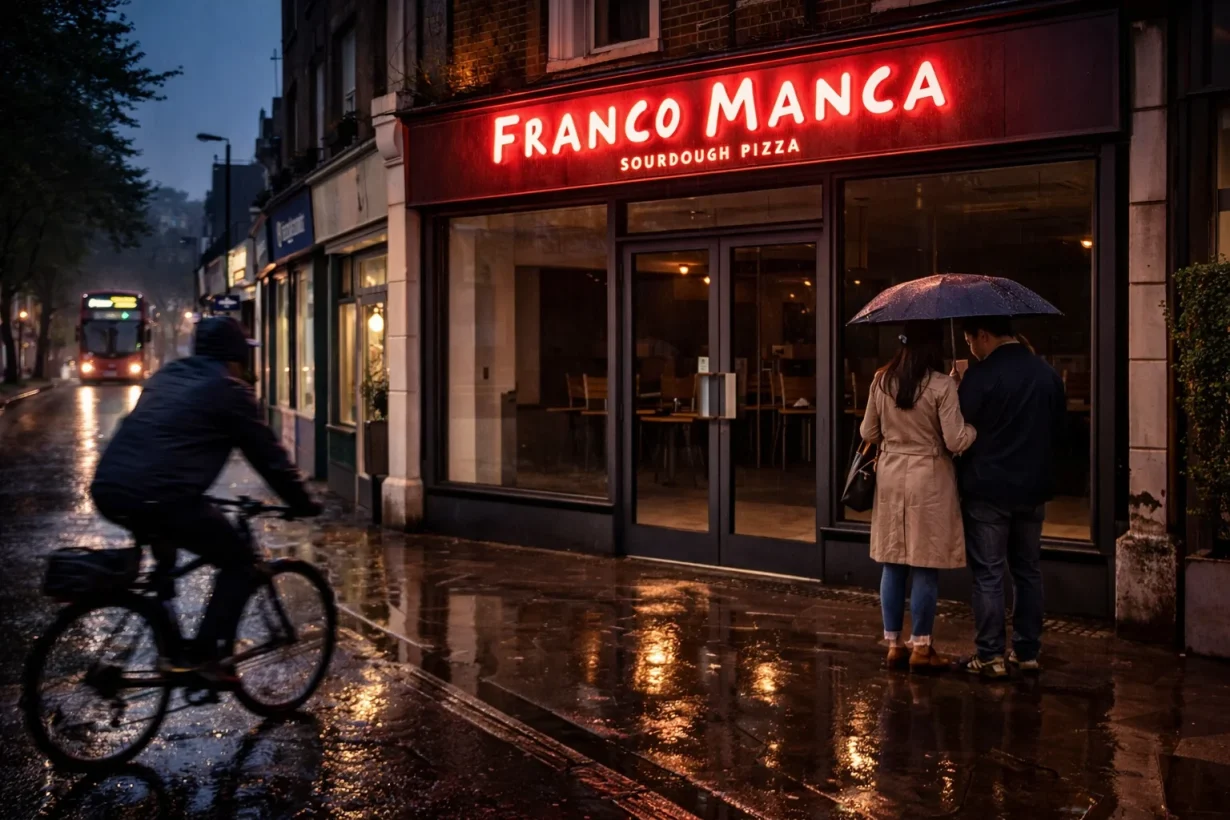

Franco Manca restaurant closures have become one of the biggest stories in the UK hospitality sector, with the sourdough pizza chain reportedly preparing to shut 16 restaurants across the country.
Around 225 jobs are believed to be at risk as parent company The Fulham Shore launches a Company Voluntary Arrangement (CVA) to restructure the business.
The reported closures affect both London and regional branches, including Brixton, Cheltenham and Plymouth. While Franco Manca has confirmed that a minority of its restaurants will close, not every branch has yet been formally confirmed.
Key points:
- Franco Manca is reportedly closing 16 UK sites
- Around 225 employees could lose their jobs
- Eight of the affected restaurants are believed to be in London
- The closures are linked to rising taxes, wages and business costs
- Franco Manca is entering a CVA restructuring process
Is Franco Manca Closing Restaurants in the UK?
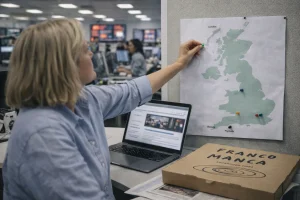
Yes, Franco Manca is closing restaurants in the UK as part of a major restructuring programme. The pizza chain’s parent company, The Fulham Shore, has confirmed that it plans to shut a minority of its sites after concluding that some branches are no longer financially sustainable.
At present, Franco Manca operates around 70 restaurants across the UK. However, reports suggest that 16 locations are now at risk of closure, with many of them based in London.
Marcel Khan, chief executive of The Fulham Shore, explained the decision in a statement:
“Even restaurant businesses that are doing all the right things from a customer and operational perspective are not immune to widely publicised pressures impacting the hospitality industry.”
The move comes after the company hired advisers Alvarez & Marsal earlier this year to examine a possible sale, restructure or cost-cutting programme.
Instead of shutting the entire business, Franco Manca is using a CVA to reduce costs and protect its remaining restaurants.
Which Franco Manca Restaurants Are Reportedly Closing?
The following 16 branches have been widely reported as being at risk. Although Franco Manca has not yet formally confirmed every site, these are the locations repeatedly named across several reports.
| Restaurant Location | Area | Status |
| Brixton | London | Reportedly at risk |
| Battersea | London | Reportedly at risk |
| Broadway Market | London | Reportedly at risk |
| Chiswick | London | Reportedly at risk |
| Kilburn | London | Reportedly at risk |
| New Oxford Street | London | Reportedly at risk |
| Stoke Newington | London | Reportedly at risk |
| Tottenham Court Road | London | Reportedly at risk |
| Bishop’s Stortford | Hertfordshire | Reportedly at risk |
| Bromley | Greater London | Reportedly at risk |
| Cheltenham | Gloucestershire | Reportedly at risk |
| Didsbury | Greater Manchester | Reportedly at risk |
| Glasgow | Scotland | Reportedly at risk |
| Hove | East Sussex | Reportedly at risk |
| Lincoln | Lincolnshire | Reportedly at risk |
| Plymouth | Devon | Reportedly at risk |
London Restaurants Facing Closure
Half of the reported Franco Manca restaurant closures are in London. Significantly, the original Brixton branch is believed to be among the locations affected.
That is particularly notable because Brixton was the first Franco Manca restaurant, opening in 2008 on a site that had operated as a pizzeria since 1986.
The London sites reportedly under threat are:
- Brixton
- Battersea
- Broadway Market
- Chiswick
- Kilburn
- New Oxford Street
- Stoke Newington
- Tottenham Court Road
Regional Franco Manca Branches at Risk
Outside London, the closures stretch across England and Scotland. Branches in Cheltenham, Didsbury, Glasgow and Plymouth are among those reportedly affected.
| Region | Reported Locations |
| South East | Bishop’s Stortford, Bromley, Hove |
| South West | Cheltenham, Plymouth |
| North West | Didsbury |
| East Midlands | Lincoln |
| Scotland | Glasgow |
A customer from Cheltenham shared their disappointment online after hearing the news:
“I only discovered Franco Manca last year and it quickly became our favourite place for pizza. If the Cheltenham branch closes, it will leave a real gap in town.”
That reaction reflects the wider concern among regular customers, particularly in towns where Franco Manca has become a popular part of the local high street.
Why Is Franco Manca Closing 16 UK Restaurants?
Franco Manca says the closures are being driven by rising operating costs and pressure on the hospitality sector. The company argues that restaurants across the UK are facing an increasingly difficult trading environment.
The main issues identified by The Fulham Shore include:
- Significant increases in employer national insurance contributions
- Higher national living wage costs
- No additional business rates relief for restaurants
- VAT rates in the UK that are higher than in many European countries
| Cost Pressure | Impact on Franco Manca |
| National Insurance increases | Higher staffing costs across all sites |
| National Living Wage rises | More expensive wage bill for hourly employees |
| Business rates | Greater fixed costs for town centre locations |
| High VAT | Reduced profitability on food and drink sales |
Marcel Khan stated:
“This includes significant increases in national insurance and the national living wage in recent history, as well as a lack of business rates relief for the restaurant sector and disproportionately high VAT in the UK compared with Europe.”
The timing is particularly difficult because many UK restaurant chains are already struggling with reduced customer spending and rising energy costs.
Franco Manca is not alone. Recent months have also seen closures and restructuring plans at Leon, Veeno and several independent restaurant groups.
A government spokesperson defended its approach, saying:
“We have the right economic plan – we’re reforming business rates to back hospitality, with a £4.3bn support package to limit bills rises.”
Even so, many restaurant operators believe that the support available to pubs has not been extended to restaurants and cafés.
Has Franco Manca Officially Confirmed the Closure List?

No, Franco Manca has not yet formally confirmed every individual branch that will close. What the company has confirmed is that it intends to shut a “minority proportion” of its restaurants as part of a CVA.
That distinction matters. The widely reported list of 16 branches comes from trade publications and multiple news reports, rather than an official branch-by-branch announcement from Franco Manca itself.
To make the situation clearer:
- Confirmed by Franco Manca: a CVA is taking place and some restaurants will close
- Widely reported: 16 specific locations are believed to be affected
- Not yet confirmed: the final timetable and whether every reported site will definitely shut
This means some restaurants could still remain open if negotiations with landlords are successful during the restructuring process.
What Does the Franco Manca CVA Mean for Staff, Customers and Landlords?
A Company Voluntary Arrangement, or CVA, is a legal process that allows a company to reorganise its debts and reduce costs while continuing to trade.
In practice, this often means:
- closing unprofitable branches
- renegotiating rents with landlords
- protecting stronger sites from further losses
- avoiding administration or complete collapse
For staff, the biggest concern is the risk to jobs. Around 225 positions could disappear if all 16 restaurants close.
One employee, who reportedly works at a London branch affected by the plans, described the uncertainty by saying:
“We were told the branch may not survive, but nobody knows exactly what will happen yet. It’s upsetting because many of us have worked here for years.”
For customers, a CVA usually means that existing restaurants continue trading while decisions are made. Gift cards, bookings and loyalty schemes are often still honoured at branches that remain open.
For landlords, the process can lead to lower rents or the closure of poorly performing sites. That is why some branches may not close immediately, even if they are currently on the reported list.
Who Owns Franco Manca and How Did the Business Reach This Point?
Franco Manca began as a single pizzeria in Brixton in 2008. Founders Giuseppe Mascoli and Bridget Hugo transformed the original restaurant into a chain known for sourdough pizza and affordable prices.
In 2015, Franco Manca was bought by The Fulham Shore, which also owns Mediterranean restaurant brand The Real Greek. The company expanded rapidly across the UK and now operates around 70 Franco Manca sites.
In 2023, Japanese restaurant group Toridoll acquired The Fulham Shore for approximately £93.4 million.
| Year | Key Event |
| 2008 | Franco Manca opens first restaurant in Brixton |
| 2015 | The Fulham Shore acquires the chain |
| 2023 | Toridoll buys The Fulham Shore for £93.4m |
| 2026 | Franco Manca begins CVA restructuring |
However, recent trading has been difficult. Documents filed by Toridoll showed that turnover at Fulham Shore fell by 5.4 per cent between April and December 2025. Revenue and earnings were both described as poor, increasing pressure on the company to take action.
What Do Franco Manca Restaurant Closures Reveal About the UK Hospitality Sector?
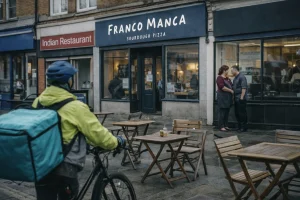
The Franco Manca restaurant closures highlight wider challenges across the UK hospitality sector in 2026. This is not just about one brand, but a sign of increasing pressure on restaurants nationwide.
The industry is facing several key issues:
- Rising wages and higher taxes
- Increasing rent and operating costs
- Lower consumer confidence and spending
The founder of Leon also criticised government policy, saying the sector is being “killed” by excessive taxation. Similar concerns are now echoed by Franco Manca and other chains.
If a well-known brand is struggling to maintain sites, smaller independent restaurants may face even greater challenges ahead.
Could More Franco Manca Restaurants Close in Future?
At present, Franco Manca has only confirmed that a minority of its sites will close. The reported figure remains 16 restaurants, but there is no guarantee that this will be the final number.
Everything now depends on the outcome of the CVA process. If the company can negotiate lower rents and stabilise its finances, further closures may be avoided. If trading conditions continue to worsen, more branches could come under review later in 2026.
For now, the best approach is to watch for official updates from Franco Manca and The Fulham Shore.
Conclusion
Franco Manca restaurant closures are set to affect 16 locations across the UK, with approximately 225 jobs potentially at risk. Although the company has confirmed that some branches will close, the full list of sites has not yet been officially verified.
The closures are being driven by rising labour costs, business rates and VAT pressures, alongside a difficult environment for the UK hospitality sector.
The CVA restructuring may help Franco Manca protect its strongest restaurants, but it also signals how difficult conditions have become for restaurant chains in 2026.
FAQs About Franco Manca Restaurant Closures
Is Franco Manca going bust?
No, Franco Manca is not going bust. The company is using a CVA to restructure and reduce costs while continuing to trade from its remaining restaurants.
How many Franco Manca restaurants are closing?
Reports suggest that 16 Franco Manca restaurants are at risk of closure across the UK.
Which London Franco Manca sites are reportedly affected?
The London sites believed to be at risk are Brixton, Battersea, Broadway Market, Chiswick, Kilburn, New Oxford Street, Stoke Newington and Tottenham Court Road.
Are all 16 Franco Manca closures officially confirmed?
No. Franco Manca has confirmed that some branches will close, but the full list of 16 sites has not yet been formally confirmed by the company.
What does CVA mean in simple terms?
A CVA is a legal agreement that allows a company to cut costs, close weaker locations and continue trading instead of entering administration.
How many jobs could be lost?
Around 225 jobs are believed to be at risk if all 16 reported closures go ahead.
Why are UK restaurant chains struggling in 2026?
Many restaurant chains are struggling because of higher wages, rising taxes, increased business rates and lower consumer spending.