



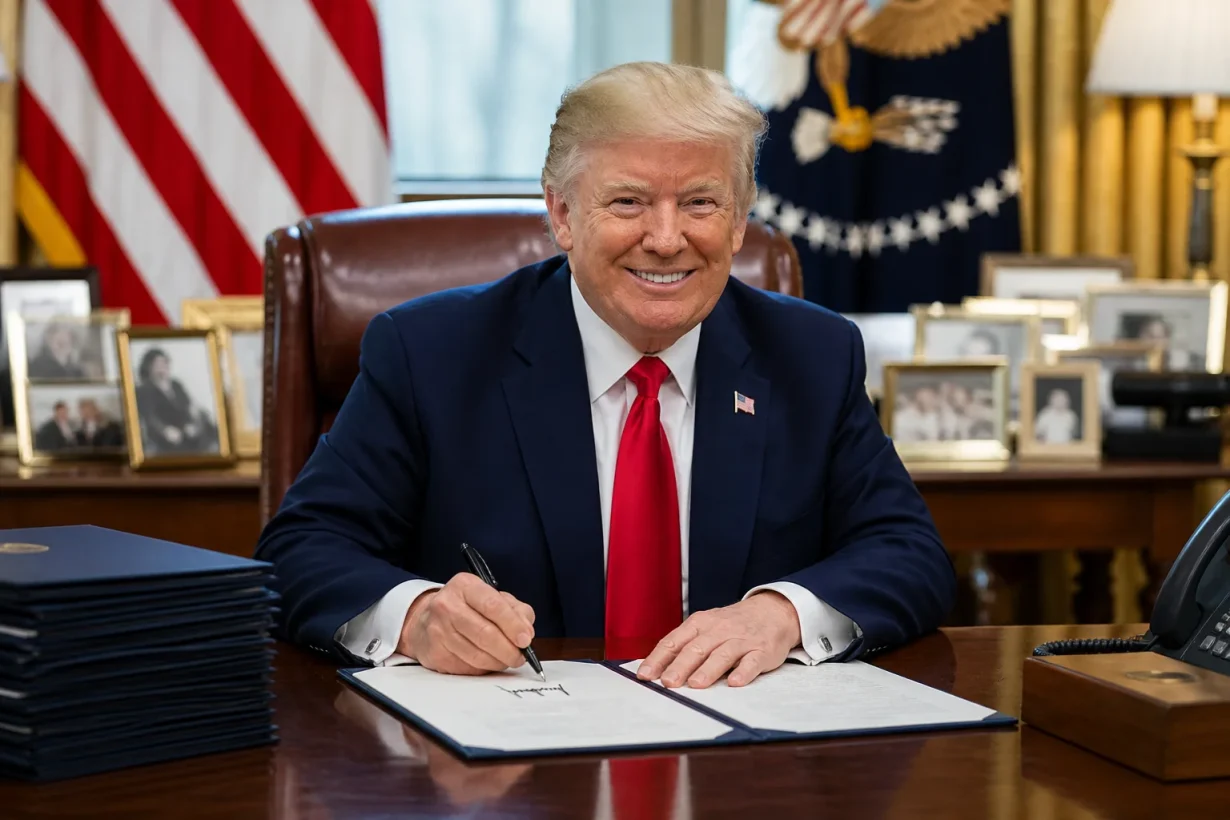

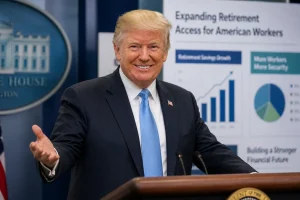
President Trump signs an executive order expanding workers access to retirement plans to help millions of Americans without workplace 401(k)s or pensions find low-cost IRA options through a federal platform called TrumpIRA.gov.
The order does not create a new retirement account, but it aims to make private-sector IRA access easier, especially for small business employees, part-time workers, independent contractors, and lower-income earners.
Key highlights:
- TrumpIRA.gov would help you compare low-cost IRA options.
- Eligible workers may qualify for the federal Saver’s Match.
- IRA providers must meet fee and access requirements.
- Congress may need to act for automatic enrollment or broader eligibility.
What Is Trump’s Executive Order Expanding Workers Access to Retirement Plans?

Donald Trump’s executive order aims to make retirement savings easier for workers without employer-sponsored plans.
Instead of creating a new government account, it directs the Treasury to launch TrumpIRA.gov, a platform to compare and open low-cost IRA options from private providers.
The policy targets a key gap in the U.S. system, helping those without access to 401(k)s or pensions, such as small business employees, part-time workers, freelancers, and self-employed individuals.
President Trump described the goal by saying, “My administration intends to give these often-left-out American workers access to the same type of retirement-savings opportunities offered to every federal worker.”
That statement refers to the Thrift Savings Plan, the low-cost retirement system used by federal employees.
Why Do Millions of American Workers Still Lack Retirement Plan Access?
The retirement coverage gap exists because the U.S. system largely depends on employers choosing to offer retirement benefits.
While larger companies often provide 401(k) plans, smaller businesses may avoid them due to costs, administrative burden, compliance requirements, and limited resources.
Key factors contributing to this gap include:
- Smaller businesses are struggling with setup and ongoing management costs
- Lack of access to payroll deduction systems for consistent saving
- Limited employer matching incentives for low- and moderate-income workers
- A growing workforce of freelancers, gig workers, and self-employed individuals
Research suggests that around 50–56 million private-sector workers lack access to employer-sponsored plans.
This issue is especially common in small businesses, where many employees have no structured way to build long-term retirement savings.
Who Will Benefit the Most from This Retirement Plan Expansion?
The workers most likely to benefit are those who currently have income but no easy way to save through work.
If you do not have access to a 401(k), pension, or workplace IRA, TrumpIRA.gov could become a starting point for comparing retirement options.
Main groups likely to benefit:
- Workers without employer-sponsored retirement plans
- Small business employees
- Part-time workers
- Independent contractors and freelancers
- Self-employed workers
- Lower- and moderate-income savers are eligible for the Saver’s Match
This could be especially useful if you have delayed retirement savings because the process felt confusing, expensive, or disconnected from your work.
A retirement policy analyst from a U.S. think tank noted:
“Access is often the missing link—not willingness. When workers are given a simple and affordable entry point, participation tends to increase significantly.”
This highlights how structural access can influence long-term financial behaviour.
How Will TrumpIRA.gov Change the Way You Access Retirement Accounts?
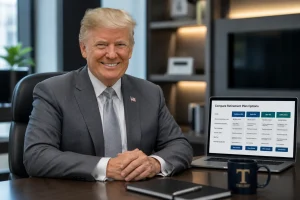
TrumpIRA.gov is expected to operate as a federal online marketplace for private IRA options. It would not directly manage your money. Instead, it would help you find low-cost IRA providers that meet government criteria.
The platform is expected to let you filter plans by cost, investment options, minimum contribution rules, and account features.
Treasury would vet the listed options, while private financial institutions would provide the actual accounts.
Key Platform Functions
TrumpIRA.gov would work as a comparison tool for retirement accounts. The idea is to reduce confusion and help you choose an IRA that fits your income, savings goals, and investment comfort level.
Expected TrumpIRA.gov Features
| Feature | Expected Benefit |
| Cost comparison | Helps you identify lower-fee IRA options |
| Investment filters | Lets you review available fund choices |
| No minimum balance requirement | Makes saving easier for beginners |
| Treasury-vetted providers | Adds a layer of public oversight |
| Saver’s Match awareness | Helps eligible workers claim federal support |
The platform could make retirement saving more accessible, but its real impact will depend on how simple it is to use and how many workers take action.
First-Time Saver Experience
For many workers, the biggest challenge isn’t motivation- it’s uncertainty. Choosing between options like a traditional IRA, Roth IRA, or different investment funds can feel confusing without clear guidance.
One freelance graphic designer shared her experience, reflecting a common concern among first-time savers.
She said:
“I’ve always known I should save, but I never knew where to start or which account made sense. If everything is in one place, I’d actually feel confident enough to begin.”
This highlights how simplifying access can turn uncertainty into action and encourage more people to start saving.
What Features Will TrumpIRA.gov Offer to Help You Compare Retirement Plans?
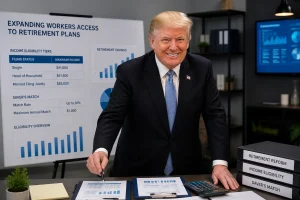
The proposed TrumpIRA.gov platform, introduced under an order by Donald Trump, is expected to make comparing retirement options simpler and more transparent.
Instead of offering a government-run account, it will connect users with private providers that meet clear standards.
Key features are likely to include:
- Access to low-cost IRA options with strict fee limits
- Annual expense ratios capped at around 0.15%
- No minimum contribution or balance requirements
- Easy comparison of providers in one place
- Diversified investment options, including target-date funds
These features aim to reduce barriers and improve long-term returns. However, choosing the right plan still depends on your financial goals, contribution capacity, and risk tolerance, making informed decision-making essential.
What Is the Saver’s Match and Why Does It Matter for Your Retirement Savings?
The Saver’s Match is a federal incentive designed to help low- and moderate-income workers save for retirement.
Introduced under legislation signed during the Joe Biden administration, it offers a government match on contributions.
Eligible workers can receive up to 50% of their contributions, capped at $1,000 for individuals and $2,000 for married couples. To get the full individual match, you typically need to contribute $2,000.
Saver’s Match Example:
| Worker Contribution | Possible Federal Match | Total Added to Retirement Savings |
| $500 | Up to $250 | $750 |
| $1,000 | Up to $500 | $1,500 |
| $2,000 | Up to $1,000 | $3,000 |
| $4,000 for married couples | Up to $2,000 | $6,000 |
The match is expected to be delivered as a refundable tax credit that goes directly into a retirement account, rather than as ordinary cash.
How Do Income Limits Affect Eligibility for the Saver’s Match?

Income limits are a key factor in determining eligibility for the Saver’s Match. Individuals earning under $35,500 and married couples earning under $71,000 may qualify for a full or partial match, depending on their income level and contributions.
This approach targets lower- and moderate-income workers who may otherwise struggle to save consistently.
The match will be delivered as a refundable tax credit deposited directly into a retirement account, meaning you can benefit even if you owe little or no federal tax.
However, eligibility is influenced by adjusted gross income, filing status, contribution amount, and account type.
If your income falls within the qualifying range, contributing to a retirement account could offer greater long-term value.
How Does This Executive Order Compare to Traditional 401(k) and IRA Plans?
The executive order does not replace 401(k)s or existing IRAs. Instead, it tries to make IRA access easier for people who do not have workplace plans.
A 401(k) is typically offered by an employer and may include payroll deductions and employer matching contributions. An IRA is opened by an individual through a financial institution.
TrumpIRA.gov would help you find qualifying IRA options, but the account would still be privately managed.
401(k) vs IRA vs TrumpIRA.gov
The biggest difference is access. A 401(k) depends on your employer. TrumpIRA.gov is intended for workers who do not have that option.
Comparison of Retirement Options:
| Feature | 401(k) | Traditional/Roth IRA | TrumpIRA.gov IRA Options |
| Offered by the employer | Yes | No | No |
| Opened by an individual | Usually no | Yes | Yes |
| Employer match possible | Yes | No | No direct employer match |
| Federal Saver’s Match possible | Yes, if eligible | Yes, if eligible | Yes, if eligible |
| Low-cost requirement | Varies | Varies | Expected requirement |
| Portability | Limited by employer plan rules | High | High |
This comparison shows that TrumpIRA.gov is less about replacing existing accounts and more about making individual retirement savings easier to start.
What Role Will Private Financial Institutions Play in This Plan?
Private financial institutions will provide the IRA options listed on TrumpIRA.gov, while the federal government sets rules and oversees standards.
This creates a public-private model where Treasury vets providers, but does not directly manage investments.
Participating firms must offer low-cost plans with no minimum balance or contribution requirements, making retirement accounts more accessible to lower-income workers. These rules aim to reduce barriers and encourage participation.
From a market perspective, the plan also opens significant opportunities for financial companies, as millions of workers without retirement accounts represent a large and untapped customer base for long-term investment products.
What Are the Potential Benefits of Expanding Retirement Plan Access?

Expanding retirement plan access can help more workers start saving earlier and more consistently.
Platforms like TrumpIRA.gov aim to simplify the process by offering low-cost options in one place, especially for those without employer-sponsored plans.
When combined with incentives like the Saver’s Match, participation is likely to increase.
Key benefits include:
- Greater access to retirement accounts for uncovered workers
- Lower-cost options for first-time savers
- Improved awareness of government incentives
- Flexible savings for gig and contract workers
- Increased financial inclusion for lower-income groups
Overall, expanding access helps close the savings gap and makes retirement planning more accessible to everyone.
Additionally, a policy advisor noted that:
“financial inclusion is not just about access to accounts, but about creating systems that people actually use.”
This reinforces that the success of such initiatives depends not only on availability but also on engagement.
What Challenges or Criticisms Could This Retirement Plan Face?
One major challenge is voluntary participation. Workers must actively visit TrumpIRA.gov, compare plans, open an account, and contribute, which may limit uptake.
Without automatic enrolment, participation could remain lower than expected, even though analysts suggest auto-enrolment would significantly boost savings rates.
Another concern is the lack of clarity around implementation. It remains uncertain which financial institutions will participate, how the platform will be promoted, and how user-friendly it will be for first-time savers.
There may also be political debate over expanding incentives like the Saver’s Match and whether Congress will formally support the policy. Ultimately, the plan’s success will depend on adoption, trust, funding, and long-term policy commitment.
What Should You Do Now to Prepare for These New Retirement Opportunities?
You do not need to wait for TrumpIRA.gov to understand your retirement options. If you do not have a workplace plan, you can start by learning how traditional IRAs, Roth IRAs, and Saver’s Match eligibility may apply to your situation.
Review your income, monthly savings ability, and retirement goals. You should also check whether your state already offers an auto-IRA program, because some states have retirement savings programs for private-sector workers.
Practical preparation steps:
- Check whether your employer offers any retirement options
- Review your eligibility for IRA contributions
- Track your adjusted gross income for Saver’s Match purposes
- Compare traditional IRA and Roth IRA basics
- Watch for official updates on TrumpIRA.gov
Preparing early can help you act faster once the new platform becomes available.
Conclusion
Donald Trump’s executive order aims to expand retirement access for workers lacking employer plans.
While it does not create a new account, it simplifies access to low-cost IRAs via TrumpIRA.gov.
The key benefits include convenience, lower fees, and Saver’s Match access, though success depends on awareness, clear rules, trusted providers, and future policy support.
Frequently Asked Questions
What is the purpose of TrumpIRA.gov?
TrumpIRA.gov is expected to be a federal online platform that helps workers without employer retirement plans compare and open low-cost IRA options from private financial institutions.
Does the order create a new government retirement account?
No. The order does not create a new retirement account. It directs workers toward private-sector IRA options through a federal comparison platform.
Can gig workers use the retirement platform?
Yes, gig workers, independent contractors, and self-employed workers are among the groups expected to benefit if they do not have employer-sponsored retirement access.
How much can eligible workers receive through the Saver’s Match?
Eligible individuals may receive up to $1,000, while married couples may receive up to $2,000, depending on income and contribution levels.
Will TrumpIRA.gov replace existing 401(k) plans?
No. It is aimed mainly at workers who do not already have access to employer-sponsored plans like 401(k)s or pensions.
Are the listed IRA options expected to have low fees?
Yes. The executive order says participating providers must maintain low costs, with total annual expenses limited to 0.15% of account balances.
Will automatic enrollment be included?
Not under the executive order alone. Automatic enrollment would likely require congressional action.