



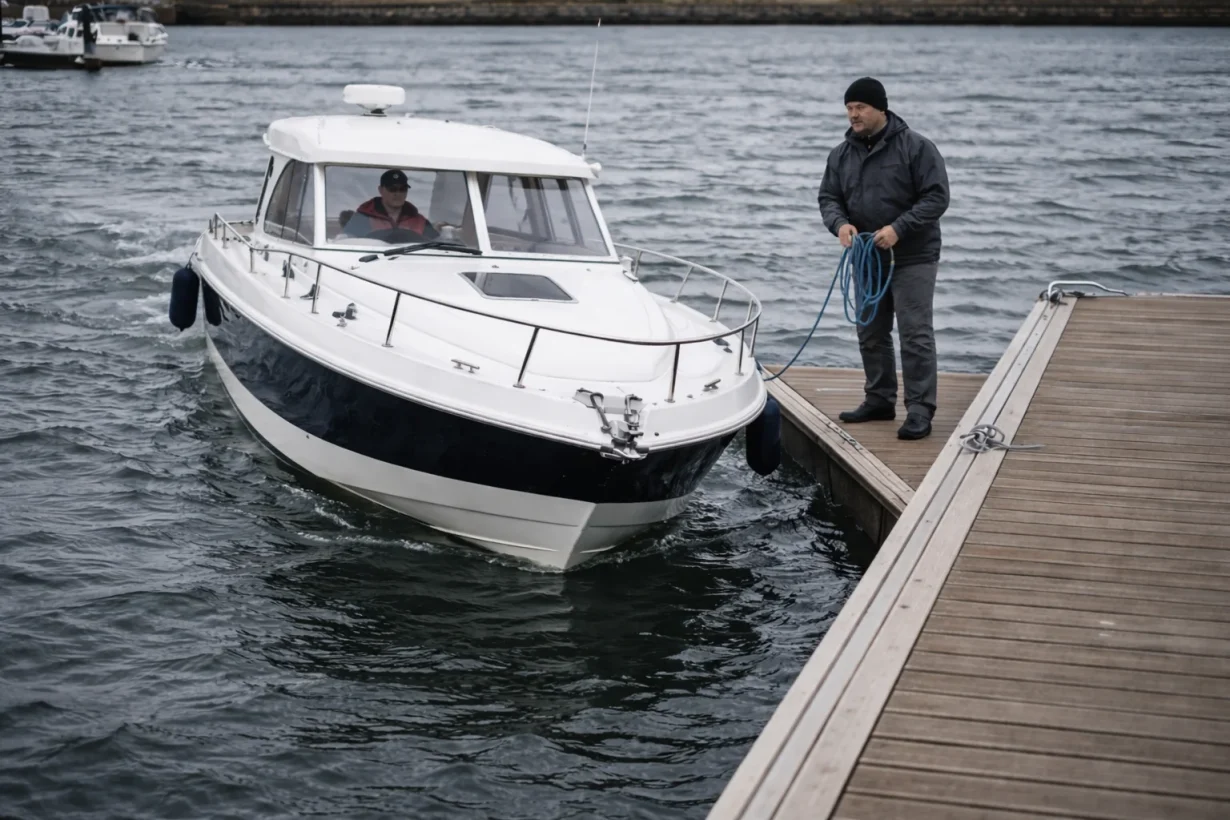

When wind or current is pushing a boat away from a dock, docking becomes less about finesse and more about maintaining control at the right moment.
Many docking problems occur not because conditions are extreme, but because the approach is too passive. Allowing the boat to drift slowly toward the dock often results in the vessel being pushed sideways and out of reach before any lines can be secured.
In these conditions, the correct approach is deliberate and planned. Steer the boat toward the dock at a controlled, steeper angle, using enough engine power to counteract the forces pushing it away.
The goal is to place the boat where control can be established quickly, rather than hoping the boat will remain aligned on its own.
Quick Summary: How to Dock When Pushed Away
The Golden Rule: Approach the dock at a 30–45 degree angle, secure the bow line first, and use the engine to pivot the stern into place. Never drift in neutral; maintain steerage way until the line is cleated.
The Physics of the “Push-Away”
When your boat is being pushed away from a dock, you are fighting two distinct physical forces.
Understanding how they differ is the key to mastering your approach:
- Wind (Freeboard Pressure): Wind acts on the “sail area” of your boat, everything above the waterline. High-profile boats like flybridge cruisers or pontoon boats are more susceptible to wind, which tends to blow the bow off course faster than the stern.
- Current (Hull Drag): Current is more powerful because it moves the water your boat is sitting in. It acts on the entire wetted surface of the hull. Unlike wind, which you can see on the surface, current can be “silent,” moving you sideways even when the air is calm.
The Danger Zone: When these forces are moving offshore, your boat loses “steerage way” (the ability to turn) the moment you slow down. Without forward power, you aren’t steering; you’re just drifting.
How Should You Approach a Dock When Wind or Current Is Pushing You Away?
When wind or current is working against the boat, the approach should be assertive but controlled. Instead of a shallow glide, the boat should approach at an angle of approximately 30 to 45 degrees toward the dock.
This angle allows the forward motion of the boat to counter the sideways push created by wind or current.
Keep the engine engaged in forward gear at low speed, using steady, intentional movement rather than drifting.
The focus during this approach is not on perfection, but on positioning the boat close enough to secure a line safely. Once that first line is attached, the docking process becomes significantly easier to manage.
Step-by-Step: The Perfect Off-Wind Approach
When the elements are trying to push you into open water, follow this three-step sequence to ensure a controlled landing.
Step 1: The 45-Degree Entry
Position your boat to approach the dock at a steep 30 to 45-degree angle. While a shallow approach works in calm air, it is a mistake here.
A steeper angle allows your forward momentum to “cut” through the wind or current, keeping you on your target line rather than being pushed sideways.
Step 2: Maintain Momentum (Avoid Neutral)
The most critical error is shifting to neutral too early. Without water moving over your rudder or outboards, you lose steerage way. Keep the engine engaged at low RPMs.
If you feel the boat being pushed off-course, use a brief “pulse” of throttle to regain your heading. Remember: No power means no control.
Step 3: Secure the Bow First
Aim the bow for a point on the dock slightly “up-wind” of your final spot. As the bow comes within reach, have a crew member secure the bow line immediately.
Once that line is cleated, the bow becomes your “anchor” or pivot point, preventing the boat from drifting back out to sea and allowing you to work the stern in safely.
The “Spring Line” Secret (The Pivot)
Once your bow line is secured to the dock, the battle is halfway won. However, the wind will still be trying to push your stern (the back of the boat) out to sea.
Instead of having a passenger struggle to pull the boat in with a rope, use the boat’s own power:
- The Setup: Ensure the bow line is short and cleated tightly.
- The Wheel: Turn your steering wheel (or outboard/outdrive) hard away from the dock.
- The Power: Shift the engine into forward gear at idle speed.
- The Result: Because the bow is “pinned” to the dock by the line, the forward thrust will push the stern inward. The boat will pivot gracefully against the bow line until the entire length of the hull is flush against the dock.
By using this method, the engine does all the heavy lifting, allowing you to stay in total control even in a stiff breeze.
Why Do Wind and Current Push Boats Away From Docks So Effectively?
Wind and current apply force in different ways, but both can overpower a boat when it is moving slowly or drifting. Wind pushes against the parts of the boat above the waterline, while the current moves the water itself, influencing the entire hull.
When a boat slows too much near a dock, steering becomes less effective. At that point, wind or current can move the boat sideways faster than the operator can correct. This is why drifting approaches often fail in these conditions and why maintaining slight forward power is so important.
Understanding that these forces are constant and predictable helps the operator plan an approach that works with physics rather than against it.
Why Is a Steeper Docking Angle More Effective in These Conditions?
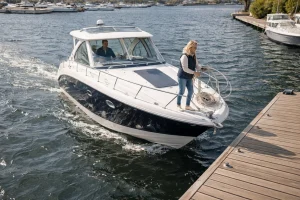
A steeper docking angle provides leverage and control. When the boat approaches at a shallow angle, wind or current can easily slide it away before lines are secured. A sharper angle ensures that forward momentum is directed toward the dock, not parallel to it.
Approaching at 30 to 45 degrees also gives the operator room to adjust. If the boat begins to drift, a small steering or throttle correction can bring it back on line. This margin for correction is much smaller with a shallow approach.
In stronger offshore wind or current, a steeper angle is often the difference between a controlled landing and a missed attempt.
Why Is Landing the Bow First the Safest Strategy?
Landing the bow first allows the operator to establish a fixed point of control. Once a bow line is secured, the boat can no longer drift freely away from the dock. This dramatically reduces uncertainty and makes the rest of the maneuver more manageable.
The bow is also typically easier to place accurately, as it responds more predictably to steering input. Once held in position, the stern can be guided in using engine power rather than physical effort from passengers.
This approach minimizes risk and reduces the temptation for unsafe actions such as jumping or pushing off the dock.
Pro Tip from the Captain’s Chair: The most common mistake beginners make is “killing the engine” too early. As you get close to the dock, your instinct is to shift to neutral to avoid a collision.
However, in a crosswind, neutral is your enemy. Without the propeller moving water over the rudder, you lose all steering authority. Keep the boat in gear until the moment your line is secured.
How Should the Engine and Steering Be Used After the Bow Line Is Secured?
After the bow line is secured, the engine becomes a positioning tool rather than a driving force. With the engine in forward gear and the steering wheel turned away from the dock, the boat naturally pivots around the secured bow.
This controlled pivot gently brings the stern closer to the dock. The movement should be slow and steady, using idle or slightly above idle power. Sudden throttle changes are unnecessary and often counterproductive.
This technique is commonly referred to as a spring-line-style maneuver, even when only a bow line is initially in use.
What If a Stern-First or Alternative Line Strategy Is Needed?
In some docking situations, securing the stern first may be more practical. In these cases, a slip line can be used. A slip line runs from the stern to the dock and back to the boat, allowing the operator to control the stern’s position while remaining onboard.
By applying gentle engine power, the stern can be drawn toward the dock while the boat remains stable. This method requires preparation and a clear understanding of line handling, but it can be effective when bow access is limited.
Regardless of the strategy, the key principle remains the same: secure one point first, then use controlled power to bring the rest of the boat alongside.
How Much Speed Is Needed to Stay in Control Without Risk?
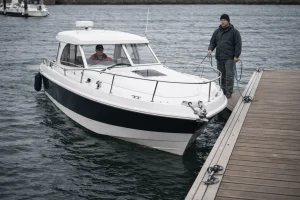
Speed during docking should be minimal but intentional. The boat must move fast enough to maintain steering response but slow enough to stop immediately if needed.
Rather than continuous acceleration, brief and measured throttle inputs provide better control. These small adjustments counteract wind or current without building unnecessary momentum.
A useful mental check is whether the operator would be comfortable with the boat gently touching the dock at the current speed. If not, the approach is too fast.
Why Is Drifting in Neutral Risky When Wind or Current Is Strong?
Drifting in neutral removes active control. Without propulsion, the rudder or drive system loses effectiveness, leaving the boat at the mercy of wind or current.
Keeping the boat in gear allows the operator to respond immediately to changes. Even at idle speed, engaged propulsion provides stability and steering authority that neutral cannot offer.
Neutral should be used briefly and intentionally, not as the primary approach method in adverse conditions.
What Preparations Should Be Completed Before the Approach Begins?
Preparation reduces pressure during the most critical moments of docking. Fenders should be placed on the docking side before the approach, protecting both the boat and the dock.
Dock lines should be organized, untangled, and ready to deploy. Brief your passengers before you reach the slip; ensure they know not to put hands or feet between the boat and the dock.
These simple steps prevent rushed decisions and improve overall safety.
⚠️ SAFETY FIRST: The “No-Fly Zone”
Never attempt to use your hands, arms, or legs to stop the boat from hitting the dock. In a crosswind, the boat’s momentum and the force of the water are stronger than any human. This is how “crush injuries” happen.
- Let the fenders do the work: That is what they are for.
- Stay inside the lifelines: Instruct passengers to keep all limbs inside the boat until it is fully stopped and tied off.
- Abort if necessary: If the approach is too fast, back out and try again rather than trying to “manhandle” the boat into place.
When Is the Right Time to Abort a Docking Attempt?
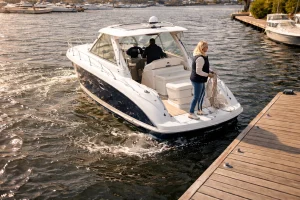
Aborting a docking attempt is not a mistake; it is often the correct decision. If the angle is wrong, speed feels uncontrolled, or the boat is drifting away faster than expected, backing out early is safer than forcing the situation.
Experienced operators routinely reset their approach when conditions change. Multiple attempts are normal, especially in wind or current.
Good judgment often matters more than technical skill in these moments.
What Mistakes Most Often Cause Docking Problems in Wind or Current?
Common mistakes include approaching too slowly, losing steering control, or attempting to force the boat alongside without securing a line. Overcorrecting with large steering or throttle movements can also destabilize the boat.
Another frequent issue is poor preparation, such as unready lines or improperly placed fenders. These oversights increase stress at the dock and lead to rushed actions.
Avoiding these mistakes begins with understanding that docking is a controlled maneuver, not a passive one.
How Can Beginners Safely Build Confidence Docking in Difficult Conditions?
Beginners should practice docking in less crowded areas and gradually introduce more challenging conditions. Repetition builds familiarity with how the boat responds to wind and current.
Practicing bow-first approaches and controlled pivots helps develop muscle memory. Over time, docking becomes a predictable process rather than a source of anxiety.
Confidence grows through preparation, patience, and experience.
What Are the Key Principles to Remember When Docking While Being Pushed Away?
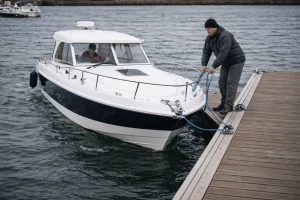
When wind or current pushes a boat away from a dock, the most important principles are angle, control, and preparation. A steeper approach, landing the bow first, and maintaining engine engagement provide consistent results.
Securing a line early, using controlled power, and being willing to retry an approach all contribute to safer docking. These techniques reduce stress, prevent damage, and improve overall boating safety.
Frequently Asked Questions
Is a 30–45 degree approach always necessary?
This range is most effective when wind or current pushes the boat away, but conditions and boat design may require slight adjustment.
Why does forward gear provide better control than reverse?
Forward gear generally produces a more predictable steering response and is easier to manage at low speeds.
Can a strong current affect docking more than wind?
Yes. Current moves the water itself and can overpower a boat quickly if not anticipated.
Should passengers assist by pushing the boat?
No. Using hands or feet to push the boat is dangerous and should be avoided.
Does this technique work for larger boats?
The principles apply broadly, though larger vessels may require more planning and space.
How long does it take to become comfortable docking in the wind?
With regular practice, most boaters see noticeable improvement within a short period.
Is it acceptable to ask Marina staff for help?
Yes. Seeking assistance when conditions are challenging is a responsible choice.