

Yes, your car insurance may cover rental cars, particularly if you have an active personal auto insurance policy and are renting a standard vehicle in the United States or Canada. However, the protection depends on your liability limits, collision and comprehensive coverage, deductible, rental location and the vehicle you choose.
A driver with liability-only insurance may be protected against certain third-party claims but still have no coverage for damage to the rented vehicle.
Our analysis of published insurer policies, rental-company agreements and financial-industry guidance highlights a common issue: drivers frequently compare rental prices without fully understanding their potential financial responsibility.
For US consumers and business travellers, the important question is not simply whether insurance applies. It is whether the existing coverage is sufficient to protect against repair bills, legal liability, administrative charges and other unexpected expenses.
Does My Car Insurance Automatically Cover a Rental Car?
Most standard US personal auto insurance policies extend some protection to eligible rental vehicles used for personal purposes.
However, the coverage normally follows the types of insurance purchased for the policyholder’s own vehicle.
For example, someone with comprehensive and collision coverage may have protection against physical damage to an eligible rental car. Someone carrying only liability coverage might not.
| Existing Car Insurance | Typical Rental Car Coverage | Important Limitation |
| Liability only | Third-party injuries and property damage | Usually does not cover physical damage to the rental itself |
| Collision coverage | Damage from covered collisions | Deductible and policy exclusions apply |
| Comprehensive coverage | Theft, fire, weather and other covered non-collision losses | Subject to deductible and policy terms |
| Full coverage | Combination of liability, collision and comprehensive | Not a guarantee against every rental charge |
| Rental reimbursement | Helps pay for a temporary rental after a qualifying claim | Does not itself insure damage caused while driving the rental |
| No personal insurance | No existing personal auto policy to rely upon | Rental-company and other qualifying protection must be assessed |
The term full coverage is particularly important. It is an informal description, not a standardised insurance product.
Two drivers who both describe themselves as fully insured may have substantially different liability limits, deductibles and exclusions.
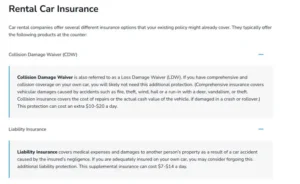
Official National Association of Insurance Commissioners guidance explains rental car insurance options and how existing personal auto coverage may overlap with rental-company protection.
What Does Your Existing Auto Insurance Actually Protect?
Understanding the difference between liability and physical-damage coverage is essential when deciding whether rental insurance is necessary.
Liability Coverage
Liability insurance generally helps pay for injuries or property damage suffered by other people when the insured driver causes a covered accident.
Suppose a driver causes an accident involving another vehicle while operating an eligible rental car.
If their policy provides applicable bodily injury and property damage liability coverage, the insurer may pay covered third-party claims up to the relevant limits.
However, liability insurance does not automatically pay to repair the rented vehicle.
Consider an illustrative policy with:
- Bodily injury liability: $100,000 per person.
- Bodily injury liability: $300,000 per accident.
- Property damage liability: $100,000 per accident.
The widely used shorthand is 100/300/100.
These limits may offer considerably more financial protection than a policy carrying lower state-minimum limits. Nevertheless, large claims can exceed even relatively substantial limits.
Collision Coverage
Collision insurance generally covers eligible damage caused when the rental vehicle collides with another vehicle or object, or overturns, subject to policy terms.
If a rental car sustains $4,000 in covered collision damage and the applicable deductible is $500, the financial calculation may look like this:
| Expense | Amount |
| Covered repair cost | $4,000 |
| Driver’s deductible | $500 |
| Potential insurance payment | $3,500 |
| Driver’s share of covered repair cost | 12.5% |
The driver pays 12.5% of the covered repair bill in this example, assuming the claim is accepted and the only unreimbursed expense is the deductible.
Other rental-company charges may still apply.
Comprehensive Coverage
Comprehensive insurance generally helps protect against eligible non-collision incidents.
Common examples include vehicle theft, fire, vandalism, hailstorms, falling objects and certain weather-related damage.
However, insurers may limit coverage for specialist vehicles, long rental periods or prohibited uses.
Our financial assessment is that physical-damage protection deserves as much attention as liability limits. A driver can have substantial third-party liability insurance while remaining personally responsible for expensive damage to the rental car.
How Can You Check Your Rental Car Coverage Before Booking?
The most reliable approach is to review the actual policy and confirm how it applies to the proposed rental.
Our review identifies six essential checks.
1. Confirm the rental vehicle is eligible.
Ask whether the policy covers the specific vehicle class, including any SUV, premium vehicle, pickup truck, van or luxury model.
2. Check the permitted rental period.
Some policies and credit card benefits impose duration limits. A short vacation rental may qualify when a longer continuous rental does not.
3. Confirm the geographical coverage.
A policy that applies within the United States and Canada should not be assumed to cover Mexico or other international destinations.
4. Review liability limits and deductibles.
Identify the maximum liability protection available and the amount you would personally pay for a covered physical-damage claim.
5. Ask about additional rental-company charges.
Determine whether the policy covers loss-of-use charges, administrative fees, towing, storage and diminished value.
6. Request written confirmation.
Where possible, obtain an email or policy document identifying the applicable coverage and significant exclusions.
A useful question to ask the insurer is:
“Does my existing policy provide liability, collision and comprehensive coverage for this specific rental vehicle, in this location, for the full rental period, and what charges would remain my responsibility?”
Drivers unfamiliar with rental agreements can also review the complete car rental booking process before making a reservation.
Is Rental Reimbursement the Same as Rental Car Insurance?
No. These two forms of coverage serve different purposes, even though they are frequently confused.
Rental car insurance concerns financial protection while driving a rented vehicle.
Rental reimbursement coverage helps pay the cost of obtaining temporary transportation when an insured vehicle cannot be used because of a qualifying covered event.
Suppose a driver’s own vehicle is damaged in an accident and requires repairs.
The driver has an optional rental reimbursement benefit that pays up to $50 per day for a qualifying period, subject to policy limits.
If the rental costs $65 per day, the driver may need to pay the $15 daily difference personally.
For a 10-day rental, that difference becomes $150.
| Coverage Feature | Rental Car Insurance | Rental Reimbursement |
| Main purpose | Protect against eligible losses involving a rented vehicle | Help pay rental expenses after a covered incident |
| Covers rental vehicle damage | May, depending on coverage | Not by itself |
| Pays daily rental charges | Generally no | Yes, within applicable limits |
| May involve a deductible | Yes | Depends on the policy and benefit structure |
| Automatically included | Depends on the policy | Commonly an optional benefit |
Progressive, for example, describes rental reimbursement options with daily limits and qualifying rental periods that vary by policy.
This distinction matters because a driver could have strong coverage while operating a rental car but no reimbursement benefit to pay the daily rental charges.
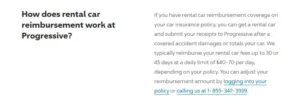
Progressive’s official rental reimbursement explanation shows how temporary transportation expenses are handled after an eligible insured vehicle is damaged.
Should You Buy Extra Insurance From the Rental Company?
Additional protection is not automatically necessary for every rental.
Our comparison suggests that the decision should depend on the coverage already available, the driver’s financial reserves and the potential costs excluded from existing policies.
Rental companies typically offer several separate products.
| Rental Protection | Main Purpose | Financial Consideration |
| Collision Damage Waiver (CDW) or Loss Damage Waiver (LDW) | Reduces or waives responsibility for covered rental vehicle damage or loss | Can reduce exposure to repair bills |
| Supplemental Liability Protection (SLP/SLI) | Provides additional third-party liability protection | Useful where existing liability limits are insufficient |
| Personal Accident Insurance (PAI) | Provides specified accident-related benefits | May overlap with health or other insurance |
| Personal Effects Coverage (PEC) | Covers eligible personal belongings | May overlap with homeowners or renters insurance |
| Roadside Assistance Protection (RAP) | Helps with specified roadside incidents | Can reduce certain lockout, key or other service charges |
A damage waiver is generally a contractual waiver rather than an insurance policy.
It may reduce or eliminate the rental company’s right to recover certain losses from the customer, provided the rental agreement is followed.
However, buying a waiver does not mean that every possible expense or incident is covered.
The product may become invalid following prohibited activities, and some vehicle types or incidents may be excluded.
When Is a Damage Waiver Worth Considering?
A damage waiver may be financially reasonable when:
- The driver has liability-only insurance.
- Collision or comprehensive protection does not extend to the rental.
- The applicable deductible is high.
- The rental company can charge losses not covered by the personal policy.
- The driver lacks sufficient emergency savings.
- A qualifying credit card benefit is unavailable.
The decision is less straightforward when the driver already has adequate personal coverage and a qualifying credit card benefit.
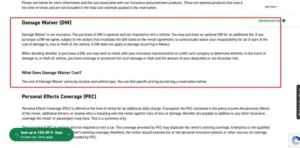
Enterprise’s official US rental protection page distinguishes Damage Waiver, Supplemental Liability Protection and Personal Effects Coverage, including the contractual nature of the waiver.
How Much Does Rental Car Insurance Add to the Total Cost?
The financial impact of rental protection becomes clearer when the daily charges are compared over the full booking.
Published consumer-finance estimates commonly place rental-counter collision or loss damage waivers at roughly $15–$30 per day, although actual prices can fall outside that range.
Rental companies set prices according to location, vehicle class, rental duration and other conditions.
Example: Seven-Day Rental Cost Comparison
The following is an illustrative financial model, not an actual rental-company quotation.
| Rental Expense | Seven-Day Cost |
| Base rental: $55 per day | $385 |
| Estimated taxes and mandatory fees | $85 |
| Rental subtotal | $470 |
| Optional damage waiver: $25 per day | $175 |
| Optional liability protection: $14 per day | $98 |
| Optional personal accident protection: $8 per day | $56 |
| Total with all listed optional products | $799 |
In this example, the customer starts with a $470 rental subtotal but finishes with a $799 total after purchasing the three optional protections.
That represents a 70% increase over the rental subtotal.
Purchasing only the $175 damage waiver would increase the subtotal by approximately 37.2%.
For drivers who already have equivalent protection, these additional expenses could represent avoidable spending.
However, declining protection solely to save $175 would be unwise if doing so exposes the driver to a much larger uninsured loss.
The most useful financial comparison is therefore:
Cost of additional protection versus the potential uninsured loss and the driver’s ability to absorb that loss.
Does Credit Card Insurance Cover Rental Cars?
Many credit cards provide rental vehicle damage protection, but the benefit is not universal.
Eligibility can depend on the specific card, issuer, rental company, vehicle category, payment method and rental duration.
Credit card rental protection is generally designed around eligible theft or physical damage to the rented vehicle.
It usually does not replace third-party liability insurance.
The distinction between primary and secondary coverage is especially important.
| Feature | Primary Credit Card Coverage | Secondary Credit Card Coverage |
| Claim payment order | Generally responds before personal auto insurance for eligible losses | Usually responds after applicable primary coverage |
| Need to claim through personal collision insurance | May be avoidable | May be necessary |
| Rental vehicle damage | Subject to benefits and exclusions | Subject to benefits and exclusions |
| Personal policy deductible | May avoid using the personal policy for an eligible loss | May cover an eligible deductible |
| Third-party liability | Generally excluded | Generally excluded |
| Claims documentation | Required | Required |
Some eligible Chase Sapphire cards, for example, provide primary auto rental coverage subject to the card’s applicable benefit terms.
Other cards provide secondary coverage, and some do not offer rental protection at all.
The critical requirements commonly incc is eligible and declining the rental company’s collision damage waiver.
Accepting the rental company’s waiver can invalidate some credit card benefits.
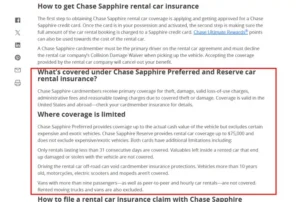
Chase’s official Sapphire rental car coverage guide explains primary protection, qualifying payment requirements, rental-duration restrictions and excluded vehicles.
What Do Insurance Professionals Say About Credit Card Protection?
Loretta Worters, a spokesperson for the Insurance Information Institute, previously highlighted a common misunderstanding in published insurance-industry commentary:
“Consumers can often be confused about what their credit card does and doesn’t cover.”
That observation remains relevant when comparing rental-company protection with personal auto policies and credit card benefits.
Our review supports a practical conclusion: credit card insurance should be assessed as a defined financial benefit, not assumed to provide comprehensive vehicle and liability protection.
When Might Personal Car Insurance Not Cover a Rental?
Several situations deserve additional attention because ordinary personal coverage may not apply.
| Rental Situation | Potential Coverage Problem | Recommended Check |
| International rental | Domestic personal policy may not extend overseas | Country-specific insurance requirements |
| Luxury or exotic vehicle | Vehicle classification or value restrictions | Insurer and card benefit exclusions |
| Moving truck or RV | Vehicle type or weight exclusion | Specialist rental protection |
| Extended rental | Maximum rental duration | Exact policy and card limits |
| Business or commercial use | Personal-use exclusions | Employer and commercial insurance |
| Unauthorised driver | Rental contract or coverage breach | Approved-driver requirements |
| Peer-to-peer rental | Different platform and insurer rules | Platform protection and policy eligibility |
| Driving in Mexico | Domestic coverage may not extend across the border | Mexican insurance and rental agreement |
Even when an insurer generally extends coverage to rental cars, a prohibited rental use can materially affect a claim.
Additional drivers should be authorised under the rental agreement and meet all relevant insurance requirements.
Does Car Insurance Cover Rentals Through Turo?
Peer-to-peer vehicle rentals require a separate assessment.
Platforms such as Turo operate differently from conventional rental companies because customers book vehicles made available by individual or business hosts.
The protection structure can involve platform-specific liability arrangements, damage responsibility and optional protection plans.
Turo’s published US terms explain that guests can remain financially responsible for physical damage to a booked vehicle and related charges, subject to the applicable agreements and protection arrangements.
Some personal auto insurance policies may extend coverage to eligible peer-to-peer rentals, but others may restrict or exclude them.
Credit card rental benefits may also exclude peer-to-peer car sharing even when they cover traditional rental companies.
For this reason, drivers should not assume that coverage for a conventional Enterprise or Hertz booking applies identically to Turo.
Our recommendation is to obtain direct confirmation from the personal insurer and credit card benefit administrator before declining the platform’s protection options.
Does Personal Car Insurance Cover Rental Cars for Business Trips?
Business travel presents different insurance considerations from private leisure travel.
A rental car used by an employee to attend meetings, visit customers or travel between business locations may introduce liability exposure for both the driver and the employer.
Whether the employee’s personal auto policy applies depends on the policy language, nature of the work and circumstances of the rental.
Businesses may require hired and non-owned auto insurance (HNOA).
HNOA can help protect businesses against qualifying third-party liability arising from rented, hired or employee-owned vehicles used for business purposes.
However, hired-auto liability insurance does not automatically provide physical-damage coverage for the rented vehicle. That may require separate hired-auto physical-damage protection.
Consider a small business sending a salesperson to attend a three-day conference.
The employee books a rental vehicle and uses it for customer meetings. An accident subsequently results in a third-party injury claim.
Depending on the circumstances, the claim could create liability for the business as well as the driver.
For an entrepreneur reviewing rental business ideas, this illustrates an important distinction between insuring the customer who temporarily uses a vehicle and insuring the business that owns or operates the rental fleet.
Companies considering starting a car rental business should assess commercial fleet insurance, physical-damage protection, customer liability arrangements and business interruption risks separately.
Our business-finance assessment is that employee rental expenditure should be governed by a written travel policy.
That policy should specify approved suppliers, vehicle categories, booking arrangements, insurance requirements and incident reporting responsibilities.
What Happens If You Damage a Rental Car Without Additional Insurance?
Declining a rental company’s damage waiver does not automatically mean a driver must pay for every repair.
The financial outcome depends on the personal insurance policy, eligible credit card protection, rental agreement and the circumstances of the damage.
Suppose a driver causes $3,000 in covered rental vehicle damage.
The driver has collision insurance with a $1,000 deductible.
| Potential Cost | Illustrative Amount |
| Rental vehicle repair | $3,000 |
| Applicable deductible | $1,000 |
| Potential insurance payment for repairs | $2,000 |
| Separate loss-of-use charge | $400 |
| Administrative fees | $100 |
| Potential driver exposure | $1,500 |
The example assumes the $500 in additional charges is contractually valid and not covered by another benefit. It excludes any further compensation or dispute resolution.
The driver could therefore face more than the headline deductible.
If an eligible credit card benefit covers some of the remaining amounts, the final personal expense may be lower.
Why Do Loss-of-Use Charges Matter?
Loss of use concerns potential rental income lost while a damaged vehicle is unavailable.
The rental company may seek compensation under its agreement, subject to applicable law and any evidence requirements.
Traditional personal auto insurance does not always cover these charges.
Additional costs can also include administrative expenses, towing, storage or diminished value, depending on the contract.
This is one reason a comparison based solely on the deductible is incomplete.
Can a Rental Car Accident Increase Your Insurance Premium?
A rental accident involving a claim under personal auto insurance may affect future premiums.
However, there is no universal percentage increase applicable to every driver.
Insurers may consider the accident circumstances, fault determination, previous claims, state regulations, discounts, accident-forgiveness provisions and other rating factors.
A useful illustration shows how even a relatively modest increase could affect the total financial cost.
Suppose a policy costs $1,800 annually.
If a qualifying accident contributes to a 15% premium increase, the new annual premium would be $2,070.
That is an additional $270 per year.
If the same incremental increase remained for three years, the difference would total $810, before accounting for other premium changes.
This is a hypothetical scenario, not a prediction that insurers will raise premiums by 15% after a rental accident.
Some qualifying credit card primary benefits may allow rental vehicle damage claims to be handled without filing a collision claim under the driver’s personal policy.
However, other claims, including liability claims, may still involve the personal insurer, and premium outcomes are never guaranteed.
Which Rental Car Insurance Option Offers the Best Financial Value?
Our editorial comparison assesses protection arrangements for a typical US driver renting a standard passenger car for a personal trip.
The ratings below are editorial suitability scores, not insurance-company financial strength ratings, verified claim approval rates or measured consumer satisfaction percentages.
The assessment considers four equally practical dimensions with different weights:
- Coverage breadth: 35%.
- Reduction of significant coverage gaps: 25%.
- Claims-handling convenience: 20%.
- Cost efficiency: 20%.
| Protection Arrangement | Editorial Suitability Rating | Our Assessment |
| Adequate personal coverage plus eligible primary credit card protection | 90% | Strong combination when all requirements are satisfied |
| Rental-company damage waiver plus adequate liability protection | 87% | Potentially simpler damage handling but often more expensive |
| Adequate personal coverage plus secondary credit card benefit | 81% | Useful supplementary protection, subject to the claims process |
| Adequate personal full coverage alone | 76% | Can be sufficient, but deductibles and certain fees remain relevant |
| Liability-only personal insurance without rental damage protection | 38% | Substantial potential exposure to rental vehicle damage |
These are comparative editorial judgements for the stated scenario, not universal rankings. Scores can change materially according to the rental location, driver, deductible, specific benefits and price.
For example, someone renting a specialist vehicle abroad should not use the 90% assessment to assume their domestic insurance and credit card will apply.
Our central financial finding is that the cheapest arrangement is not necessarily the strongest, and the most expensive insurance package is not automatically the best value.
The objective is to secure suitable coverage without unnecessarily paying for overlapping products.
What Should You Do If Your Rental Car Is Damaged or Stolen?
Drivers should follow the rental agreement and the requirements of every insurer or benefit administrator involved.
A practical incident-response procedure includes:
- Check safety first. Contact emergency services when necessary, particularly where injuries or immediate hazards are involved.
- Notify the appropriate authorities. Obtain a police report where required.
- Inform the rental company promptly. Follow its accident, theft and damage reporting procedures.
- Document the incident. Photograph the vehicle, surroundings, damage and relevant conditions.
- Contact the applicable insurer. Confirm whether the event qualifies for coverage before making assumptions about payment.
- Notify the credit card benefit administrator. Observe any notification and document-submission deadlines.
- Retain financial records. Keep the rental agreement, accident report, repair estimate, invoices and all correspondence.
- Examine additional charges. Request an itemised explanation for any administrative, towing, loss-of-use or diminished-value fees.
A rental company may initially bill the customer even where insurance reimbursement is expected.
Drivers should therefore understand the claim process before choosing to rely on personal or credit card coverage.
What Documents Should You Keep When Renting a Car?
A complete documentation trail helps reduce disputes involving existing damage, billing changes and insurance claims.
Before collecting the vehicle, retain the confirmed booking, rental agreement, protection selections and estimated charges.
Record the condition of the vehicle using clear photographs or video.
Pay particular attention to bumpers, wheels, windshield, mirrors, body panels and the interior.
When returning the vehicle, record its condition again, together with fuel level, mileage and the final receipt.
Our operational assessment is that proper documentation can be as important as selecting the correct insurance product.
A well-documented rental does not guarantee a successful dispute, but it provides useful evidence when charges are challenged.
What Should You Ask Before Declining Rental Insurance?
Before accepting or rejecting optional coverage, drivers should have clear answers to the following questions:
- Does my personal insurance apply to this rental vehicle and trip?
- Are both liability and physical damage covered?
- What deductible would I pay after a covered accident?
- Are loss-of-use, diminished-value and administrative charges covered?
- Does my credit card offer primary or secondary protection?
- Will accepting the rental company’s damage waiver affect my credit card benefit?
- Are additional drivers, the destination and the entire rental period covered?
- How would I file a claim, and which documents would be required?
These questions help turn an insurance decision into a straightforward financial risk assessment rather than a last-minute purchase at the rental counter.
Final Assessment
For many US drivers, personal car insurance can cover eligible rental cars, but the protection is rarely as simple as assuming that an existing policy covers everything.
Our analysis shows that the most important distinctions concern third-party liability, damage to the rented vehicle, deductibles, rental-company fees and the different roles of credit card benefits.
For a driver with adequate personal coverage, an eligible credit card and a standard domestic rental, buying every additional protection product may offer limited financial value.
For someone with liability-only coverage, a specialist vehicle, an overseas booking or a business-related rental, the financial risks are substantially different.
The most effective approach is to confirm coverage before booking, compare the cost of additional protection against potential uninsured losses, and retain clear documentation throughout the rental.
The goal is not simply to spend less on rental insurance. It is to avoid paying twice for the same protection while ensuring that the most financially significant risks are properly covered.
Frequently Asked Questions
Does State Farm Cover Rental Cars?
State Farm personal auto insurance may extend applicable coverage to eligible rental cars, subject to policy limits and exclusions. Confirm the specific vehicle, destination and type of use before booking.
Does GEICO Cover Rental Cars?
GEICO states that personal auto coverage may extend to qualifying rental vehicles. The protection depends on the liability, collision and comprehensive coverage carried by the driver.
Does Progressive Cover Rental Cars?
Progressive generally extends applicable personal auto coverage to eligible rental vehicles, subject to policy terms. Rental reimbursement is a separate optional benefit.
Does My Insurance Cover Rental Cars in Another State?
A US personal auto policy commonly provides applicable protection across states, but limits, state-specific requirements and policy exclusions should be checked.
Does Car Insurance Cover Rental Cars in Mexico?
Standard US personal auto coverage should not be assumed to apply in Mexico. Drivers should confirm Mexican insurance requirements and coverage directly before travelling.
Can I Rent a Car Without Owning a Vehicle?
Yes. Ownership of a vehicle is not normally required to rent one, but the driver must satisfy the rental company’s conditions and have appropriate liability and damage protection. Non-owner auto insurance may be worth considering for frequent renters.
Is Rental Car Insurance Worth Buying for a Short Trip?
It can be worthwhile when existing coverage is missing or inadequate. Drivers with suitable personal insurance and an eligible credit card benefit may be able to avoid duplicating protection.