

Turo is changing how people rent cars and how vehicle owners generate income from assets they already own. Instead of visiting a traditional rental counter, customers can book specific vehicles directly from local owners and independent car rental businesses through an online marketplace. For entrepreneurs, the same platform creates an opportunity to earn revenue by making eligible vehicles available to paying customers.
But how does Turo car rental actually work, what does it cost, and is hosting profitable?
We analysed Turo’s booking structure, updated 2026 hosting arrangements, protection plans, pricing policies and the financial considerations associated with peer-to-peer car sharing. Our review examines the opportunities alongside less obvious expenses, including platform fees, vehicle depreciation, damage exposure and maintenance.
What Is Turo Car Rental?
Turo is an online peer-to-peer car-sharing marketplace that connects people who need temporary access to a vehicle with owners and independent businesses willing to rent out eligible cars.
Founded in 2009, the business operates differently from conventional rental companies such as Hertz, Enterprise and Avis.
Traditional rental companies generally own or manage a fleet of vehicles, while Turo provides a platform where individual owners and commercial hosts can list vehicles, manage bookings and communicate with customers.
For example, someone who owns a Toyota Camry but rarely uses it during the week could list that vehicle on Turo. Another person visiting the area could book it for several days and collect it from an agreed location.
Turo manages the booking and payment process, provides platform support and makes protection arrangements available, subject to its terms.
Key Facts About Turo
| Feature | Details |
| Business model | Peer-to-peer car-sharing marketplace |
| Founded | 2009 |
| Main users | Travellers, local drivers, car owners and fleet operators |
| Vehicle types | Economy cars, SUVs, electric vehicles, luxury cars and more |
| Booking method | Website or mobile application |
| US minimum guest age | 18 for eligible standard vehicles |
| UK minimum guest age | Generally 21, subject to licensing and vehicle requirements |
| Vehicle pickup | Host location, approved delivery location or participating airport |
| Guest protection | Multiple plans with different damage responsibility limits |
| Host income | Percentage of trip price, depending on the earnings plan and market |
| Main business risk | Maintenance, depreciation, claims and inconsistent bookings |
Turo belongs to the wider asset-sharing industry, where individuals and businesses earn revenue by allowing other people to use assets temporarily.
Our examination of different rental business ideas shows why this model appeals to entrepreneurs: an existing asset can potentially generate recurring revenue without requiring a traditional shopfront.
However, the ability to earn money from a vehicle should not be confused with guaranteed profitability.
How Does Turo Car Rental Work for Customers?
Customers use Turo to search for available vehicles, compare individual listings, choose a protection plan and complete a reservation.
Unlike conventional car rental, the customer generally books a particular vehicle rather than a broad category such as economy, compact or premium.
Step 1: Search for an Available Vehicle
Customers begin by entering their destination, pickup location and rental dates.
Available listings can include:
- Economy cars for inexpensive daily travel.
- SUVs for families and longer journeys.
- Electric vehicles for drivers wanting to try an EV.
- Premium vehicles for special occasions.
- Minivans and larger vehicles for group travel.
- Sports cars and other specialty vehicles, subject to eligibility.
Each listing provides information about the vehicle, host, location, rental conditions and customer feedback.
We recommend reviewing recent customer comments rather than relying entirely on an attractive vehicle photograph or headline daily price.

Step 2: Compare Prices and Booking Conditions
After choosing a vehicle, customers should examine the complete booking conditions.
Important details include the distance allowance, collection arrangements, cancellation terms and any additional charges.
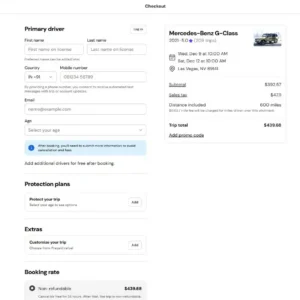
A vehicle advertised at $55 per day does not necessarily cost exactly $55 per day once all applicable charges are included.
Customers should compare the checkout total with competing vehicles before paying.
Step 3: Complete Driver Verification
Turo checks driver eligibility before allowing a customer to use a booked vehicle.
Customers may need to provide a valid driver’s licence, identity information and an accepted payment method.
Approval depends on the country, vehicle category and other eligibility requirements.
Drivers should also ensure that any additional person who may use the vehicle has been approved through Turo.
Step 4: Select a Protection Plan
Before completing the reservation, customers review their available protection options.
Different plans can significantly change the amount a customer may have to pay if eligible physical damage occurs.
Selecting a cheaper protection plan may reduce the upfront booking cost but increase financial exposure after an incident.
Step 5: Collect and Return the Vehicle
Vehicle collection depends on the arrangement offered by the host.
Some hosts meet customers in person and provide the keys. Others use lockboxes or supported remote unlocking systems.
Customers should document the condition of the vehicle before driving.
Our recommended collection procedure is to:
- Inspect the exterior for scratches or dents.
- Check the interior for existing damage.
- Photograph the wheels, windscreen and body panels.
- Record the vehicle’s fuel or battery level.
- Confirm the agreed distance allowance and return time.
- Upload relevant photographs through Turo’s trip documentation process.
The same inspection should be completed when returning the vehicle.
These records are particularly important if a dispute develops over damage or cleanliness.
How Much Does Turo Car Rental Cost?
Turo does not operate with one universal daily rental price.
Vehicle owners establish pricing within the platform’s available pricing tools and rules, while the final customer cost depends on the vehicle, location, trip duration and additional charges.
For travellers researching how much it costs to rent a car, this distinction matters because comparing advertised prices alone can produce misleading conclusions.
What Fees Can Appear on a Turo Booking?
| Charge | What it means |
| Vehicle trip price | Price for using the selected vehicle during the booking |
| Trip fee | Platform charge calculated according to booking factors |
| Protection plan | Optional plan cost, where applicable |
| Delivery fee | Charge for bringing the vehicle to an agreed collection point |
| Airport fee | Applicable fee associated with certain airport collections |
| Young driver fee | Additional charge for eligible younger drivers |
| Taxes | Applicable government taxes |
| Extras | Optional services or equipment |
| Post-trip charges | Possible refuelling, additional distance, late return or other eligible costs |
Turo has introduced pricing improvements for longer bookings. In most markets, its trip fee was reduced to zero for trips lasting one month or longer from March 2025.
That does not make monthly rentals fee-free overall; other charges and conditions may still apply.
Example of a Five-Day Turo Rental
Consider a hypothetical five-day booking.
| Expense | Illustrative amount |
| Vehicle at $55 per day | $275 |
| Trip fee | $58 |
| Protection plan | $45 |
| Delivery fee | $30 |
| Airport fee | $25 |
| Estimated taxes | $22 |
| Total estimated booking | $455 |
The effective daily cost becomes $91, compared with the original advertised $55 daily vehicle rate.
That represents approximately a 65.5% increase over the advertised base vehicle price.
Important: These figures are an illustrative financial example, not a live Turo quotation, typical price or measured average. Actual fees and taxes may be significantly different.
Our analysis suggests that the correct approach is to calculate:
Effective daily rental cost = Total checkout price ÷ Number of rental days
This is more useful than comparing base vehicle prices that exclude important expenses.
Is Turo Cheaper Than Traditional Car Rental Companies?
Turo can be cheaper than conventional car rental, but it is not consistently the least expensive option.
Its competitiveness depends heavily on local vehicle supply, booking dates, host pricing and the customer’s insurance or protection requirements.
| Comparison | Turo | Traditional rental company |
| Vehicle selection | Usually select a specific listed car | Often book a vehicle category |
| Pickup | Host location or available delivery | Primarily rental branches and airports |
| Pricing | Host pricing plus applicable platform charges | Company pricing plus applicable extras |
| Customer experience | Varies by host | Varies by branch and provider |
| Vehicle reviews | Often available for individual listings | Usually company or branch reviews |
| Long-term booking | Host discounts may apply | Monthly and long-term rates may apply |
| Damage protection | Platform-specific arrangements | Rental company protection products |
| Cancellation | Depends on booking terms | Depends on booking terms and provider |
Turo may provide particularly good value when a customer needs a specific vehicle model or a collection location that traditional rental companies do not serve conveniently.
However, a conventional rental company may be financially preferable when a customer has access to a corporate discount, loyalty benefits or relevant rental insurance.
For business travellers, we would compare the total cost, insurance arrangements, customer support and replacement vehicle options, not merely the advertised price.
What Insurance and Protection Does Turo Provide?
Insurance is one of the most important parts of any Turo booking.
A common mistake is to assume that Turo’s protection plans work exactly like the insurance products offered by conventional car rental businesses.
They do not.
There are two distinct areas to understand.
Third-Party Liability Insurance
Turo trips in the United States include third-party automobile liability insurance under arrangements described by the platform.
This addresses qualifying liability for injury or property damage involving other people.
The coverage structure and applicable limits depend on the jurisdiction.
In many US circumstances, the liability coverage is secondary to other applicable personal insurance, although state-specific exceptions exist.
Protection for Damage to the Host’s Vehicle
Turo’s US guest protection plans establish contractual limits on financial responsibility for eligible physical damage to the booked car.
These contracts are not themselves insurance policies.
The standard US options are:
| Guest plan | Financial responsibility for eligible physical damage |
| Premier | $0 |
| Standard | Up to $500 |
| Minimum | Up to $3,000 |
| Decline, where available | Potential responsibility for the full qualifying damage cost |
Premier availability is restricted by driver age, vehicle value and other booking factors.
These limits do not generally protect customers from mechanical or interior damage caused by misuse or neglect, and restrictions or exclusions may apply if platform rules are breached.

Does Personal Car Insurance Cover a Turo Rental?
Customers should never assume their existing policy or credit card rental protection automatically applies.
Some personal insurance arrangements may provide relevant coverage, while others exclude peer-to-peer vehicle sharing.
Our assessment of car insurance coverage for rental vehicles highlights the importance of distinguishing conventional rental-car insurance from car-sharing arrangements.
Before booking, customers should ask their insurer whether the policy applies specifically to a Turo vehicle, which types of damage are covered and which deductibles or exclusions may apply.
For vehicle owners, the issue is equally important: protection applying during an eligible Turo trip does not automatically replace the need for appropriate insurance when the car is not being rented.
How Old Do You Have to Be to Rent a Car on Turo?
Age requirements depend on the country and the type or value of the vehicle.
In the United States, Turo’s requirements include:
| Vehicle category | Minimum booking age |
| Standard eligible vehicle | 18 |
| Vehicle worth more than $20,000 | 21 |
| Deluxe Class | 25 |
| Super Deluxe, Classic or Specialty | 30 |
Drivers aged 18–24 are subject to a young driver fee, which varies according to the booking.
Customers must also hold an accepted driving licence and satisfy the platform’s approval process.
Anyone comparing minimum ages for renting a car should recognise that age requirements are not identical across Turo and conventional rental companies.
In the United Kingdom, Turo generally requires drivers to be at least 21 and to have held a qualifying licence for the required minimum period. Vehicle-specific restrictions can still apply.
How Does Turo Work for Car Owners and Hosts?
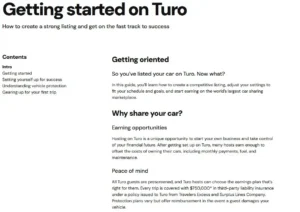
Hosting allows eligible vehicle owners to list their cars for temporary use by customers.
Instead of receiving a fixed salary, hosts receive earnings based on completed trips, applicable host-share arrangements and other eligible charges.
A person with one spare vehicle might use Turo to offset ownership expenses. An entrepreneur with several vehicles may operate a larger rental business.
However, the responsibilities extend beyond simply uploading photographs and waiting for bookings.
Setting Up a Vehicle Listing
To begin, an eligible host generally needs to:
- Register and complete the required identity and ownership information.
- Confirm that the vehicle meets Turo’s listing requirements.
- Upload accurate photographs and vehicle details.
- Establish availability and pricing settings.
- Select an applicable host earnings plan.
- Configure pickup arrangements and any permitted extras.
- Maintain the vehicle and respond to booking requests.
- Follow check-in, return and damage-reporting procedures.
In the US, vehicles generally must be no more than 12 years old when initially listed and have fewer than 130,000 miles, subject to exceptions and additional eligibility rules.
A vehicle’s age, condition, title history and market value can also affect eligibility.
What Responsibilities Do Hosts Have?
Hosts are responsible for operating their listings in accordance with the platform’s requirements.
Typical work includes vehicle cleaning, scheduled maintenance, customer communication, inspection photographs, coordinating pickups and addressing problems during bookings.
It is also important to monitor vehicle condition between trips.
From a business perspective, the car is not merely a personal possession. It becomes an income-producing asset subject to increased mileage, wear and operational risk.
Entrepreneurs considering how to start a car rental business should evaluate Turo as one possible distribution channel rather than assuming that access to the marketplace eliminates the responsibilities of running a rental operation.
How Much Money Can Turo Hosts Earn in 2026?
Turo’s host earnings structure changed significantly in 2026.
In most US markets, host earnings plans provide different shares of the trip price depending on the level of damage responsibility selected.
US Host Earnings Plans
| Earnings plan | Host share in most US markets | Host damage responsibility |
| More peace of mind | 70% | $250 |
| Balanced | 80% | $1,500 |
| More earnings | 90% | $2,750 |
The higher-share plans allow hosts to keep a larger proportion of trip revenue but expose them to a larger contribution if an eligible damage claim occurs.
These are not guaranteed business profit margins.
What Changed in March 2026?
From 31 March 2026, Turo introduced variable host shares in selected US markets.
The applicable percentage can depend on how far in advance a guest books.
| Advance booking period | More peace of mind | Balanced | More earnings |
| 28 days or more | 80% | 90% | 100% |
| 14–27 days | 75% | 85% | 95% |
| 3–13 days | 70% | 80% | 90% |
| 0–2 days | 65% | 75% | 85% |
This structure applies to designated markets including Austin, Dallas, Detroit, Las Vegas, Maui, Philadelphia, Phoenix, San Diego and Seattle.
For entrepreneurs, the important financial implication is that two bookings at the same vehicle price can generate different host revenue depending on when the reservation was made.
The changes create a stronger incentive to secure advance bookings rather than depending exclusively on last-minute demand.

Caption: Official 2026 Turo host earnings comparison showing standard host shares, damage responsibility and advance-booking variations.
Is Turo Hosting Profitable for Car Owners?
Turo hosting can be profitable, but rental revenue alone does not indicate whether an individual vehicle is a successful business investment.
Our financial analysis focuses on five factors:
- Vehicle utilisation: The proportion of available days actually booked.
- Host share: The percentage of trip revenue retained.
- Operating expenses: Cleaning, maintenance, insurance and administration.
- Depreciation: The loss of vehicle value through age, mileage and use.
- Capital costs: Loan interest, financing commitments and the owner’s invested capital.
A vehicle can receive frequent bookings while still producing a disappointing financial return.
Example of Monthly Turo Host Earnings
Consider a vehicle rented for 15 days per month at an average trip price of $70 per day.
| Financial item | Monthly amount |
| Booked days | 15 |
| Average trip price | $70 |
| Gross trip revenue | $1,050 |
| Host share | 80% |
| Host trip earnings | $840 |
| Cleaning and turnover | -$90 |
| Maintenance allowance | -$80 |
| Off-trip insurance allowance | -$110 |
| Parking and administration | -$40 |
| Additional operating reserve | -$120 |
| Estimated operating contribution | $400 |
Under this hypothetical scenario, the host retains $400 before vehicle financing, depreciation, income taxes and any other unlisted expenses.
The operating contribution represents approximately 47.6% of the host’s trip earnings.
It is not a net profit margin.
Once vehicle finance costs and economic depreciation are considered, the actual return may be significantly lower.
These figures are illustrative assumptions rather than verified operating results from a Turo host.
How Does Vehicle Utilisation Affect Earnings?
Utilisation is one of the strongest drivers of rental economics.
At the same $70 daily trip price and 80% host share:
| Monthly booked days | Utilisation of 30 available days | Host trip earnings |
| 5 | 16.7% | $280 |
| 10 | 33.3% | $560 |
| 15 | 50% | $840 |
| 20 | 66.7% | $1,120 |
| 25 | 83.3% | $1,400 |
These calculations exclude expenses, discounts and additional earnings.
Our assessment indicates that businesses should prioritise sustainable utilisation and net contribution rather than merely maximising the number of listed vehicles.
Adding more vehicles increases capital exposure and operating complexity. It does not guarantee that demand will increase proportionately.

What Are the Biggest Risks of Hosting on Turo?
Any car-sharing business involves financial, operational and customer-service risks.
Understanding these risks before listing a vehicle is essential.
Vehicle Depreciation and Maintenance
Additional driving increases mileage and may accelerate wear on tyres, brakes, suspension and other components.
An owner may earn several thousand dollars in annual hosting revenue but also experience a reduction in vehicle resale value.
For financial planning, depreciation should be considered separately from immediate cash expenses.
Accidents and Damage Claims
Accidents can create costs even when a protection arrangement applies.
Hosts may face their selected damage responsibility, excluded losses or periods when the vehicle cannot generate bookings.
Applicable protection terms may also exclude reimbursement for ordinary wear and tear or lost hosting income.
Seasonal Demand
Demand can fluctuate with tourism, airport activity, local events and the broader economy.
A host operating in a popular holiday destination may experience strong revenue during peak months but limited bookings outside the main season.
Financing and Insurance Restrictions
Vehicle owners should review loan, lease and insurance agreements before listing a car.
Certain finance contracts or insurance policies may restrict commercial or peer-to-peer rental activity.
Hosts must also account for applicable local business regulations, registration requirements and tax obligations.
Time Commitment
Hosting is sometimes described as passive income.
For most owners actively managing their vehicles, that description is incomplete.
Vehicle preparation, customer support, returns, inspections and maintenance require time.
A professionally operated vehicle-sharing business should place an economic value on the owner’s labour, even when that person does not draw a formal salary.
Can Turo Be Used to Build a Larger Car Rental Business?
Yes. Some entrepreneurs use peer-to-peer marketplaces to operate multi-vehicle rental businesses.
However, a growing fleet should be managed using the same financial discipline as any other asset-intensive enterprise.
Before expanding, owners should establish whether their existing vehicles generate adequate returns after expenses.
Important operational considerations include financing terms, insurance, maintenance schedules, parking capacity, fleet availability and damage claims.
A useful business calculation is:
Monthly operating break-even days = Fixed monthly operating costs ÷ Contribution per booked day
For example, assume a vehicle has $450 in monthly fixed operating costs, earns $56 per booked day after its host-share percentage and incurs $11 in variable operating expenses per booked day.
Its contribution per booking day is $45.
The vehicle would require 10 booked days per month to cover those assumed operating costs.
This simplified calculation excludes depreciation, taxes and any costs not included in the assumptions.
For entrepreneurs, break-even analysis is more reliable than relying entirely on promotional income illustrations.
What Are the Advantages and Disadvantages of Turo Car Rental?
Turo offers meaningful benefits for customers and vehicle owners, but the model involves trade-offs.
| Advantages | Disadvantages |
| Ability to book specific vehicles | Final price may exceed the advertised rate |
| Wide variety of vehicle types | Service quality depends partly on the individual host |
| Flexible pickup arrangements | Protection terms require careful review |
| Potential value on certain bookings | Extra fees can change the cost comparison |
| Income opportunity for vehicle owners | Depreciation and maintenance reduce returns |
| Access to longer booking periods | Host availability and cancellations can affect plans |
| Digital communication and trip records | Damage disputes can create administrative work |
For renters, the principal attraction is convenience and vehicle choice.
For hosts, the principal attraction is potential recurring revenue from an existing or specifically acquired asset.
In both cases, the quality of the financial outcome depends on details that are easy to overlook at first glance.
How Does Turo Compare in Our Expert Review?
We evaluated Turo’s marketplace model using six criteria relevant to renters, vehicle owners and small-business operators.
The percentages below represent our qualitative editorial scores based on the published service structure and financial considerations. They are not customer satisfaction statistics, audited outcomes or results from a representative survey.
| Review category | Editorial rating | Assessment |
| Booking convenience | 84% | Flexible digital booking and pickup options |
| Vehicle choice | 91% | Strong variety and specific vehicle selection |
| Price transparency | 70% | Total charges require careful comparison |
| Protection clarity | 68% | Important distinctions and exclusions |
| Host income potential | 72% | Real opportunity, but substantial cost exposure |
| Service consistency | 76% | Experience varies by vehicle and host |
| Overall editorial rating | 77% | Useful alternative with important financial trade-offs |
The overall rating is the rounded, equally weighted average of the six category scores.
These scores measure our editorial assessment of the model, not a claimed percentage of satisfied Turo customers.
What Do We Consider Turo’s Strongest Feature?
Vehicle choice is the platform’s clearest competitive advantage.
Customers can seek a particular model, specification or vehicle type rather than accepting an unspecified vehicle within a standard rental category.
This can be especially useful for travellers who need specific seating capacity, electric-vehicle features or other particular requirements.
Where Does Turo Have the Greatest Financial Weakness?
The gap between headline rental prices and final costs deserves the most attention.
For hosts, the equivalent concern is the difference between gross earnings and actual profit.
A strong booking rate cannot compensate indefinitely for excessive depreciation, weak pricing discipline or high maintenance expenses.
Our analysis therefore places greater emphasis on complete transaction economics than on promotional prices or estimated earnings.
What Should Customers Check Before Booking a Turo Car?
We recommend a final verification checklist before committing to a reservation.
- Final price: Compare the full checkout amount against alternative rentals.
- Vehicle reviews: Read recent reviews and inspect the host’s booking history.
- Protection: Understand the financial responsibility and exclusions associated with the selected plan.
- Distance: Confirm the included mileage or kilometres and the cost of exceeding them.
- Collection: Check the exact pickup location and any airport parking obligations.
- Drivers: Confirm that everyone who may drive is approved.
- Cancellation: Review the specific booking’s refund conditions.
- Return: Understand the vehicle’s refuelling, charging and return requirements.
A renter who completes these checks is in a stronger position to compare Turo fairly with traditional rental companies.
Can You Cancel a Turo Booking and Get a Refund?
Turo provides cancellation options, but the exact refund depends on the booking type and when cancellation occurs.
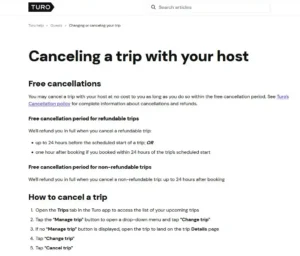
For a standard refundable booking, customers can generally cancel without charge up to 24 hours before the scheduled trip start.
Bookings made close to departure normally have a shorter free cancellation window.
Non-refundable discounted trips have different rules, including an initial 24-hour cancellation grace period after booking.
If a host cancels, Turo provides options for rebooking or obtaining a refund.
The safest approach is to inspect the cancellation information shown for the individual reservation rather than assuming that every trip has identical conditions.
Is Turo Available in the United Kingdom?
Yes. Turo operates in the UK, although its eligibility conditions, earnings plans and protection arrangements differ from those in the United States.
UK customers generally need to be at least 21 years old and satisfy the applicable driving-licence requirements.
The UK guest protection options include different financial responsibility limits:
| UK guest protection | Eligible physical damage responsibility |
| Premier | £250 |
| Standard | £750 |
| Minimum | £2,000 |
Declining protection, where permitted, can create substantially greater financial exposure.
For UK hosts, the March 2026 earnings structure provides standard plan shares of 60%, 70% and 80%, with different damage responsibility limits.
This illustrates an important principle: customers and vehicle owners should always consult the rules for the country in which their trip or listing operates.
A US protection limit or host earnings percentage should not automatically be applied to a UK reservation.
Is Turo Worth It for Renters and Entrepreneurs?
Turo is worth considering when it provides a clear advantage in price, convenience or vehicle choice.
For renters, the platform can offer access to vehicles and collection arrangements that may be difficult to obtain through conventional rental firms.
However, the best decision depends on the final booking cost, protection terms, host reliability and flexibility.
For entrepreneurs, hosting can create an additional revenue stream and provide access to an established marketplace without developing an independent booking platform.
Yet the economics become less attractive when the business relies on expensive vehicle finance, low booking frequency or optimistic resale assumptions.
Our assessment is that Turo should be evaluated as a genuine operating business opportunity, not a guaranteed passive-income product.
Final Thoughts: Understanding the Real Value of Turo
Turo provides a flexible alternative to traditional car rental while giving vehicle owners an opportunity to generate income from eligible cars. Its appeal comes from greater vehicle choice, convenient booking and the potential to operate a rental business through an established marketplace.
However, the financial details matter. Renters should compare complete booking costs and protection arrangements, while hosts should examine operating expenses, vehicle depreciation and realistic utilisation. Our analysis suggests that Turo offers the greatest value when convenience and pricing are assessed together, and hosting decisions are supported by careful financial planning rather than optimistic revenue estimates.
Frequently Asked Questions About Turo Car Rental
Is Turo a legitimate car rental service?
Yes. Turo is an established peer-to-peer car-sharing marketplace connecting eligible vehicle owners with customers. Individual vehicle quality and host reliability still vary.
Do you need your own car insurance to rent from Turo?
You generally do not need to hold a personal car insurance policy to book an eligible Turo trip, but you should understand the trip’s liability insurance and protection arrangements.
Can you rent a Turo car for a month?
Yes. Turo supports longer reservations, including monthly rentals, subject to vehicle availability and booking conditions.
Can someone else drive your Turo rental?
Yes, provided they meet Turo’s eligibility requirements and are approved as additional drivers for the trip.
Can you use Turo for business travel?
Yes. Turo can be used for business travel, subject to the platform’s permitted-use rules and the employer’s travel and insurance requirements.
Do Turo hosts get paid before or after a trip?
Host earnings are generally processed after the trip begins or according to the applicable payout schedule. The precise timing depends on the trip and payment arrangements.
Is Turo hosting considered passive income?
Not entirely. Hosts usually need to manage cleaning, maintenance, customer communication, vehicle handovers and administrative tasks, unless those responsibilities are delegated.