

Renting a car in the United States typically costs around $40 to $60 per day for a standard vehicle, although economy cars can be cheaper and airport rentals, SUVs and luxury vehicles can cost substantially more.
The amount displayed during an online search, however, does not always represent the final expense.
Our analysis of US car rental pricing, company policies and booking structures shows that taxes, airport charges, insurance, additional drivers, fuel and security deposits can significantly affect the overall cost.
For business travellers, families and entrepreneurs, understanding these expenses is essential for making financially sensible decisions.
We examined rental pricing benchmarks and published supplier conditions to explain how much drivers should budget for a day, week or month, which charges are avoidable and how to compare rental companies based on the total amount payable.
How Much Does It Cost to Rent a Car in the US?
The average cost of renting a car in the United States is approximately $44 per day, based on national rental-search pricing benchmarks available during 2026.
At that rate, a seven-day rental would cost approximately $308 before adding any charges that are not included in the quoted price.
However, national averages can conceal considerable differences between locations. A smaller vehicle rented from a neighborhood branch may cost substantially less than a similar car collected from a busy airport.
Our review also found that vehicle size does not always determine price. Rental companies frequently adjust rates according to demand and availability, meaning an SUV can occasionally be cheaper than a midsize sedan.
Average Car Rental Prices by Vehicle Type
| Vehicle Type | Approximate Daily Budget | Seven-Day Budget |
| Economy car | $25–$60 | $175–$420 |
| Compact car | $30–$65 | $210–$455 |
| Midsize sedan | $35–$80 | $245–$560 |
| Standard SUV | $40–$100 | $280–$700 |
| Minivan | $65–$130 | $455–$910 |
| Pickup truck | $45–$110 | $315–$770 |
| Luxury car | $70–$180+ | $490–$1,260+ |
| Specialty or exotic car | $200+ | $1,400+ |
These are illustrative US planning ranges, not verified national averages or guaranteed supplier quotations. The weekly figures multiply the daily ranges by seven and exclude additional expenses. Actual weekly rates may be discounted.
For customers primarily concerned about affordability, economy and compact vehicles are generally sensible starting points.
However, the cheapest category may not provide the best overall value if it cannot comfortably accommodate passengers, luggage or business equipment.
How Much Does It Cost to Rent a Car for Different Periods?
Car rental companies generally offer daily, weekly and longer-term pricing arrangements.
Our financial assessment suggests comparing the complete booking total rather than assuming that multiplying a daily rate will always produce the actual weekly or monthly cost.
The following example uses a $44 daily rental benchmark.
| Rental Duration | Illustrative Base Cost |
| One day | $44 |
| Two days | $88 |
| Three days | $132 |
| Five days | $220 |
| Seven days | $308 |
| 14 days | $616 |
| 30 days | $1,320 |
These calculations exclude taxes, additional services and potential rental-duration discounts.
How Much Is a Rental Car for One Day?
For a standard vehicle, a practical initial budget is approximately $40–$60 per day.
A one-day rental might be suitable for attending business meetings, visiting clients or completing a journey where other transportation methods would be inconvenient.
However, customers should pay attention to pickup and return times.
Many rental contracts use consecutive 24-hour periods rather than simply charging by calendar date. Returning a vehicle beyond the agreed period could result in additional charges.
How Much Does a Weekly Car Rental Cost?
A weekly car rental may cost approximately $300–$500 for a standard vehicle, although location, season and availability can move prices outside this range.
Weekly rates can be more economical than booking separate daily rentals, particularly when providers offer promotional packages.
Our recommendation is to compare a seven-day quote against a five-day or six-day quote before completing a reservation.
Sometimes a weekly pricing structure provides better value even when the car is not required for every day.
However, returning a vehicle early can alter the original pricing arrangement, so the supplier’s terms must be checked.
How Much Is a Monthly Car Rental?
A monthly car rental may require a budget of around $1,200–$1,800 for a standard vehicle, with substantial variation by location and rental provider.
Some companies provide discounted long-term arrangements, while others price extended rentals differently from standard daily reservations.
Monthly rentals can be useful for temporary employment, extended business assignments, vehicle repairs or individuals who need transportation without committing to purchasing a car.
Before booking, customers should clarify whether the agreement includes maintenance, unlimited mileage, roadside assistance and any requirement to renew or exchange the vehicle.
What Additional Fees Increase the Cost of Renting a Car?
The advertised daily rate is only one component of the total rental expense.
Our review identified several charges that can materially affect affordability.
| Additional Expense | Typical Charging Method | Financial Consideration |
| Sales and rental taxes | Percentage or location-specific charges | Usually mandatory |
| Airport concession fees | Percentage or fixed amount | Depends on pickup location |
| Customer facility charges | Daily or transaction-based | Common at airports |
| Damage waiver | Daily optional charge | Depends on vehicle and supplier |
| Additional driver | Daily charge per eligible driver | Exemptions may apply |
| Young renter surcharge | Daily fee | Often applies below age 25 |
| Child safety seat | Daily equipment charge | Depends on availability |
| One-way drop-off | Route-dependent charge or higher rate | May be substantial |
| Toll administration | Daily usage or transaction fee | May be added to tolls |
| Refuelling service | Fuel replacement plus applicable service pricing | Often avoidable |
| Late return | Extra time or additional rental day | Depends on agreement |
| Excess mileage | Charge per additional mile | Applies to mileage-limited rentals |
These costs should be reviewed before payment because a seemingly inexpensive reservation may become substantially more expensive after necessary additions.
Why Are Airport Car Rentals More Expensive?
Airport rental locations are convenient, but they frequently involve higher operating costs and additional facility-related charges.
Rental companies may pass airport concession expenses, customer facility fees and other location-specific costs to customers.
In NerdWallet’s April 2026 analysis, downtown car rental locations were, on average, $126 cheaper for a seven-day rental than the corresponding airport locations examined.
This does not mean every neighborhood rental is cheaper. Transportation from the airport to an alternative rental office must also be considered.
Airport vs Downtown Rental Cost Comparison
Consider two hypothetical five-day bookings for similar vehicles.
| Expense | Airport Rental | Downtown Rental |
| Base rental | $300 | $250 |
| Taxes and location fees | $75 | $40 |
| Transportation to rental office | $0 | $25 |
| Total | $375 | $315 |
In this example, choosing the downtown location saves $60, or 16% of the airport rental total.
However, the saving may disappear if reaching the neighborhood branch requires an expensive taxi ride or creates substantial inconvenience.
Our assessment is that airport convenience has genuine value, particularly for business travellers operating under strict schedules.
How Much Does Rental Car Insurance Cost?
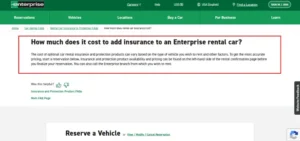
Rental car insurance and protection products can materially increase the cost of a reservation.
Unlike the base rate, there is no universal insurance price applicable across every supplier, vehicle category or US location.
Companies may offer several products with different purposes, exclusions and coverage limits.
Common Rental Protection Options
| Protection Product | Main Purpose |
| Collision Damage Waiver (CDW) | Reduces or waives certain responsibility for damage to the rental vehicle |
| Loss Damage Waiver (LDW) | Addresses qualifying vehicle loss or damage under the agreement |
| Supplemental Liability Protection | Provides additional third-party liability protection subject to policy terms |
| Personal Accident Insurance | Provides specified accident-related benefits |
| Personal Effects Coverage | Protects certain personal belongings subject to limits |
A collision or loss damage waiver is generally a contractual waiver rather than a conventional insurance policy.
Our analysis suggests that customers should first establish whether their personal auto insurance policy or credit card already provides suitable rental vehicle coverage.
However, credit-card collision benefits generally do not replace liability insurance. Coverage can also differ for business travel, international rentals, long rental periods and specialty vehicles.
Financial example: Suppose an optional damage waiver costs $25 per day.
For a seven-day rental, the additional cost would be $175.
Against a $308 base rental, that represents a 56.8% increase before taxes and other expenses.
The decision should therefore be based on the protection provided, existing cover and potential financial exposure rather than price alone.
Enterprise explains that rental protection prices vary according to the vehicle and reservation details.
How Much Extra Do Drivers Under 25 Pay?
Many US car rental companies charge a young renter fee for eligible drivers younger than 25.
This fee is usually additional to the advertised vehicle rate.
For example, Hertz publishes a standard young renter fee of $19 per day, subject to applicable location and rental conditions.
A seven-day rental would therefore incur an additional $133 in young renter charges at that rate.
| Rental Duration | Extra Cost at $19/Day |
| One day | $19 |
| Three days | $57 |
| Five days | $95 |
| Seven days | $133 |
| 14 days | $266 |
The age requirements themselves also vary.
Hertz normally permits rentals from age 20 at most US locations, with lower minimum ages in certain states. Other suppliers may apply different thresholds and vehicle restrictions.
Customers should check age eligibility before paying for a reservation.
A low online price provides little value if the driver does not satisfy the company’s pickup requirements.

Hertz’s official young renter policy explains minimum rental ages and the additional daily fee for drivers under 25.
How Much Does It Cost to Add Another Driver?
Rental companies commonly charge an additional fee when another person is authorized to operate the vehicle.
Avis, for example, lists an additional driver fee of $13 per day in most US states, with exceptions and different arrangements in certain states.
| Rental Duration | Additional Driver Cost at $13/Day |
| One day | $13 |
| Three days | $39 |
| Five days | $65 |
| Seven days | $91 |
For a seven-day rental with a $308 base price, a $91 additional driver fee represents an increase of approximately 29.5%.
However, some suppliers allow qualifying spouses, domestic partners or business-related drivers to operate the vehicle without an additional fee.
These exemptions depend on the company’s policies and eligibility requirements.
For business travel, it is especially important to establish whether employees sharing a vehicle qualify for any exemptions.
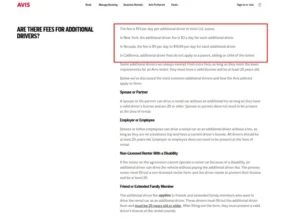
Avis outlines its additional driver charges and the circumstances in which eligible drivers may be exempt.
How Does a Rental Car Security Deposit Work?
A security deposit is one of the most frequently misunderstood parts of a car rental transaction.
Our financial analysis distinguishes between two important figures:
- Rental expenditure: The amount the customer ultimately pays for using the car.
- Security deposit: Money or available credit temporarily held or collected to protect against specified additional charges.
A refundable security deposit is not automatically an additional rental expense.
For example, suppose a customer books a vehicle with an estimated rental cost of $350 and an illustrative $250 deposit.
| Item | Amount |
| Estimated rental charge | $350 |
| Security deposit | $250 |
| Potential funds or credit required at pickup | $600 |
| Normal rental expenditure if no extra charges arise | $350 |
The customer may need access to $600 at collection, even though only $350 represents the expected final rental expenditure.
Enterprise confirms that US deposit amounts vary according to location, vehicle and other factors.
Credit-card payments may involve an authorization hold, while debit-card arrangements can involve funds being taken and later refunded.
Refund timing depends on the payment method and financial institution.
Enterprise indicates that debit-card deposit refunds typically appear within approximately five to ten business days after the rental is returned, although actual processing can vary.
This distinction is particularly important for travellers using debit cards or businesses with limited working capital.

Enterprise’s official deposit refund policy explains how credit-card authorization holds and debit-card refunds work.
What Is the Total Cost of Renting a Car?
The most useful financial measure is the total trip expenditure, not the headline daily rate.
To demonstrate the difference, we modelled three hypothetical rental scenarios.
These examples are budgeting exercises, not live quotations, customer transactions or measured national averages.
Example 1: Budget Rental for a Short Business Trip
A business traveller books an economy vehicle for four days.
| Expense | Amount |
| Base rental: $45 × 4 days | $180 |
| Estimated taxes and mandatory fees | $54 |
| Fuel | $40 |
| Parking | $36 |
| Total trip cost | $310 |
The original base rental costs $180, but the complete transportation expense reaches $310.
That is approximately 72.2% higher than the advertised rental subtotal.
This scenario illustrates why business travel budgets should include parking and fuel rather than focusing only on the vehicle invoice.
Example 2: Family Rental From an Airport
A family requires a vehicle for five days and purchases additional services.
| Expense | Amount |
| Base rental: $65 × 5 days | $325 |
| Estimated taxes and airport fees | $90 |
| Optional damage waiver | $125 |
| Child safety seat | $70 |
| Fuel | $65 |
| Tolls and related charges | $35 |
| Parking | $60 |
| Total trip cost | $770 |
The final cost is approximately 136.9% above the original $325 base rate.
Although the optional protection and equipment may be appropriate for the family, they materially change the rental budget.
Example 3: Seven-Day Rental for a Young Driver
Consider a 23-year-old driver using the $44 daily benchmark and an illustrative fee structure incorporating Hertz’s published $19 daily young renter charge.
| Expense | Amount |
| Base rental: $44 × 7 days | $308 |
| Estimated mandatory taxes and fees | $70 |
| Young renter fee: $19 × 7 days | $133 |
| Fuel | $64 |
| Optional damage waiver: $25 × 7 days | $175 |
| Total with waiver | $750 |
The total without the optional damage waiver would be $575.
With the waiver, the total is approximately 143.5% higher than the $308 base rental.
The example demonstrates how age-based charges and optional protection can substantially affect younger customers.
What Do These Examples Show?
| Scenario | Advertised Base | Modelled Total | Increase |
| Four-day business rental | $180 | $310 | 72.2% |
| Five-day family airport rental | $325 | $770 | 136.9% |
| Seven-day young-driver rental with waiver | $308 | $750 | 143.5% |
These percentage increases are calculated from the hypothetical scenarios. They should not be interpreted as typical industry markups.
Our conclusion from the modelling is straightforward: car rental affordability must be assessed using the entire transportation budget.
Which Rental Car Companies Offer Better Value?
Major US providers include Enterprise, Hertz, Avis, Budget, Alamo, National, Dollar and Thrifty.
Our review suggests that rental companies should be compared using complete prices, location convenience, vehicle availability, payment requirements and additional charges.
A brand that offers the lowest price for one booking may be more expensive for another.
In NerdWallet’s April 2026 comparison, Budget, Avis and Sixt ranked among the less expensive suppliers examined. The study found an average seven-night price of $333 for Budget compared with $679 for National under its research conditions.
That difference illustrates the value of comparison shopping, but it does not establish that either supplier will always be cheaper.
Our Car Rental Booking Value Ratings
We assessed four booking approaches using five editorial considerations: potential savings, price transparency, flexibility, convenience and ease of resolving booking problems.
| Booking Approach | Editorial Value Rating | Assessment |
| Comparing multiple suppliers before booking | 94% | Strongest starting point for identifying competitive total prices |
| Booking directly with a rental company | 90% | Useful for clear supplier communication and reservation changes |
| Choosing an off-airport location | 88% | Potential savings, provided transport costs remain reasonable |
| Selecting prepaid nonrefundable rates | 73% | Can reduce initial prices but creates cancellation exposure |
Rating methodology: These percentages are editorial judgment scores out of 100, not survey findings, independently measured customer satisfaction or verified statistical savings. Higher ratings reflect the overall usefulness of each approach for a price-conscious US renter.
No individual supplier has been assigned a percentage performance rating without a consistent comparison of its actual offers.
How Do Fuel, Tolls and Mileage Affect Rental Costs?
Several expenses arise after the reservation has been made.
They can be particularly significant for customers completing long road trips or driving between different states.
Fuel Charges
Most conventional rental agreements specify a fuel-return requirement.
Returning the vehicle with less fuel than required can result in refuelling charges.
Purchasing prepaid fuel may be convenient, but customers should examine whether unused fuel will be refunded.
From a budgeting perspective, refilling the vehicle at an ordinary gas station before returning it may be the more economical option when permitted by the agreement.
Toll Road Charges
Some rental companies provide electronic toll payment services.
In certain regions, Enterprise lists a TollPass convenience charge of $4.95 per day when the service is used, capped at $34.65 per rental, in addition to the tolls themselves.
Rules and available payment alternatives vary geographically.
A compatible personal toll transponder may sometimes reduce administration expenses.
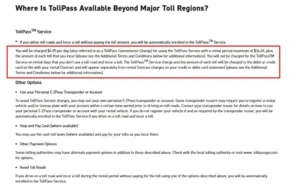
Enterprise’s official TollPass information explains the daily convenience charge, rental maximum and additional toll expenses.
Mileage Restrictions
Many mainstream US car rentals include unlimited mileage, but this should not be assumed for every vehicle or booking.
Some luxury vehicles, specialty rentals, local agreements and peer-to-peer rentals may restrict mileage.
For example, a hypothetical rental with a 500-mile allowance and an excess charge of $0.30 per mile would cost another $60 if the driver travelled 700 miles.
The actual allowance and excess rate must be confirmed in the rental agreement.
One-Way Return Fees
Returning a vehicle to a different location can trigger an additional charge or a different base rate.
These charges depend on the rental route, supplier, demand and vehicle availability.
A customer collecting a vehicle in Los Angeles and returning it in San Francisco should therefore compare a one-way reservation against alternatives before booking.
A universally applicable one-way surcharge cannot be calculated reliably without the actual route.
When Is the Cheapest Time to Rent a Car?
Rental prices fluctuate according to demand, travel dates, location and fleet availability.
Airport markets can be especially sensitive to tourism activity, business events and seasonal travel.
A 2026 summer survey covering 100 US airports found an average daily price of $82.90 for the cheapest available rental vehicles included in the study.
The same survey identified particularly expensive destinations such as Anchorage, where the cheapest available vehicles averaged $182 per day during the surveyed summer period.
These figures demonstrate why nationwide averages should not be applied automatically to specific destinations.
Booking timing also matters.
However, customers should not assume that reserving either very early or at the last minute will always produce the lowest price.
A financially sensible approach is to make a flexible reservation when an acceptable rate appears, then compare equivalent offers again before departure.
Provided the original booking can be cancelled without penalty, this may allow the customer to benefit from subsequent price reductions.
How Can You Reduce the Cost of Renting a Car?
Our analysis identified several practical strategies that can reduce unnecessary expenses without compromising the suitability of the vehicle.
- Compare total prices: Examine mandatory taxes and fees rather than ranking offers by daily rates alone.
- Check neighborhood branches: Compare airport and downtown rentals after including transportation costs.
- Choose the right vehicle: Avoid paying for unnecessary seating, luggage space or premium features.
- Review existing insurance: Check personal and credit-card coverage before buying overlapping protection.
- Avoid unnecessary additional drivers: Use exemptions where applicable and permitted.
- Check membership benefits: Eligible AAA, employer, loyalty and other membership discounts may reduce specific rental expenses.
- Understand fuel terms: Return the car with the required fuel level.
- Review toll arrangements: Establish whether administration charges can be avoided legally.
- Compare weekly pricing: Check whether an extended reservation offers a better effective daily rate.
- Use flexible reservations strategically: Recheck prices where cancellation terms allow.
The cheapest option is not necessarily the one with the lowest advertised rate.
A slightly more expensive reservation that includes suitable mileage allowances, appropriate protection and fewer additional charges may provide better overall value.
Is Renting a Car Cheaper Than Using Uber or Public Transportation?
The answer depends largely on how frequently the vehicle will be used.
A rental can provide better value for multi-stop business journeys, family road trips and destinations where public transportation is limited.
However, renting may become uneconomical when a vehicle remains parked for most of the day.
Consider the following hypothetical three-day city visit.
| Expense | Rental Car | Rideshare |
| Vehicle or trip charges | $135 | $150 |
| Rental taxes and fees | $35 | Included in assumed rideshare fares |
| Fuel | $30 | Included |
| Parking | $60 | $0 |
| Total | $260 | $150 |
In this scenario, rideshare transportation is $110 cheaper.
However, a traveller making numerous journeys across a large metropolitan area may face much higher rideshare expenses.
The decision should reflect anticipated routes, passenger numbers, parking availability, time constraints and the total expected transportation cost.
For entrepreneurs exploring opportunities rather than booking vehicles personally, the economics work differently.
Our comparison of 20 rental business ideas to start in the US examines how rental income, asset utilization, maintenance and operating expenses influence the commercial viability of vehicle rental businesses.
What Should Business Owners Consider Before Renting Cars?
Business-related car rentals require additional financial attention because the cost of transportation affects operating budgets.
Companies may use rental vehicles for client visits, temporary employee transportation, business conferences or short-term operational requirements.
Our analysis suggests that a business should assess the following before entering a rental agreement:
- Whether the company has access to negotiated corporate rates.
- Whether additional employees can drive without paying extra fees.
- Whether the intended commercial use is permitted and appropriately insured.
- Whether mileage requirements match the planned business activity.
- Whether the rental invoice provides sufficient detail for accounting and reimbursement.
- Whether the total expense is lower than alternative transportation arrangements.
For frequent vehicle requirements, a company may also compare short-term rentals with leasing, fleet ownership or other transportation arrangements.
The decision depends on utilization, financing, depreciation, insurance and operational requirements.
Entrepreneurs interested in operating on the supplier side can also examine how to start a car rental business, including fleet acquisition costs, maintenance responsibilities and the operational factors that influence profitability.
What Should You Check Before Paying for a Rental Car?
Before confirming a reservation, customers should review the complete payment conditions.
Our recommended approach is to separate the transaction into three categories.
First, identify mandatory expenditure. This includes the vehicle rate, applicable taxes and compulsory location charges.
Second, identify optional expenditure. This may include additional protection products, child seats, equipment and other selected services.
Third, identify conditional financial exposure. This includes security deposits, excess mileage, refuelling charges, late returns, damage responsibilities and cancellation penalties.
The distinction allows a customer to understand not only the amount likely to be spent but also the credit or cash that may be needed at pickup.
Customers unfamiliar with the reservation process can review the requirements and steps for renting a car in the US before confirming a booking.
Our financial assessment is that a transparent $60-per-day offer may provide better value than a $45-per-day offer once the complete contractual conditions are considered.
Final Assessment
The cost of renting a car in the United States can begin at relatively affordable daily rates, but the full financial commitment depends on much more than the vehicle category.
Our review of 2026 pricing information and rental-company policies indicates that location, duration, driver eligibility, optional protection and contractual fees all influence the amount customers ultimately spend.
For many standard bookings, planning around a $40–$60 daily base rate provides an initial budget reference, but customers should calculate the complete trip expense before deciding whether a rental represents good value.
The most important principle is to compare total cost, not advertised price. A rental that appears cheaper at the beginning of the booking process is not necessarily the most economical choice once all relevant expenses are included.
Frequently Asked Questions
Can You Rent a Car for $30 a Day?
Yes. Economy cars can sometimes be available for $30 per day or less, particularly during periods of lower demand. However, the price may exclude mandatory fees, protection products and other charges.
How Much Does It Cost to Rent a Car for a Weekend?
A two- or three-day rental might have a base cost of approximately $80–$180 for a standard vehicle, depending on rates and availability. Weekend pricing, taxes and additional services can change the total.
Do Rental Car Prices Include Insurance?
Rental prices may include certain legally required protections, but the scope varies by jurisdiction and supplier. Optional damage waivers and additional insurance products can increase the rental price.
Is a $200 Deposit Enough to Rent a Car?
Not necessarily. Deposit requirements vary according to the rental company, location, payment method and vehicle. Customers must check the specific reservation conditions rather than assume a fixed deposit.
Is It Cheaper to Rent a Car for Seven Days?
Sometimes. Weekly pricing can offer a lower effective daily rate than shorter reservations. However, customers should compare the actual total and understand the consequences of returning a vehicle early.
Can You Rent a Car Without a Credit Card?
Some US rental companies accept debit cards under specific conditions. Additional identification, payment restrictions or deposit requirements may apply, depending on the supplier and location.
What Happens if You Return a Rental Car Late?
A late return may trigger extra-hour charges, another rental day or additional optional-product charges. The exact outcome depends on the rental agreement and any applicable grace period.