


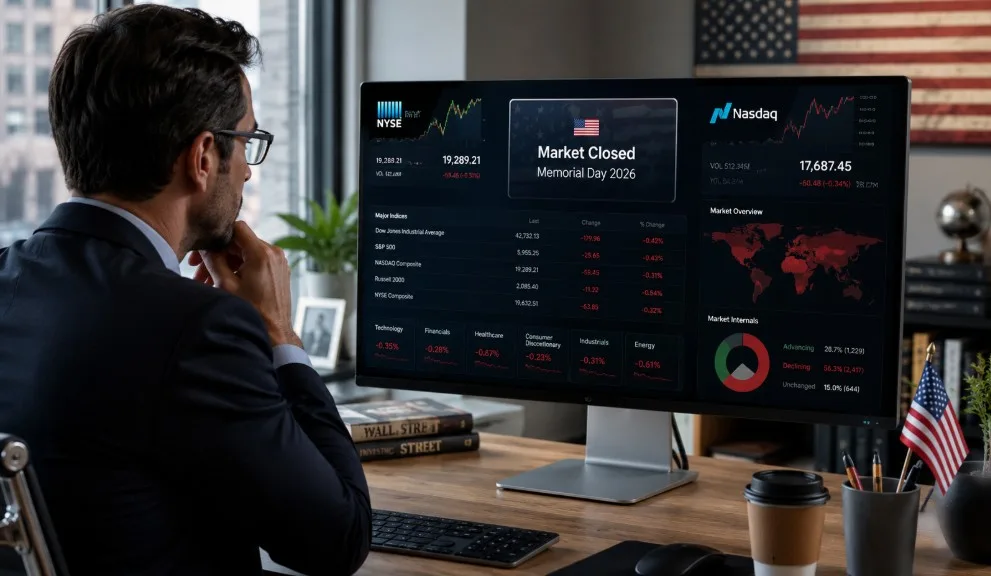

The U.S. stock market is closed on Memorial Day in 2026, as the holiday falls on Monday, May 25, and is recognised as a federal market holiday across major exchanges.
Both the New York Stock Exchange (NYSE) and Nasdaq halt trading for the day, with normal operations resuming on Tuesday, May 26, 2026. This closure is part of the standard annual holiday calendar observed by U.S. financial markets.
Key takeaways:
- Stock market closed: Monday, May 25, 2026
- Affects NYSE, Nasdaq, and bond markets
- Trading resumes: Tuesday, May 26, 2026
- Part of official U.S. federal holiday schedule
Investors typically plan ahead for reduced liquidity and a paused trading session during this long weekend.
Is the Stock Market Open or Closed on Memorial Day 2026?
The U.S. stock market is fully closed on Memorial Day 2026, with no trading activity on the New York Stock Exchange (NYSE) or Nasdaq. This closure is part of the official federal holiday schedule observed across financial institutions in the United States.
All equities trading pauses for the entire day, including regular session, pre-market, and after-hours trading. Investors cannot execute trades until the market reopens on Tuesday, May 26, 2026.
The closure is consistent with long-standing U.S. market tradition, where Memorial Day is recognized as one of the key annual holidays when trading is suspended across all major exchanges.
“Memorial Day is one of the core market holidays when liquidity fully disappears across U.S. equities, and investors should plan accordingly,” – notes a senior U.S. equity market strategist.
Why is the US Stock Market Closed on Memorial Day?

The closure of the stock market on Memorial Day is rooted in the holiday’s national significance and the coordinated structure of U.S. financial market operations.
What Memorial Day Represents in the United States?
Memorial Day is observed to honour U.S. military personnel who have died in service to the country. It is a federal holiday, meaning most government institutions, financial regulators, and public services pause operations for the day. Because financial markets are closely aligned with federal and banking systems, they also close in observance.
“Market holidays like Memorial Day are part of a long-standing tradition that aligns financial operations with federal observances and ensures system-wide consistency.” – A NYSE spokesperson
Federal Holiday Rules for Financial Markets
U.S. stock exchanges follow a coordinated calendar developed in alignment with the Securities Industry and Financial Markets Association (SIFMA). This ensures that equities, bonds, and settlement systems operate uniformly.
When a federal holiday occurs, trading systems are fully paused to avoid settlement disruptions and operational risk.
A Nasdaq market operations representative has stated:
“Consistency across exchanges and clearing systems is essential, which is why federal holidays are observed uniformly across U.S. equity markets.”
Does Every Financial Market Shut Down Completely?
Not every financial instrument behaves the same way during Memorial Day. While equities and bond markets close, some global and digital markets continue operating. Cryptocurrency markets, for example, remain open 24/7, and certain international exchanges operate independently of U.S. holidays.
However, U.S.-listed securities remain fully inactive until the next trading session resumes.
Which Exchanges are Closed on Memorial Day 2026?
Memorial Day 2026 results in a full closure across all major U.S. equity and fixed-income trading venues. This includes both primary exchanges and supporting trading systems that facilitate market liquidity.
Major US Stock Exchanges Affected
The following exchanges remain closed on Monday, May 25, 2026:
- New York Stock Exchange (NYSE)
- Nasdaq Stock Market
- NYSE American
- NYSE Arca
- NYSE National
These closures apply across all listed securities, including stocks, ETFs, and structured products. No transactions are processed during the holiday, and all trading activity is paused until the next session begins.
Bond and OTC Market Closures
The U.S. bond market also follows the SIFMA holiday schedule and is closed for Memorial Day. This includes trading in U.S. Treasuries, municipal bonds, and corporate debt instruments.
Over-the-counter (OTC) markets also shut down, ensuring that all fixed-income and decentralized trading systems remain aligned.
This coordinated closure is essential for maintaining settlement integrity across multiple asset classes, especially where trades are dependent on synchronized clearing cycles.
Do Derivatives and Options Markets Close Too?
Yes, U.S. options and equity-linked derivatives markets also close in line with the broader exchange schedule.
However, some globally traded derivatives tied to international indices may still operate depending on their respective jurisdictions and exchanges.
Exchange Closure Comparison Table:
| Market Type | Status on Memorial Day 2026 | Notes |
| NYSE & Nasdaq | Closed | Full equity trading pause |
| Bond Market (SIFMA) | Closed | Includes U.S. Treasuries |
| OTC Markets | Closed | No decentralized trading |
| Futures Markets | Limited/varies | Some contracts may trade globally |
The uniform closure ensures stability across the financial system and prevents settlement mismatches across asset classes.
When Does the Stock Market Reopen After Memorial Day 2026?
The U.S. stock market reopens on Tuesday, May 26, 2026, returning to standard trading hours of 9:30 a.m. to 4:00 p.m. Eastern Time. There is no staggered or partial reopening; the market resumes full functionality immediately at the opening bell.
Because trading activity is paused for a full day, order flow often accumulates over the holiday weekend. This can sometimes lead to heightened attention during the first hour of trading, as investors react to global developments that occurred while U.S. markets were closed.
A senior NYSE trading floor analyst commented:
“After long weekends like Memorial Day, we often see a surge in opening volatility as global events and investor sentiment build up over the closure period.”
What is the Full US Stock Market Holiday Schedule for 2026?

The U.S. stock market follows a structured annual calendar designed to ensure consistency across equity, bond, and clearing systems. This schedule includes both full closures and occasional early trading sessions depending on the holiday.
Key Federal Holidays Affecting Wall Street
The major market holidays in 2026 include:
- New Year’s Day
- Martin Luther King Jr. Day
- Memorial Day
- Juneteenth
- Independence Day (observed)
- Labor Day
- Thanksgiving Day
- Christmas Day
Each of these holidays is observed uniformly across major exchanges, ensuring synchronized closures across the financial system.
How Holiday Schedules Are Decided Each Year?
Market holiday schedules are jointly coordinated by NYSE, Nasdaq, and SIFMA. This collaboration ensures that equity markets, bond markets, and settlement systems operate on a unified calendar.
This coordination is particularly important for maintaining accurate trade settlement cycles and preventing mismatches between different financial institutions.
Are Trading Hours Ever Adjusted Instead of Fully Closed?
Yes, in some cases markets may close early rather than shut down completely. Early closures typically occur before major holidays such as Independence Day or Thanksgiving, where trading ends at 1:00 p.m. Eastern Time instead of the regular close.
These adjustments help reduce risk exposure and allow smoother settlement processing heading into extended breaks.
How Does Memorial Day Affect Trading Activity and Investors?
Memorial Day can temporarily affect trading activity and overall market behaviour, even though the closure lasts only one day.
Trading volumes often decline before the long weekend as institutional investors reduce market exposure, which may lead to lower liquidity and smaller price movements ahead of the holiday.
During the closure, U.S. equity trading and ETF pricing remain paused, although some futures contracts may continue trading depending on market rules.
Because many international markets remain open, global economic or political developments can build up before U.S. markets reopen, sometimes increasing volatility afterward.
“Holiday closures are designed to maintain settlement integrity across markets, even when global trading continues elsewhere.” — SIFMA representative
Understanding how holiday closures affect liquidity and investor activity can help traders prepare more effectively for market reopening conditions
Are Banks, USPS, and Financial Services Open on Memorial Day 2026?
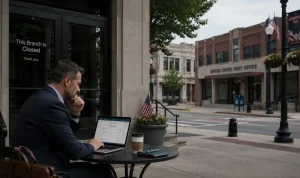
Most banks, postal services and government-related financial institutions are closed on Memorial Day 2026 because it is a federal holiday in the United States.
While physical branches and offices pause operations, many digital financial services continue working normally.
Key service impacts include:
- Banks and Federal Reserve offices remain closed
- USPS does not provide regular mail delivery
- FedEx and UPS may operate limited express services
- Most federal and government offices are closed
Although in-person banking services are unavailable, online banking, mobile apps and digital payment systems generally continue operating.
Customers expecting deliveries or financial processing should prepare for possible delays until the next business day.
What is the Trading Schedule Before Memorial Day Weekend?
The trading schedule leading into Memorial Day follows a predictable structure that is consistent each year.
Markets remain open on the Friday before the holiday, allowing investors to complete positions or rebalance portfolios.
- Friday, May 22, 2026: Normal trading hours
- Monday, May 25, 2026: Market closed
- Tuesday, May 26, 2026: Trading resumes
Although there is no official early closure for Memorial Day, trading volume often declines as the weekend approaches, reflecting reduced institutional participation.
This pre-holiday slowdown is a common pattern in U.S. equity markets and is often observed across other long weekends as well.
Are International Stock Markets Open on Memorial Day?
International stock markets operate independently of U.S. holiday schedules, meaning many global exchanges remain open during Memorial Day. This includes major markets in Asia and parts of Europe.
Markets in Tokyo and Hong Kong typically operate under normal trading hours, while European markets may vary depending on regional observances. As a result, global trading activity continues even when U.S. markets are closed.
This creates a temporary disconnect where international price movements occur without immediate U.S. market reaction. When U.S. markets reopen, they often adjust quickly to reflect developments that occurred during the closure period.
Conclusion
The U.S. stock market is fully closed on Memorial Day 2026, in line with federal holiday observance across major financial institutions.
Both NYSE and Nasdaq suspend trading for the day, with bond and OTC markets also closed. Trading resumes on Tuesday, May 26, 2026, under normal conditions.
For investors, this closure is a routine part of the annual market calendar, but it plays an important role in maintaining operational consistency across financial systems.
Understanding these schedules helps traders plan ahead and manage expectations around liquidity and market activity during holiday periods.
FAQs About Memorial Day Stock Market Closure 2026
Does Memorial Day affect after-hours trading in the U.S.?
After-hours trading closes along with the main market and does not operate on Memorial Day.
Are stock futures and forex markets open on Memorial Day 2026?
Yes, futures and forex markets typically continue operating, though liquidity may be lower.
Can investors place orders during Memorial Day closure?
Orders can be placed, but they are not executed until markets reopen on Tuesday.
How does the holiday impact ETF and index fund pricing?
ETF pricing pauses due to underlying market closure, though global factors may still influence valuation.
Is cryptocurrency trading affected by Memorial Day?
No, crypto markets operate 24/7 and are unaffected by U.S. market holidays.
What is the reason behind U.S. market holiday closures?
They align with federal holidays and allow settlement systems and institutions to operate uniformly.
Does Memorial Day impact dividend or settlement processing?
Yes, settlement timelines are pushed forward due to market closure, delaying processing by one business day.