



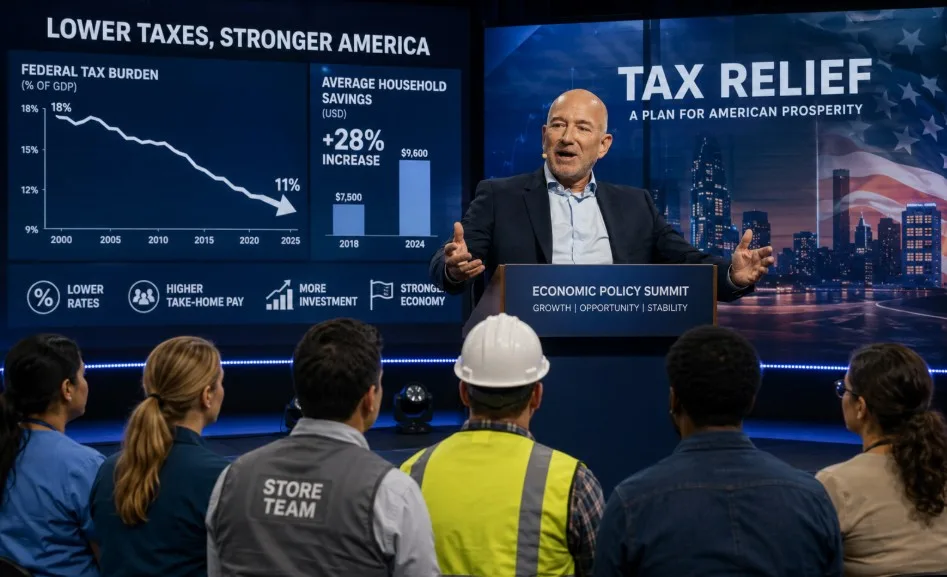

The Jeff Bezos income tax proposal suggests that the bottom half of U.S. earners should pay zero federal income tax, potentially giving many working households more monthly cash for rent, groceries, fuel, childcare, and savings.
Bezos argues that lower-income Americans contribute only a small share of total federal income tax revenue, so eliminating their tax bill could offer meaningful relief without a major revenue loss.
Key highlights:
- The proposal is not an official law.
- It focuses on federal income tax, not payroll, state, or sales taxes.
- Bezos used a $75,000-a-year nurse as a real-world example.
- Similar ideas exist in Congress, including the Keep Your Pay Act.
What Is the Jeff Bezos Income Tax Proposal?
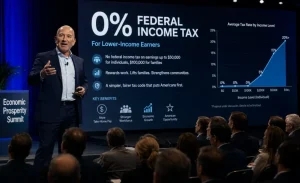
The Jeff Bezos income tax proposal is a tax reform idea calling for the bottom 50% of U.S. earners to pay no federal income tax.
Bezos made the argument during a CNBC interview, saying that people struggling with everyday costs should not have to send part of their paycheck to Washington.
The idea is simple: if lower-income Americans already contribute a relatively small share of federal income tax revenue, removing that burden could provide direct household relief. Bezos stated that the bottom half of earners pay about 3% of federal income taxes, while the top 1% pays close to 40%.
“I don’t think it should be 3%. I think it should be zero,” Bezos said during the CNBC interview.
However, this is currently only a proposal. There is no active Bezos-backed bill, and Congress would need to pass legislation before any such change could become law.
Why Does Jeff Bezos Want the Bottom 50% of Earners to Pay Zero Federal Income Tax?
Jeff Bezos has argued that the bottom 50% of earners should pay no federal income tax, saying many households are struggling with rising living costs.
He believes tax relief could provide immediate financial support and improve economic opportunity for lower-income families.
Reasons Behind the Proposal:
- Cost of Living Pressures: Higher expenses for housing, food, healthcare and childcare.
- Increased Disposable Income: More take-home pay for working households.
- Economic Opportunity: Helping families build financial stability and improve their prospects.
- Personal Perspective: Bezos has linked the idea to his family’s experience of overcoming economic challenges.
Supporters view the proposal as practical relief for struggling workers, while critics argue it does not address the broader tax burden faced by many households
Who Would Qualify Under the Jeff Bezos Income Tax Proposal?

The exact qualification rules are unclear because Bezos has not released a detailed policy plan. Based on his comments and the reporting around them, the proposal appears to target the bottom half of income earners, often discussed as individuals or families earning around $75,000 or less.
Possible Eligibility Framework:
| Potential Rule | What It Could Mean |
| Bottom 50% of earners | Eligibility based on national income distribution |
| $75,000 income threshold | Workers or households under this level may qualify |
| Federal income tax only | Payroll, state, and local taxes would still apply |
| Adjusted gross income | Eligibility may be based on IRS taxable income measures |
A major policy question is whether the threshold would apply to single filers, married couples, or households. Without those details, the proposal remains a broad concept rather than a complete tax plan.
How Much Could Lower-Income Americans Save If Federal Income Tax Was Removed?
Bezos used the example of a nurse in Queens earning $75,000 and paying more than $1,000 a month in taxes. His point was that this money could instead help with essentials such as rent, groceries, transportation, or emergency savings.
The $75,000 “Nurse in Queens” Example
In Bezos’ example, eliminating a $12,000 annual tax bill could mean roughly $1,000 extra per month. That would be significant for many households, especially in expensive cities such as New York, Los Angeles, Boston, Seattle, and Washington, D.C.
Possible Monthly Impact:
| Annual Federal Tax Removed | Monthly Household Relief | Possible Use |
| $3,000 | $250 | Utility bills or groceries |
| $6,000 | $500 | Rent support or car payment |
| $12,000 | $1,000 | Childcare, rent, debt, or savings |
A Real-Life Example:
Consider a healthcare worker in New York earning $62,000 per year. If their federal income tax bill were reduced by $4,800 annually, they would have an extra $400 each month.
That additional income could help pay for groceries, reduce credit card debt, or build an emergency fund. For families living paycheck to paycheck, even a modest tax reduction can have a meaningful impact on everyday financial decisions and overall financial stability.
Why Actual Savings May Vary by Household?
Actual savings would depend on income, deductions, filing status, tax credits, dependents, and state of residence. Some lower-income households already owe little or no federal income tax after credits such as the Earned Income Tax Credit and Child Tax Credit.
That means the largest benefits may go to workers who earn enough to owe federal income tax but not enough to feel financially secure.
What Taxes Would Americans Still Pay Even If Federal Income Tax Became Zero?
The proposal would not eliminate all taxes. This is one of the most important details for readers to understand. Even if federal income tax disappeared for the bottom half of earners, many households would still pay several other taxes.
Taxes That Would Still Apply:
- Social Security payroll tax
- Medicare payroll tax
- State income tax where applicable
- Local income tax in some cities
- Sales tax
- Property tax, directly or through rent
- Gasoline, vehicle, utility, and excise taxes
This matters because payroll taxes can be a major burden for working Americans. Social Security and Medicare taxes come directly out of wages, and sales taxes often take a larger share of income from lower earners than from wealthy households.
So, the Jeff Bezos income tax proposal would reduce one tax burden, but it would not make working families tax-free overall.
How Does the Proposal Compare with the Keep Your Pay Act?
The closest legislative comparison is Senator Cory Booker’s Keep Your Pay Act. That proposal would make the first $75,000 of income tax-free for households filing jointly, with proportional relief for single filers and heads of household.
Cory Booker’s $75,000 Tax-Free Income Proposal
Booker’s plan is more formal because it was introduced in Congress and referred to the Senate Finance Committee. It directly targets working households by excluding a portion of income from federal income tax.
“No income tax on the first $75,000 families earn would be a game changer for working people,” Booker said in his statement on the proposal.
Similar Goals, Different Political Messaging
Both ideas focus on tax relief for lower and middle-income Americans. However, Bezos frames the issue as economic efficiency and household relief, while Booker connects it to tax fairness and making wealthy individuals and corporations pay more.
Comparison Table:
| Feature | Bezos Proposal | Keep Your Pay Act |
| Status | Public proposal | Congressional bill |
| Main goal | Zero federal income tax for bottom half | First $75,000 tax-free for families |
| Political approach | Affordability and efficiency | Tax fairness and working-family relief |
| Key challenge | No detailed bill | Limited legislative progress |
Why Congress Has Not Advanced a Broad Tax Exemption Yet?
Broad tax exemptions are difficult because lawmakers must decide how to replace lost revenue, who qualifies, and whether higher earners should pay more. Even popular tax cuts can become complicated when budget rules, deficits, and political priorities enter the debate.
Would the Jeff Bezos Income Tax Proposal Reduce Income Inequality?
The proposal could reduce short-term financial pressure for some lower-income households, but its effect on long-term income inequality is less certain.
Giving workers more take-home pay can improve affordability, but it does not directly address wages, housing supply, healthcare costs, education costs, or wealth concentration.
Supporters may argue that more disposable income helps families stabilize and invest in their future. Critics may argue that the tax system should focus more on untaxed wealth, capital gains, and high-income tax strategies.
A professional tax policy view would be: “Federal income tax relief can improve cash flow, but inequality depends on the full tax system, wage growth, asset ownership, and cost-of-living pressures.”
That makes the proposal important, but not a complete solution to America’s wealth gap.
How Would the Proposal Affect Government Revenue and Federal Spending?

Bezos argues that the revenue loss would be manageable because the bottom half of earners contributes only about 3% of federal income tax revenue. In theory, that makes the proposal less expensive than broad-based tax cuts across all income groups.
Still, 3% of federal income tax revenue is not nothing. Congress would have to decide whether to offset the loss through spending cuts, higher taxes elsewhere, closing loopholes, borrowing, or economic growth assumptions.
This is where the proposal becomes politically difficult. Tax cuts are popular, but revenue replacement is controversial. Any serious version of the plan would need a detailed budget score and IRS implementation rules.
What Are the Main Criticisms of Bezos’ Tax Proposal?
Critics raise several concerns. First, many low-income households already pay no net federal income tax because of deductions and refundable credits. Second, the proposal does not remove payroll taxes, which many workers feel more directly.
Main Criticism Points:
- It may not help the lowest-income households much if they already owe no federal income tax.
- It may benefit moderate earners more than the poorest families.
- It does not solve payroll, state, local, or sales tax burdens.
- It lacks formal legislative details.
- It may increase pressure on the federal deficit without offsets.
At the same time, supporters argue that even partial tax relief can matter. For families earning too much to qualify for major credits but too little to feel financially stable, the proposal could provide real monthly support.
What Does the Jeff Bezos Income Tax Proposal Mean for U.S. Tax Policy in 2026?
The Jeff Bezos income tax proposal adds a new angle to the 2026 tax debate. Instead of only focusing on whether the rich should pay more, it asks whether lower earners should pay federal income tax at all.
The idea is likely to influence conversations around tax brackets, credits, deductions, payroll taxes, and middle-class relief. However, it should not be mistaken for law. Until Congress acts, taxpayers should continue following current IRS rules.
For 2026, the proposal’s biggest impact may be political rather than immediate. It gives lawmakers, voters, and policy experts a clear question: should America reduce taxes from the bottom up instead of only debating increases at the top?
Conclusion
The Jeff Bezos income tax proposal could become one of the most discussed tax reform ideas of 2026 because it speaks directly to affordability.
By calling for zero federal income tax for the bottom half of earners, Bezos is arguing that working Americans need more take-home pay and that the government can absorb the revenue loss.
Still, the idea has limits. It does not erase payroll taxes, state taxes, sales taxes, or the broader cost-of-living crisis. It also needs legislative detail before it can become real policy. For now, it is a powerful proposal shaping the national tax conversation.
Frequently Asked Questions
Is Jeff Bezos’ income tax proposal an official law?
No. It is not currently law. Bezos has publicly supported the idea, but Congress would need to pass legislation for it to take effect.
Would this proposal remove Social Security and Medicare taxes?
No. The proposal focuses on federal income tax. Payroll taxes for Social Security and Medicare would still apply unless Congress changed those rules separately.
Do the bottom 50% of earners already pay very little federal income tax?
Yes. Tax Foundation data cited in reports shows the bottom half pays around 3% of federal income taxes. Many lower-income households already owe no net federal income tax after credits.
Could families earning over $75,000 still benefit from a similar tax plan?
Possibly, depending on how Congress writes any future bill. Some proposals focus on making the first $75,000 of income tax-free rather than setting a strict income cutoff.
How would the government replace lost tax revenue?
Possible options include spending cuts, closing tax loopholes, increasing taxes elsewhere, or accepting higher deficits. No detailed Bezos plan has explained this fully.
Why are billionaires involved in the income tax debate?
Billionaires often influence tax debates because their wealth, tax rates, philanthropy, and business impact are central to discussions about fairness and economic policy.
Could this proposal become part of a future U.S. tax reform bill?
Yes, but only if lawmakers adopt and develop it. Similar ideas, such as the Keep Your Pay Act, show there is political interest in tax relief for working households.