




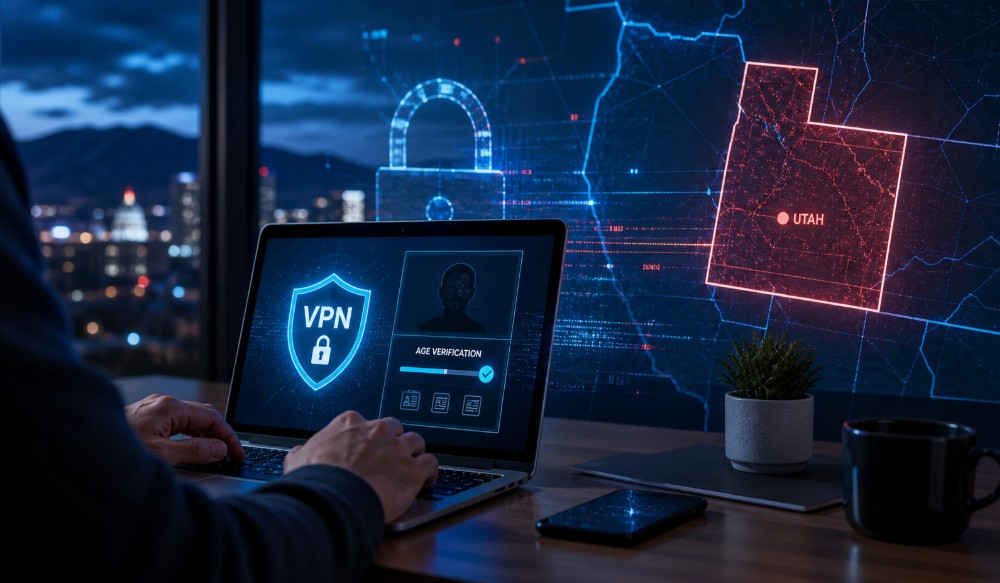

The VPN age verification law Utah introduced through Senate Bill 73 is already reshaping how users, websites, and VPN providers approach online privacy and compliance.
In simple terms, the law requires websites hosting adult or harmful content to verify user age, even if users attempt to bypass restrictions using a VPN. This makes Utah the first US state to directly target VPN usage within age verification laws.
Key takeaways:
- Utah holds websites liable even when users mask location with VPNs
- VPN detection is technically difficult, raising enforcement concerns
- Privacy risks and global compliance challenges are increasing
- The law may influence nationwide internet regulation trends
This shift signals a major turning point in the balance between online safety and digital privacy.
What Is the Utah VPN Age Verification Law and Why Was It Introduced?
The Utah VPN age verification law comes from Senate Bill 73 (Online Age Verification Amendments), taking effect on May 6. It was introduced to address concerns about minors accessing harmful or explicit content online, often using VPNs to bypass restrictions.
Unlike earlier rules, the law requires websites to verify user age and holds them accountable even if users hide their location. This marks a shift from user responsibility to platform liability.
Similar laws are gaining traction across the United States, with states like California exploring account-level verification, while federal proposals such as the “Parents Decide Act” suggest wider nationwide adoption.
“We are entering a phase where digital identity verification is becoming embedded in internet infrastructure, raising both security and privacy questions.”
This law is not just about Utah, it reflects a broader push toward tighter digital governance.
How Does the Utah Age Verification Law Specifically Target VPN Usage?
The defining feature of this legislation is its direct stance on VPN usage. Traditionally, VPNs allow users to mask their IP address and appear as if they are browsing from a different location. Utah’s law attempts to neutralize this capability.
Under SB 73, a user is considered to be accessing a website from Utah if they are physically located in the state, regardless of VPN use.
Additionally, websites are prohibited from offering guidance on bypassing restrictions via VPNs.
Key legal provisions:
- Users are treated as Utah-based based on physical presence, not IP address
- Websites cannot provide VPN bypass instructions
- Platforms remain liable even when VPNs are used
This effectively closes a major loophole used by individuals to access restricted content, but it also introduces complex enforcement challenges.
The law’s wording suggests a strict compliance expectation without fully addressing the technical limitations of VPN detection.
How Does the Utah Age Verification Law Affect VPN Users in the USA?
The impact of the VPN age verification law Utah extends far beyond state borders. For everyday users, VPNs are not just tools for accessing restricted content, they are essential for privacy, security, and even professional safety.
Users in Utah may experience reduced access to certain websites, especially if platforms choose to block VPN traffic entirely to avoid legal risks. Meanwhile, users outside Utah could also be affected if websites adopt global verification measures.
The law may disproportionately impact:
- Journalists protecting sensitive communications
- Activists and whistleblowers
- Individuals seeking anonymity for personal safety
A notable industry observation states:
“When laws target edge cases like misuse, they often end up affecting mainstream users who rely on the same technologies for legitimate reasons.”
This ripple effect suggests that the law could reshape how VPNs are perceived and used across the United States.
Why Are VPN Providers and Websites Concerned About Compliance?

The compliance burden introduced by Utah’s law has triggered significant concern among VPN providers and website operators.
The core issue lies in the expectation that platforms must identify users who are intentionally trying to remain unidentifiable.
VPN companies like NordVPN have described the law as a “liability trap,” where websites are held responsible for something they cannot reliably control. This creates a paradox: businesses must enforce rules that are technically infeasible.
Comparison of Responsibilities Under the Law:
| Entity | Responsibility Under SB 73 | Key Challenge |
| Websites | Verify user age and location | Cannot reliably detect VPN usage |
| VPN Providers | No direct obligation but indirect impact | Increased scrutiny and restrictions |
| Users | Must comply with age restrictions | Reduced anonymity and access |
As a result, many websites may adopt overly cautious strategies, such as blocking all VPN traffic or implementing global age verification systems. This defensive approach could significantly alter the user experience across the web.
What Technical Challenges Make the Utah VPN Law Difficult to Enforce?
Enforcing the Utah VPN age verification law involves complex technical challenges due to how VPNs operate. These tools mask IP addresses and encrypt traffic, making user identification difficult.
As a result, the law places expectations on websites that current technology cannot reliably meet, creating a gap between legal requirements and technical reality.
Limitations of VPN Detection Technologies
Detecting VPN usage is not straightforward. Most systems rely on identifying known VPN IP addresses, but this is unreliable since providers constantly rotate IPs and expand networks.
Modern VPNs also use residential IPs, which closely resemble normal home connections, making detection even harder.
Key challenges in VPN detection:
- Constant rotation of VPN IP addresses
- Use of residential IPs that mimic real users
- Difficulty distinguishing real vs masked traffic
- Rapid evolution of VPN technology
These limits mean detection tools often produce incomplete or inaccurate results, making consistent enforcement difficult.
Why Accurate User Location Verification Is Nearly Impossible?
Verifying a user’s real location is even harder. The law assumes websites can detect if users are physically in Utah, but this is rarely feasible.
Advanced methods like deep packet inspection (DPI) can identify VPN protocols but require ISP-level access, which websites do not have. Techniques like ASN analysis also fail against advanced VPN setups, where traffic appears normal.
Technical limitations overview:
| Detection Method | Effectiveness | Limitation |
| IP Reputation Databases | Moderate | Easily bypassed with rotating IPs |
| ASN Analysis | Low | Cannot detect residential or personal VPNs |
| Deep Packet Inspection | High | Requires ISP-level access |
These barriers show why enforcing location-based rules is challenging.
“You cannot reliably identify a user using tools designed to conceal identity without changing how the internet operates.”
Overall, these constraints make enforcement inconsistent and often impractical.
What Are the Privacy Risks Linked to VPN Age Verification Requirements?
The privacy implications of this law are significant. Age verification often requires users to submit personal information, which may include government-issued IDs or biometric data. This raises concerns about data security and misuse.
For users who rely on VPNs to maintain anonymity, these requirements undermine the very purpose of using such tools. There is also the risk that collected data could be shared with third parties or exposed in data breaches.
Additionally, organizations like the Electronic Frontier Foundation (EFF) warn that the law could push websites to implement blanket verification measures. This means users worldwide could be subjected to identity checks, regardless of their location.
The debate ultimately centers on a fundamental question: how much privacy should individuals sacrifice for online safety?
How Are VPN Companies, Websites, and Advocacy Groups Responding?

The introduction of the VPN age verification law Utah has triggered swift and widespread reactions from across the digital ecosystem.
VPN providers, website operators, and digital rights organizations are all grappling with the implications of a law that many believe is difficult, if not impossible, to enforce effectively.
While the legislation aims to strengthen online safety, stakeholders argue that it introduces legal ambiguity, operational risks, and significant privacy concerns.
Industry Reactions and Legal Concerns
VPN providers and online platforms have been quick to criticize the law. NordVPN labeled it an “unresolvable compliance paradox,” emphasizing the disconnect between legal expectations and technical reality.
Some websites have already begun restricting access in regions with strict age verification laws, while others are considering banning VPN traffic altogether.
Digital Rights Organizations and Public Backlash
Advocacy groups like the EFF argue that the law sets a dangerous precedent. They warn that it could lead to widespread surveillance and reduced internet freedom.
Key responses from stakeholders:
- VPN providers raising technical and legal objections
- Websites exploring restrictive access policies
- Advocacy groups highlighting privacy risks
This growing opposition suggests that the law may face legal challenges or revisions in the future.
Could the Utah VPN Law Impact All Internet Users, Not Just in Utah?
One of the most concerning aspects of the VPN age verification law Utah is its potential global impact. Because websites operate across borders, compliance strategies often extend beyond a single jurisdiction.
If platforms choose to implement universal age verification or block VPN traffic entirely, users worldwide could be affected. This creates a scenario where a state-level law influences global internet practices.
Global impact scenarios:
| Scenario | Potential Outcome |
| Global age verification rollout | Reduced anonymity for all users |
| VPN traffic bans | Limited access to privacy tools |
| Selective compliance | Inconsistent user experiences |
This demonstrates how localized legislation can have far-reaching consequences in a connected digital ecosystem.
Will Utah’s Law Influence Other States to Regulate VPN Usage?
Utah’s approach could serve as a blueprint for other states considering similar regulations. With growing concern about online safety, lawmakers may look to replicate or adapt SB 73.
At the same time, the challenges and backlash associated with the law may deter widespread adoption. Policymakers must balance enforcement feasibility with public acceptance.
Internationally, similar discussions are already underway. Countries like the UK and France have explored VPN restrictions, while VPN usage has surged in response to regulatory changes.
This suggests that Utah’s law is part of a broader global trend toward tighter internet regulation.
How Can VPN Users Adapt to the Changing Legal and Privacy Landscape?

As the Utah VPN age verification law changes privacy expectations, users must rethink how they use VPNs.
While privacy tools remain important, they now require more informed and responsible use. Adapting means understanding both how VPNs work and the legal rules shaping their use.
Best Practices for Safe and Compliant VPN Usage
Users must stay informed about evolving regulations and understand how laws like SB 73 affect their online behavior. Choosing reputable VPN providers and reviewing privacy policies is essential.
Alternatives and Future of Secure Browsing
As regulations evolve, users may explore alternative privacy tools or adopt hybrid approaches to maintain security while complying with legal requirements.
Practical adaptation strategies:
- Monitor legal developments in your region
- Use VPNs responsibly and within legal boundaries
- Consider additional privacy tools beyond VPNs
Adapting to these changes will require a balance between maintaining privacy and complying with emerging laws.
Is the Utah VPN Age Verification Law Effective or Controversial?
The effectiveness of the law remains highly debated. Supporters argue that it strengthens protections for minors and holds platforms accountable. Critics, however, point to its technical flaws and potential privacy violations.
Some experts suggest enforcement may evolve into a “don’t ask, don’t tell” approach, where compliance is only required when a user’s location is clearly known.
Ultimately, the law highlights a growing tension between regulation and technological reality. Its long-term success will depend on how these challenges are addressed.
Conclusion
The Utah VPN age verification law marks a major shift in regulating online activity, directly targeting VPN use. While it aims to improve online safety, it raises important concerns around privacy, enforcement, and broader impact.
As other regions consider similar measures, the balance between security and digital freedom remains critical.
Ultimately, the future of VPN usage will depend on how well such laws adapt to evolving technologies and real-world challenges.
FAQs About
What is the Utah VPN age verification law?
It is a regulation under Senate Bill 73 requiring websites to verify user age, even if users attempt to bypass restrictions using VPNs.
When does the Utah VPN law take effect?
The law comes into effect on May 6, making Utah the first state to enforce such measures targeting VPN usage.
Does the law ban VPNs in Utah?
No, the law does not ban VPNs, but it limits their effectiveness in bypassing age verification systems.
Why is the law controversial?
It is controversial due to technical enforcement challenges and concerns about user privacy and data security.
Can websites detect VPN users accurately?
No, detecting VPN users reliably is extremely difficult due to encryption and constantly changing IP addresses.
Will this law affect users outside Utah?
Potentially, as websites may apply global compliance measures to avoid legal risks.
What are the privacy risks of age verification?
Users may need to share sensitive personal information, increasing the risk of data breaches and misuse.